


Lobularia maritima Seeds | Sweet Alyssum
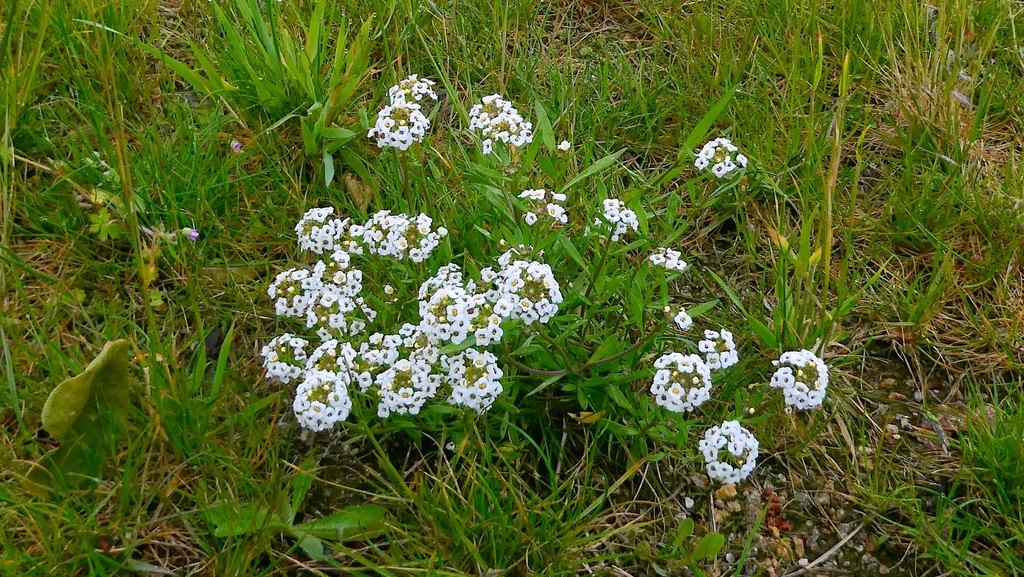
LATIN NAME: Lobularia maritima
COMMON NAME: Sweet Alyssum
Plant Profile
Sweet alyssum is a low, much-branched annual that builds a dome 5 to 30 cm tall and 20 to 30 cm across, smothered in flower for months on end. It is a brassica, which explains the four-petalled flowers, the peppery taste of the leaves and the flea beetles that arrive without warning in June.
The leaves are 1 to 4 cm long and only 3 to 5 mm wide, alternate, stalkless, oval to lance-shaped, entire-edged and covered in fine hairs. The flowers are about 5 mm across, four rounded petals around six stamens with yellow anthers, and they carry a scent close to honey on a warm afternoon. Pink, rose and violet forms exist and are less happy in heat.
The fruit is a small hairy pod holding two seeds, and it ripens continuously through the season rather than all at once. Wind does the dispersal, so one plant becomes a drift along a path edge within two years. The genus name refers to that pod: lobulus, a small lobe, which is a modest name for a plant this useful.
Science & Biotechnology
The scent is a general invitation and the guest list is unusually broad. Honeybees, solitary bees, hoverflies, small wasps and butterflies all work the flowers, and most of them are predators or parasites of something else in the garden. That breadth is why the plant is sold as a companion for vegetables rather than as a flower in its own right.
Being a brassica it carries glucosinolates, the mustard-oil compounds that give cabbage and rocket their bite. The same chemistry makes the petals and young leaves edible and faintly peppery, and it makes the plant findable by the specialist insects that have evolved to eat brassicas. Neither fact tends to appear on the label, which is a pity in both directions.
It comes from the Mediterranean basin and Macaronesia, from the Canaries to Cape Verde, and it grows on sand, walls, slopes and waste ground over calcareous soil between sea level and 300 m. One subspecies is endemic to the Columbretes Islands off eastern Spain, where it grows nowhere else and is protected by the difficulty of getting there.
Uses & Benefits
The usual job is edging: a low cushion at the front of a border, in a paving crack, or under tulips where it hides the yellowing foliage. It tolerates shearing, flowers six weeks from sowing and keeps going until frost, so municipal plantings lean on it so heavily and why it has become almost invisible.
The flowers and young leaves can be eaten raw. They taste of mustard and honey at once, and a few petals scattered over a salad are worth the small trouble of picking them. Wash anything taken from a street planting, and do not pick from ground that may have been sprayed or used by dogs.
For pollinators it works as a bridge. It starts flowering while the fruit blossom is over and the annuals are still small, and in mild climates it never quite stops. Dark-flowered forms are less reliable in heat, so if the garden is hot and dry, stay with white and let the coloured strains have the shade. Elsewhere in Brassicaceae, the list holds Lunaria annua, Aurinia saxatilis and Iberis umbellata.
Growing from Seed
The seed is tiny and needs light, so press it into the surface and water with a fine rose instead of covering it. Mix it with dry sand to spread it evenly and to see where it has gone. At 18 to 21 °C germination takes seven to fourteen days, and a single windowsill tray is enough to raise a hundred plants.
Prick out when the first true leaves show and space the plants 15 to 20 cm apart; they spread wider than the packet suggests. Trim the spent flower heads every few weeks and the plant keeps producing instead of setting seed and stopping. One mid-season shear is usually enough to bring it back into flower within a fortnight.
It self-seeds freely and the seedlings are easy to move while they are small. Named strains do not come true, so a purple bed drifts back towards white in two or three seasons, which some gardeners mind and others do not. In cold gardens treat it as an annual; in mild ones it behaves as a short-lived perennial and flowers all winter.
Our Take
It is cheap, quick and useful, and it has been overused to the point of invisibility. The way to make it interesting again is to stop treating it as a carpet and let it spill over a wall or seed into gravel, where the honey scent reaches you at sitting height rather than at ankle height.
The one real drawback is the flea beetle, which riddles the leaves with shot holes in early summer. Healthy plants outgrow the damage. If yours do not, the ground is probably too dry and too lean, and a mulch will do more for the plant than any spray will.
Related Reading
Readers interested in Sweet Alyssum frequently explore these as well: