


Solanum mammosum Seeds | Nipplefruit
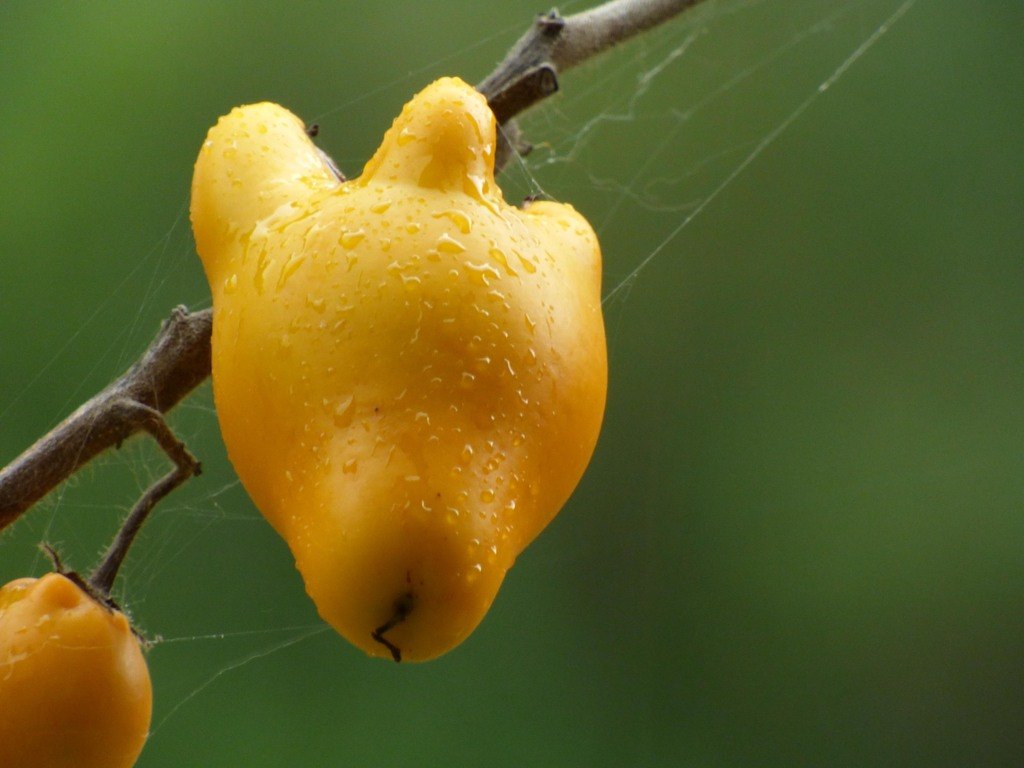
LATIN NAME: Solanum mammosum
COMMON NAME: Nipplefruit
Plant Profile
Nipplefruit is a tropical annual or short-lived perennial in the nightshade family, growing to 1.5 m in a season and more where it is frost-free. The stems and branches are covered in straight hairy thorns, which is the first thing anyone who handles it discovers. The leaves are thin, simple, alternate, with prominent veins and a soft grey-green cast.
The flowers come in clusters of five to eight, in elongated purple buds, and open to the pale violet stars typical of the genus. They are not the reason for the plant. The fruit is: a waxy yellow berry with reddish-brown seeds, shaped at one end like a cow’s udder and at the other like a human breast, with five blunt protrusions.
It is native to tropical South America and has naturalised through southern Mexico, the Greater Antilles, Central America and the Caribbean. The names it carries are all anatomical: nipplefruit, cow’s udder, fox head. The older English name, apple of Sodom, was borrowed from a different plant entirely.
Science & Biotechnology
The fruit is poisonous, and the toxin is the usual nightshade arrangement of steroidal glycoalkaloids. That is also the useful part: the Kofan people of Colombia and Ecuador use the plant as an insect repellent, chiefly against cockroaches, and the same compounds do the work. The juice will lather, and it has been used as a detergent in place of washing powder.
There is a contradiction in the literature that nobody has quite resolved. The ripe fruit is inedible and toxic, yet unripe fruit is boiled and eaten as a vegetable in the Philippines, and the leaves are brewed as a tea described as anodyne. Both practices are recorded, and neither makes the ripe berry safe.
It is one of those species that has collected invalid names the way a hedge collects litter. Solanum corniculatum, S. cornigerum, S. globiferum, S. platanifolium and S. villosissimum are all synonyms, and the name S. mammosum has itself been misapplied to S. circinatum and S. torvum by different authors. The plant is easy to recognise and hard to name correctly. Near kin on the list are Solanum nigrum, Solanum pseudocapsicum and Browallia speciosa, all Solanaceae.
Uses & Benefits
The fruit is the product, and the market is Asian. In China the five fingers are read as longevity for the family, and the golden fruit is wired into New Year trees; in Japan it is the foxface, sold by the stem in florists from autumn. In Chinese it is five-fingered eggplant, which describes it exactly and warns you off eating it in the same phrase.
For the flower trade it is close to ideal: the stems are stiff, the fruit lasts for weeks, and nothing else looks remotely like it. One stem in a tall vase is enough. The thorns mean gloves, and the sap stains, so handle it as you would a Euphorbia and not as you would a tomato.
In the garden it is a curiosity for a hot summer, grown as an annual in temperate climates and as a shrub in the tropics. It adapts to most soils and does best in moist loam, and it needs a long season: sown in February, it will fruit in August; sown in April, it will not fruit at all before the frost.
Growing from Seed
Sow indoors in late winter, 5 mm deep, at 22 to 25 °C. Germination is uneven, two to four weeks, and the seedlings are slow for the first month before they suddenly take off. Pot them on twice; the root system is vigorous and a plant held in a small pot will stall and never recover the season.
Plant out after the last frost, in full sun, with 60 cm between plants. Water well and feed once a month; too much nitrogen gives leaf and thorns and very little fruit. The plant is brittle at the joints when it is carrying a load of berries, so stake the main stem early rather than trying to prop it up later.
Fruit ripens about three months after flowering, turning from green to a clean waxy yellow. Pick with a length of stem if it is for the house, and handle it by the stem, not the fruit, which bruises and then rots. Save seed from a fully ripe berry, wash it, and dry it on paper.
Our Take
This is a plant with one idea and it executes it well. Nobody grows nipplefruit for the flowers, the leaves or the scent; they grow it because a yellow fruit shaped like an udder is a thing worth having once, and because the florists charge a great deal for a stem of it in December.
Grown from seed it costs almost nothing, provided you start early enough and have the summer for it. Give it heat, space and a stake, keep it away from children and from the kitchen, and it will pay you back in a handful of stems that nothing else in the garden can match.
Related Reading
If Nipplefruit appeals to you, these related plants are worth a look: