


Browallia speciosa Seeds | Amethyst Flower
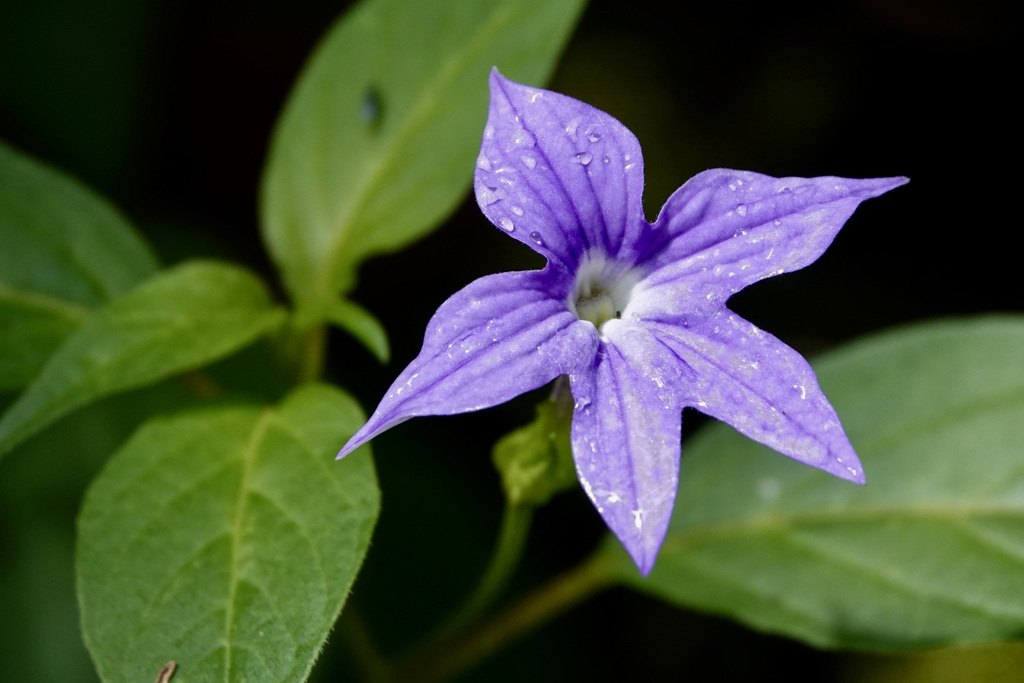
LATIN NAME: Browallia speciosa
COMMON NAME: Amethyst Flower
Plant Profile
Amethyst flower is the commercial name, bush violet the descriptive one, and both are slightly wrong: Browallia speciosa is a Solanaceae of Andean foothill forest, blue-violet rather than either amethyst or violet, and one of the few really blue annuals that prefers shade to sun.
It is a tender perennial grown as an annual, thirty to forty-five centimetres tall, with soft, slightly sticky foliage and open-faced flowers about three centimetres across, each with a white or pale yellow eye. The flower tube is short and wide, and the plant carries a dozen or more open at once in a good season.
Its native range runs from Costa Rica and Panama through Colombia and Ecuador to Peru, always at forest margins and stream edges where the light is broken. That preference has followed it into cultivation: it is the blue annual for the shaded bed, the north-facing window box and the porch that never gets direct sun.
The genus was named by Linnaeus for John Browall, a Swedish bishop and natural philosopher who was an early defender of the sexual system of classification. There are about six species, and speciosa is the one that has entered the trade, alone among them. Near kin on the list are Nicandra physalodes, Physalis peruviana and Solanum pseudocapsicum, all Solanaceae.
Science & Biotechnology
The distribution shows the two sides of the plant’s biography: native in Central and northern South America, introduced in Cameroon, Taiwan and Sri Lanka, where it persists around gardens and plantations. It has not become invasive anywhere, which fits a plant whose wild habit depends on the broken light of forest edge rather than open ground.
The documented folk use is specific. Among the Ingano people of Mocoa, in the Colombian department of Putumayo, the leaves are chewed and packed around carious molars to relieve pain. The practice is recorded in the ethnobotanical literature; whatever the active principle is, it has not been isolated or tested, and the use should be recorded rather than recommended.
The flowering response is day-length neutral, so the plant performs evenly through the season in gardens far from the equator. Observation records from the tropics show peaks in the December-to-February window, the dry season of its northern range, with a scatter through the rest of the year.
Uses & Benefits
Its garden use is the shaded position that defeats most blue flowers. In a hanging basket or a shaded bed it flowers from early summer to frost without deadheading, and in mild climates it can be lifted and overwintered on a bright windowsill, flowering into the winter.
The plant is not edible, and the family’s general content of alkaloids argues against nibbling it. No toxicity is recorded for the species, but the folk use for toothache is a reminder that the plant is chemically active, and the sensible course is to grow it and leave it alone.
As a breeding subject it has been quiet since the mid-twentieth century, when compact strains were fixed for the bedding trade. The colour range is narrow by modern standards, blues and whites, and that narrowness is part of the plant’s character rather than a failure of the breeders.
Growing from Seed
Sow in late winter at twenty to twenty-two degrees, on the surface and uncovered, because the seed needs light. Germination runs ten days to three weeks and is improved by steady warmth rather than by any treatment; the seed is small and should be sown thinly rather than thinned later.
Prick out early into individual cells, because the stems are brittle and the roots fine. Grow on at fifteen to eighteen degrees in bright but indirect light, and pinch once when the plant has three pairs of leaves to force the bushy habit that the bedding strains are supposed to carry.
Plant out after the last frost at twenty-five centimetres, in shade or broken light, in soil that holds moisture without sitting wet. Water in dry spells and feed lightly; the plant is a moderate feeder, and overfeeding produces leaf at the expense of the flowers that are the point.
Our Take
Amethyst flower solves a problem that most annuals cannot touch: the shady corner where blue is wanted and nothing blue will grow. Impatiens filled that role for decades and has been broken by disease, and this is one of the few replacements that is genuinely blue rather than mauve.
It asks for less than it appears to: no deadheading, no feeding to speak of, no sun worth mentioning. The Ingano toothache remedy is the sort of detail that makes a plant memorable, but the reason to grow it is a shaded window box that flowers blue from June to October.
Related Reading
More species in the same orbit as Amethyst Flower: