


Petunia hybrida Seeds | Garden Petunia
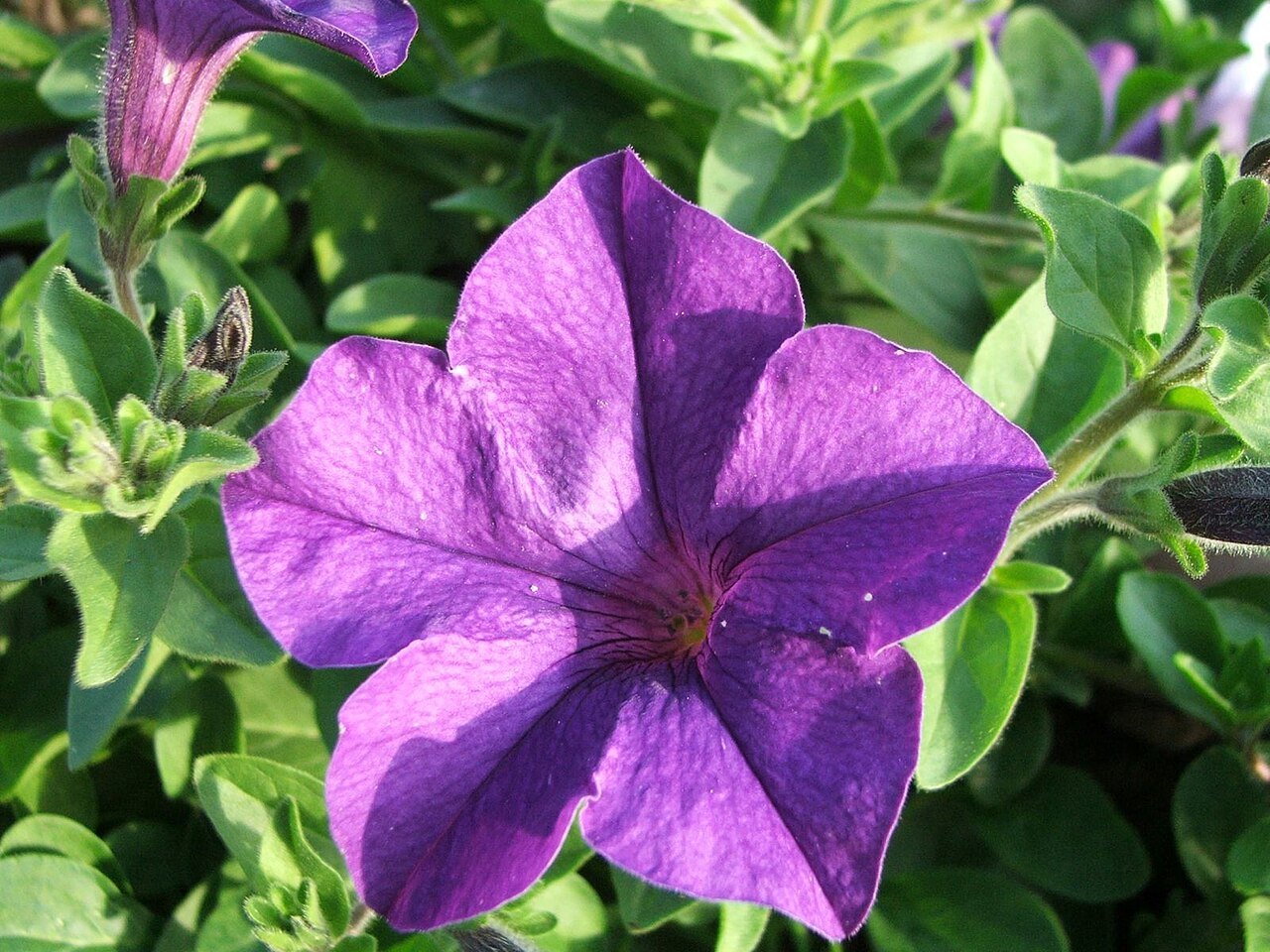
LATIN NAME: Petunia hybrida
COMMON NAME: Garden Petunia
Plant Profile
The garden petunia has no wild population and never had one. It is a hybrid raised in the 1830s from two South American species that could hardly look less alike: Petunia axillaris, white-flowered, with a tube nine centimetres long and a scent meant for hawkmoths, and Petunia integrifolia, a smaller magenta thing with a tube barely half that length, built for bees. The cross has carried the name Petunia × atkinsiana since 1837, and nearly every petunia in the trade descends from those two parents plus a century and a half of breeding on top.
Nothing about the plant is stiff. Stems are lax and jointed, leaves are soft and slightly fleshy, and both are covered in glandular hairs that leave a tacky resin on your forearm when you brush past on a warm afternoon. The flower is a funnel with five shallow lobes, in white, pink, scarlet, purple and near-blue, often veined or edged in a second colour, and the tube is angled so that rain runs off rather than filling it.
Modern series divide into compact bedding sorts and long-jointed trailing ones, which in a basket will run a metre and a half before they think of stopping. Flowering begins in early summer and continues to the first hard frost, and in mild gardens the single-flowered kinds seed themselves into gravel and path edges.
Science & Biotechnology
Petunia is a laboratory organism that happens to be a bedding plant, and one accident in its history changed molecular biology. In 1990 Richard Jorgensen’s group at DNA Plant Technology was trying to deepen flower colour by adding an extra copy of the chalcone synthase gene, the first committed step in anthocyanin production.
The transgenic plants came out white, with blotches where the new gene and the old one had both been silenced. The result, published as ‘sense suppression’, was the first clean demonstration of what became RNA interference, the pathway for which Andrew Fire and Craig Mello took the Nobel Prize in 2006. Nobody had set out to find it; the petunia simply refused to be made more purple.
The genus has since become a model for flower form and scent as well as colour. Its genome was sequenced in 2016, and the benzenoid pathway behind the evening perfume has been mapped gene by gene, which is how breeders now know what they are selecting against when they chase a bigger flower. In 2023 a bioluminescent petunia reached the American market under the name Firefly, engineered with genes from a luminous mushroom; the plant glows faintly green in the dark, a novelty that says more about the state of plant transformation than about the flower.
Uses & Benefits
Petunia earns its place by performing when little else will. It takes full sun, shrugs off heat that shuts down lobelia and nemesia, and recovers from a missed week of watering that would finish most bedding. Trailing kinds are the standard basket plant for a hot wall, where they can be seen from below and where their habit does the work no amount of pinching would. Upright series fill the front of a border and, because most are self-cleaning, need no deadheading: the corolla drops of its own accord a day or two after pollination.
The flowers are not poisonous, and they are edible in the narrow sense that nothing happens if you eat one. They taste of almost nothing, and a nursery plant will have been sprayed more often than a salad crop, so the kitchen is not the place for them. Scent is another matter.
The old white axillaris blood still surfaces at dusk in single-flowered varieties as a faint clove and vanilla perfume, carried by benzenoid volatiles released on a rhythm set by the plant’s internal clock. Doubled and frilled cultivars have largely bred that rhythm away, so the most expensive petunia in the catalogue is often the least interesting one after dark.
Growing from Seed
Petunia seed is dust: roughly ten thousand to a gram, smaller than a grain of salt, so almost all commercial seed is pelleted, coated in clay to make it handleable and to carry a fungicide against damping off. Pelleted seed also sows evenly.
Sow on the surface of a fine, moist mix and do not cover it, because light is part of the germination trigger. Hold the tray at 21 to 24 degrees C and keep the pellet damp but not wet; seedlings show in seven to fourteen days, and germination is uneven enough that the first and last may be a week apart.
Prick out at the two-leaf stage into a cooler, brighter place, around 16 degrees C, or the seedlings will stretch into weak stems that never recover. Pinch once above the third pair of leaves, grow on for six weeks, and harden off for a week before planting out after the last frost.
Trailing kinds want a fortnightly feed once they are flowering, and a hard cut back in midsummer, to within ten centimetres of the crown, will buy a second flush in September. Rain marks the flowers badly, so in a wet climate the baskets are better under an eave than out in the open.
Our Take
The cheapest colour in the catalogue and the most reliable. Buy pelleted seed, sow in February rather than April, and resist the giant frilled novelties: the plain single ones flower harder, recover from rain, and smell of cloves at dusk.
Related Reading
Gardeners who grow Garden Petunia often pair it with these related subjects: