


Manihot grahamii Seeds | Graham’s Manihot
LATIN NAME: Manihot grahamii
COMMON NAME: Graham’s Manihot
Plant Profile
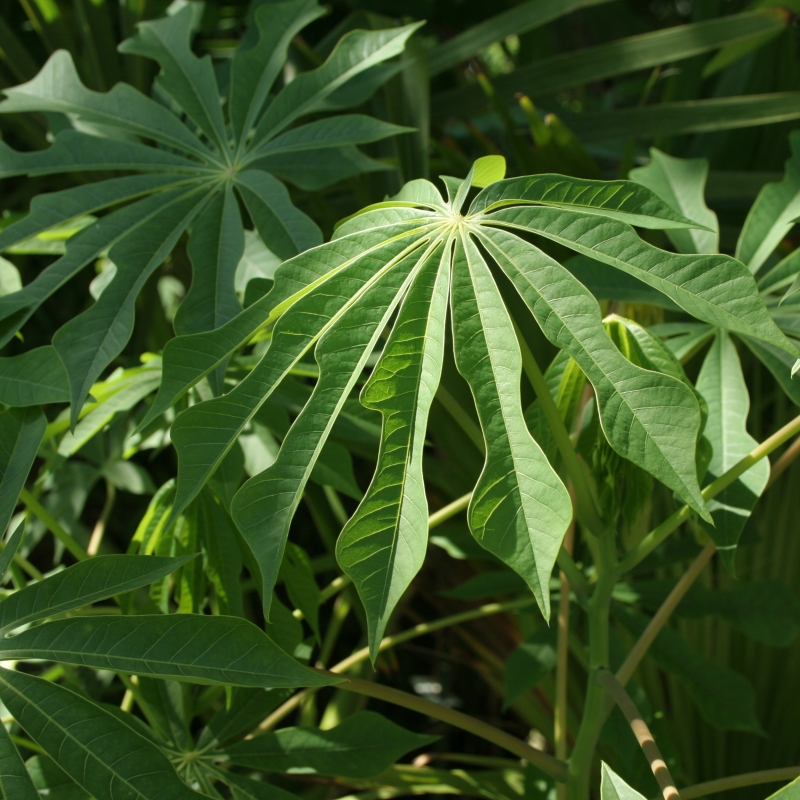
Graham’s manihot is a large shrub or small tree of the spurge family from southern Brazil and northeastern Argentina, growing two to four metres in a season from a tuberous root. Its leaves are deeply divided into seven to eleven narrow, finger-like lobes, giving the plant a tropical, almost papaya-like look, and its stems are smooth, green and hollow. In late summer it carries small, yellowish-green flowers in loose clusters, followed by three-lobed capsules that burst and throw seed. The plant dies to the ground in a frost and regrows from the root in spring, and it is one of the few members of a tropical genus that can be grown in a temperate garden. It is sometimes sold as hardy tapioca, which is misleading: the roots are not edible.
Science & Biotechnology
Manihot grahamii belongs to the Euphorbiaceae, the family of cassava, and it shares the genus’s milky latex and its tuberous roots, but it has none of cassava’s food value and its sap is toxic and irritant. The species is diploid and is one of the wild relatives used in cassava breeding programmes, where it contributes frost tolerance and resistance to some diseases. Its ability to regrow from a tuberous root after frost is unusual in a genus that is otherwise entirely tropical, and it is the reason the plant can be grown in cool climates. The seed is explosively dispersed, and in warm climates the plant self-sows freely enough to be considered a weed. The latex contains diterpene esters that cause skin blistering in sensitive people, and the sap should be kept away from eyes and broken skin.
Uses & Benefits
The plant is grown as an ornamental foliage shrub for a tropical effect in a temperate garden, where its deeply cut leaves and fast growth make it a good substitute for ricinus or for a young papaya. It is also used in a large pot on a terrace, where it can be moved under cover for winter, and its frost-hardiness makes it a useful plant for a sheltered town garden. The seed capsules are decorative in autumn. It has no food use, and the roots should never be eaten despite the common name. Its latex is toxic and irritant, so wear gloves when cutting it back, and keep it away from children and pets. In warm climates it can spread by seed and should be deadheaded.
Growing from Seed
Sow the seed in spring at twenty to twenty-five degrees, one centimetre deep in a free-draining mix; germination takes two to four weeks and is usually reliable. The seedling grows fast and should be potted on before the roots fill the container, since it makes a tuber quickly. Grow on in full sun with steady water and a rich compost. Plant out after the last frost, or keep it in a large pot and move it under cover before the first frost. Cut the stems back to fifteen centimetres in autumn and mulch the crown. In mild climates it will self-sow, so remove the capsules if that is not wanted. Wear gloves when handling the sap.
Our Take
A tropical-looking spurge that dies back and returns each spring, and not a tapioca. Its sap blisters skin, so wear gloves.
Related Reading
Gardeners who grow Graham’s Manihot often pair it with these related subjects: