


Nemophila menziesii Seeds | Baby Blue Eyes
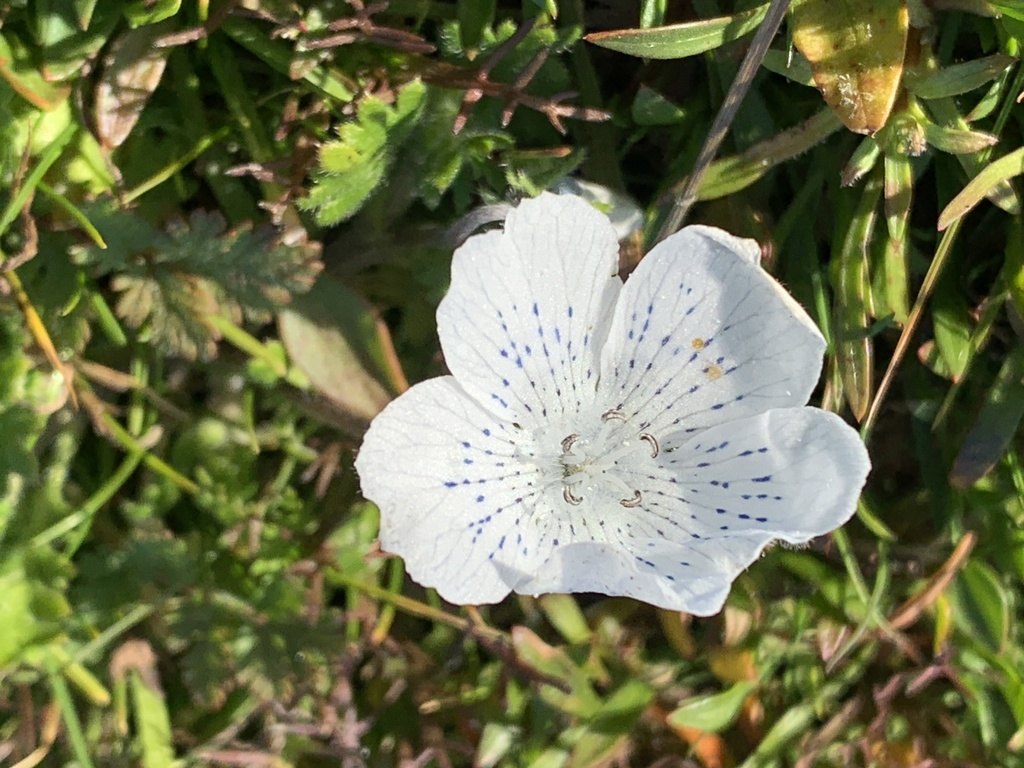
LATIN NAME: Nemophila menziesii
COMMON NAME: Baby Blue Eyes
Plant Profile
Baby blue eyes is a low annual from California, Oregon and Baja California, 15 to 25 cm high, with weak stems that sprawl rather than stand. It grows from sea level to almost 2,000 m across the state, in chaparral, valley grassland and mountain meadow, so different populations behave so differently in a garden.
The leaves are pinnately lobed, the lower ones stalked and the upper ones nearly stalkless, and the whole plant is soft and slightly succulent. The flowers are cups 2 to 4 cm across, five-lobed, clear blue with a white centre and a scatter of black dots just inside the eye. A white form occurs naturally.
The genus sits in Boraginaceae, though it spent most of the twentieth century in Hydrophyllaceae, and the family name on old seed packets is the giveaway. The species is named for Archibald Menzies, the surgeon and naturalist who collected on the Pacific coast in the 1790s.
Science & Biotechnology
The flowers are protandrous: the anthers release pollen before the stigma of the same flower is receptive, which pushes pollen outward before selfing becomes possible. The plant is nevertheless self-compatible, so a solitary plant will set seed. The timing simply biases the traffic toward insects when they are about.
Experiments that altered corolla size and shape found only small changes in pollination success, which suggests the flowers are serviced by a broad set of generalist visitors rather than one specialist. That is unusual in a plant with such a precise colour pattern, and it may explain why the species holds its shape across a huge range.
Seed biology is where the species gets interesting. Plants grown in competition with the grass Bromus diandrus produced smaller seeds with longer dormancy, and the effect carried into the next generation alongside the mother plant’s own genes. Both the environment and the parent matter, so seed from a dry slope behaves differently from seed from a wet meadow. Other Boraginaceae on the list: Cynoglossum amabile, Cerinthe major and Cynoglossum officinale.
Uses & Benefits
It is a front-of-border plant and a meadow plant, and it is at its best in quantity: a drift of it under tulips, or a sheet of it across a rough lawn in April, is worth more than a dozen isolated clumps. The blue is a true blue, which is rare, and it holds in shade better than most annuals of its colour. It also associates well with late tulips, because it covers the ground while the tulip stems are still bare.
The Kawaiisu, whose territory lay in the southern Sierra Nevada, are recorded as having grazed it with cattle, which says something about its palatability and nothing about its garden value. It is also the sort of plant that California native gardeners use as a filler between shrubs while those shrubs establish.
There are three varieties. Var. atomaria has white flowers with black dots and a faint blue flush, var. integrifolia is the southern form with narrower leaves, and var. menziesii is the blue one everyone means. The cultivar Penny Black is near-black with a white eye, and it is the only variant that reads at a distance.
Growing from Seed
Sow in early autumn, where the plants are to flower, and do not sow in spring unless you garden somewhere with cool wet summers. The seed responds to falling temperature and rain, the way the California winter does, and spring-sown seed sits until the following autumn or dies waiting. This single point decides whether the plant succeeds.
Scatter on raked ground, barely cover, and keep damp until the seedlings are up in ten to twenty days. Thin to 15 cm; the plants do not transplant, having almost no root system to hold a clod. In a cold climate, sow in a cold frame in September and plant the modules out in October, while the soil is still warm.
They flower from April into June and die as the ground dries, leaving seed that will come back if you let the patch lie undisturbed through summer. Do not hoe it. The seed bank is the whole mechanism, and a tidied bed in July is a bed without baby blue eyes next spring.
Our Take
It is the cheapest blue in gardening and the most disappointing if you treat it like a hardy annual and sow it in March. Sow it in autumn, leave the dead plants standing, and it will do the rest. The colour is worth the fuss, and there is no other annual that gives this particular shade at this height.
The plants are frail and the season is short, four or five weeks at most. That is fine in a meadow and maddening in a border, where the gap they leave in June is exactly where something else was supposed to be. Use them as a layer, not as a feature, and they earn their place.
Related Reading
Gardeners who grow Baby Blue Eyes often pair it with these related subjects: