


Myosotis sylvatica Seeds | Wood Forget-me-not
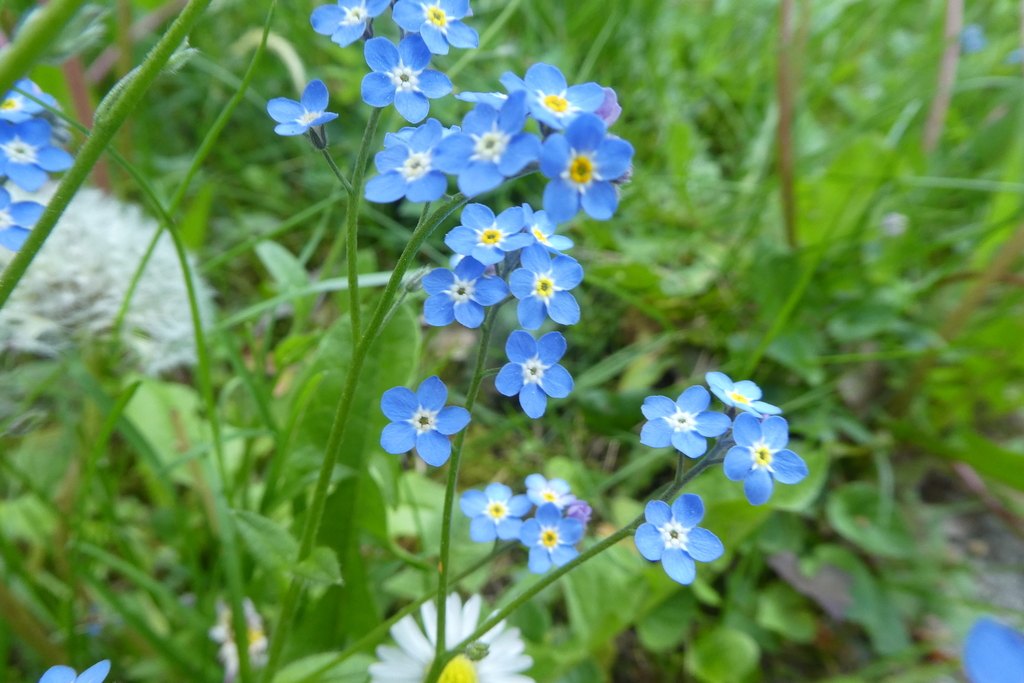
LATIN NAME: Myosotis sylvatica
COMMON NAME: Wood Forget-me-not
Plant Profile
Wood forget-me-not is native to Europe and has been in gardens long enough that the two categories have blurred. It is a short-lived herbaceous perennial, 12 to 30 cm tall and about 15 cm across, with softly hairy leaves and a profusion of flat, disc-shaped flowers that are pink in bud and open an intense sky-blue with a yellow eye.
The diagnostic characters are small and reliable. The hairs on the stem stand out at more or less right angles rather than lying flat. The calyx tube carries hooked hairs. When the fruit ripens the calyx teeth spread to expose it, and the mature calyx sits on spreading stalks longer than the tube. Basal leaves are stalked and form a rosette; upper leaves are sessile.
In the British Isles it is widespread in England, Wales and the Isle of Man, less frequent further north, and it reaches the east coast of Scotland and the southwest while being absent from most of the Highlands, Orkney, Shetland and the Outer Hebrides. Because it self-seeds so freely, garden escapes are indistinguishable from native plants across much of that range.
Science & Biotechnology
Those hooked hairs on the calyx are a dispersal mechanism, not a taxonomic curiosity. The ripe nutlets sit inside the calyx, and the hooks catch in fur and feather, so the seed travels on animals rather than on wind. It is the same principle as a burdock, executed at a scale that goes unnoticed until you find seedlings along a hedge margin where no plant was ever set.
The colour change from pink bud to blue flower tracks the pH of the vacuole in the petal cells. Anthocyanins are pH indicators: acidic vacuoles give red and magenta, neutral or slightly alkaline ones give blue. The shift happens as the flower opens, and the yellow eye that follows is a nectar guide, marking the centre for insects at exactly the moment the flower becomes receptive.
Each flower produces four nutlets, and a well-grown plant produces hundreds of flowers over six weeks. The seed is small, dark, glossy and long-lived in the soil, so a single good year stocks the seed bank for a decade. That is why the plant appears in a new bed years after the last one flowered, and why it is so hard to be rid of once it is welcome.
Uses & Benefits
Its garden use is spring bedding, and the classic pairing is with tulips and wallflowers: blue at knee height under flowers that are doing something louder. The combination works because forget-me-not is almost the only plant in that season that gives a mass of true blue at low level, and because it keeps its leaves through winter, so the bed is never bare.
The name has a longer history than the plant’s garden career. The German Vergissmeinnicht is recorded from the fifteenth century, and the English name follows it directly. Whatever the origin, the sentiment attached to the flower is why it is given away so often and why a garden that has it rarely has to buy it again.
The cultivars are mostly selections for habit and colour rather than for anything radical. Blue Ball is compact and round, Ultramarine is a dwarf with very deep blue flowers, Victoria Rose is bright pink and Snowball is white. Bluesylva and Blue Ball both hold the RHS Award of Garden Merit, and both are worth the small premium over unnamed seed. Near kin on the list are Myosotis alpestris, Cynoglossum officinale and Anchusa capensis, all Boraginaceae.
Growing from Seed
Sow in June or July for the following spring, on the surface and barely covered, at 15 to 18 °C. Most seedlings are up inside three weeks. The rule with this plant is that seed is sown one year to flower the next: a spring sowing will flower in the same autumn at a spindly 10 cm, and it will be over before the tulips open.
Prick out into trays as soon as the seedlings can be handled and grow them on in a cold frame, planting out in early autumn at 20 cm spacing. The plants sit through winter as flat rosettes, which is when they earn their keep, covering the ground under bulbs that would otherwise stand in bare soil until April.
The important decision comes after flowering. Pull out most of the plants, but leave two or three in places where you would be happy to see them next year, and let those set seed. The seedlings will choose their own positions, usually better ones, and within three years the colony will have moved to where the soil and light actually suit it.
Our Take
Use it as a drift under deciduous shrubs rather than in a straight row along a path. A row of forget-me-nots looks like a municipal planting; a patch that has been allowed to find its own edges looks like a garden. The plant is at its best when it is slightly out of control and slightly too blue.
Do not deadhead everything. The tidiness instinct is understandable and it removes the mechanism that makes the plant worth having. Leave a few, accept the seedlings in the gravel, and pull the ones that offend you in autumn. That is the whole maintenance regime, and it costs about ten minutes a year.
Related Reading
Gardeners who grow Wood Forget-me-not often pair it with these related subjects: