


Anchusa capensis Seeds | Cape Forget-me-not
LATIN NAME: Anchusa capensis
COMMON NAME: Cape Forget-me-not
Plant Profile
Anchusa capensis is a South African annual or short-lived perennial of the borage family, native to Namibia, South Africa and Lesotho, where it grows on disturbed ground and among rocks in the winter-rainfall and summer-rainfall regions alike. It reaches about 60 cm, with rough, hairy leaves and a loose, branching habit that needs no support.
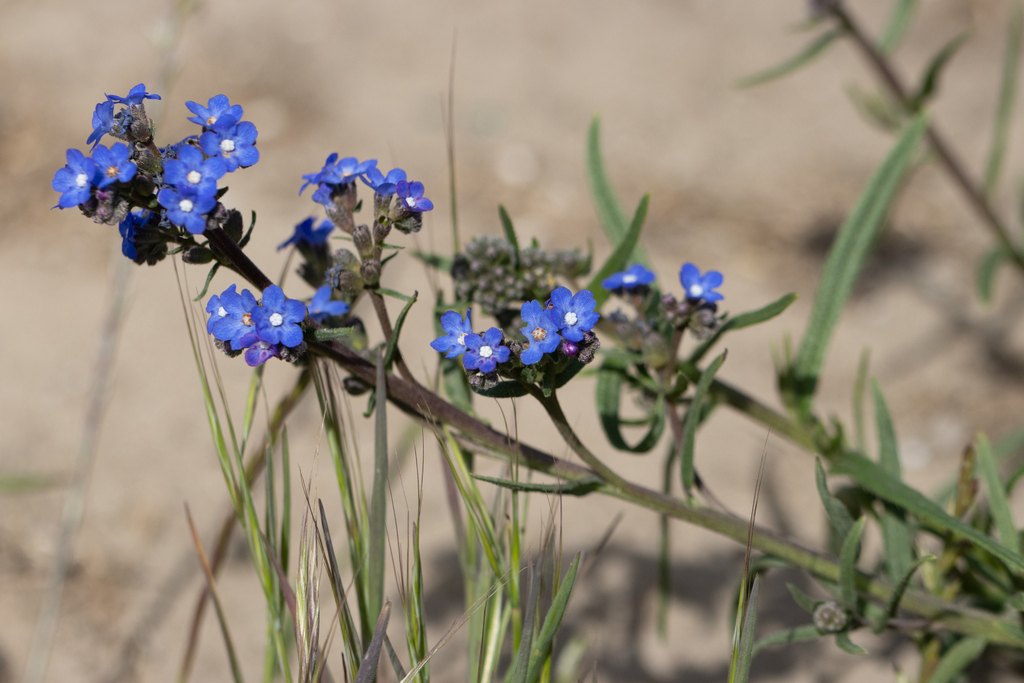
The flowers are the reason to grow it. Each is a small five-lobed tube about 1 cm across, in a saturated cobalt blue with a white eye, carried in clusters at the tips of the branches over a long period in summer. The buds are red, which is unusual and gives the plant a two-colour look in bud and flower at once.
Inside the flower, five small white scales, called fornices, arch over the throat and protect the stigma and anthers. They are a feature of the borage family, and in this species they are prominent enough to be seen without a lens, which makes the flower worth looking at closely rather than from across the border.
Science & Biotechnology
The genus name comes from the Greek anchousa, a cosmetic paint made from the roots of a related species, Anchusa tinctoria, which was used as a dye base for face paint in the ancient Mediterranean. The specific name capensis means from the Cape, though the plant’s range extends well beyond it into Namibia and Lesotho.
The blue is a delphinidin-based anthocyanin, and it is unusually stable for a blue flower pigment, so the colour holds in heat and does not fade to mauve as quickly as the blue of a delphinium. The white eye is a region without pigment, and it functions as a nectar guide, directing bees to the centre of the flower.
Anchusa is a genus of about 35 species, centred on the Mediterranean and western Asia, and it sits in the Boraginaceae alongside borage, comfrey and forget-me-not. Many members of the family contain pyrrolizidine alkaloids, which are liver toxins, and Anchusa is no exception; the plant is not edible and should not be used as a herb. Elsewhere in Boraginaceae, the list holds Anchusa officinalis, Cerinthe major and Nemophila menziesii.
Uses & Benefits
In a border the colour reads across twenty metres. Anchor it between yellow and white flowers, where the blue holds its own without disappearing, or use it as a single accent in a bed of grey foliage, where it looks almost artificial. It is also good in a cutting garden, since the stems are long enough to use and the flowers last four or five days in water.
Bees work the flowers steadily, and the plant is one of the best summer forage sources for short-tongued species, which can reach the nectar at the base of the short tube. That makes it a useful plant in a wildlife border, and it flowers at the moment when the spring forage has finished and the summer perennials have not yet started.
The cultivar Dawn has white, pink, mauve and blue flowers in one packet, which is either charming or muddled depending on your taste; Blue Angel is a compact dark blue, and Blue Bird is taller with indigo flowers. The species itself is the strongest blue of the three.
Growing from Seed
Sow indoors six to eight weeks before the last frost at 18 to 21 °C, covering the seed lightly. You should see the first pair of leaves within a fortnight. The seedlings grow quickly and can become leggy in poor light, so keep them cool and bright.
Prick out into 7 cm pots and pinch once to encourage branching. Plant out after the last frost, 30 cm apart, in full sun. The plant tolerates poor soil and drought, and it flowers best in a lean site; rich soil gives soft growth and fewer flowers.
Flowering begins about twelve weeks from sowing and continues into autumn if the plants are deadheaded. In mild climates it self-sows freely, sometimes too freely, and seedlings will appear in gravel and in the cracks of paving. Pull the ones you do not want while they are small. In cold climates treat it as an annual and resow each spring.
Our Take
If you want a blue that stops people at the gate, this is it. The colour is closer to a pigment blue than anything else an annual offers, and it holds in heat. The plant itself is unremarkable, a rough-leaved bush that flops a little and needs staking in a windy site, but the flowers carry it. Grow it in the middle of a border, in groups of five or more, and let it self-sow. It is cheap, fast and generous, and the blue is worth the space.
Related Reading
Continue exploring with these related plants: