


Mentha canadensis Seeds | Corn Mint
LATIN NAME: Mentha canadensis
COMMON NAME: Corn Mint
Plant Profile
Mentha canadensis has one of the widest natural ranges of any mint, and one of the strangest: it is native to North America from the Northwest Territories south to central Mexico, and to eastern Asia from Siberia through China and Japan to Java. The two populations have been separated for a long time, but they are the same species, and the plants in a Sichuan ditch and an Ontario marsh are interfertile.
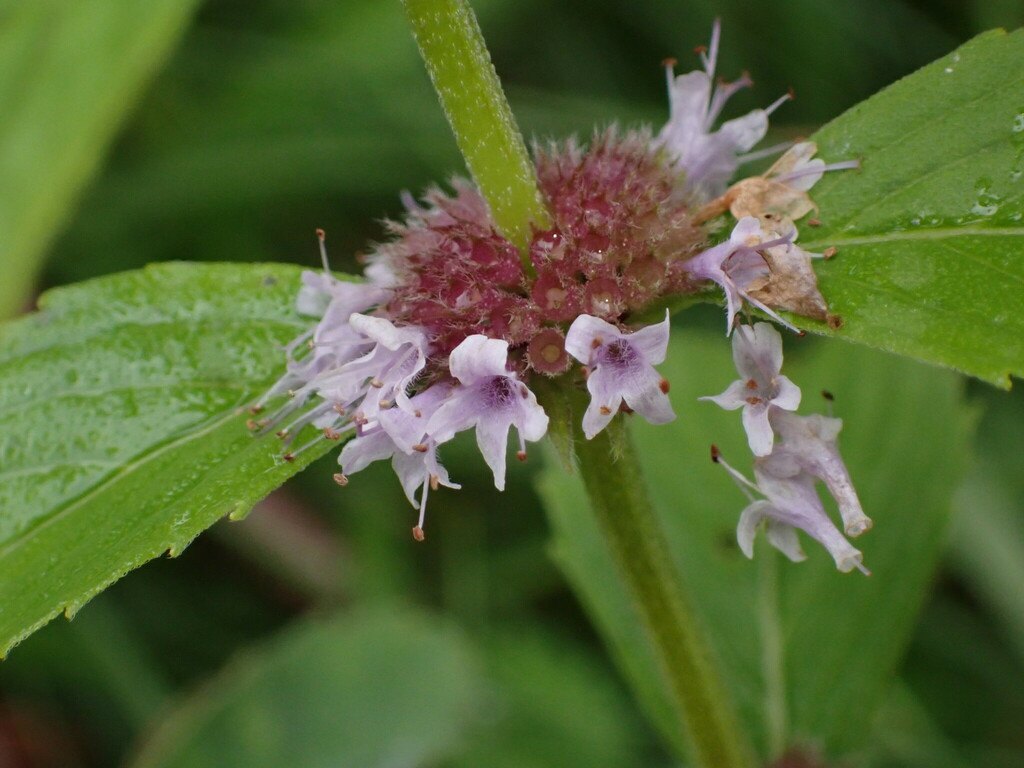
It is an upright perennial, 30 to 60 cm tall, spreading by creeping stolons that run just below the surface. Leaves are opposite, lance-shaped to ovate, 3 to 8 cm long, toothed and slightly hairy, with a strong menthol smell when crushed. The flowers are small, lilac to pale violet, in whorls in the upper leaf axils, opening in July and August in the wild.
East Asian populations were long treated as a separate species, Mentha haplocalyx, and the name is still used in Chinese Floras and in the Chinese materia medica, where the dried aerial parts are known as bo he. Molecular work has since shown that the two are not distinct, and M. haplocalyx is now treated as a synonym of M. canadensis.
Science & Biotechnology
The menthol content of M. canadensis is high, often 70 to 90 per cent of the essential oil, so it is preferred over peppermint for menthol production in Japan and Brazil. The oil also contains menthone, menthyl acetate and a range of minor monoterpenes, and the ratio between them determines whether the oil smells sharp and cold or soft and sweet.
Menthol works on the skin and mucous membranes by activating the TRPM8 receptor, the same ion channel that responds to cold, so a mint leaf feels cool without any change in temperature. That mechanism was worked out in the early 2000s and is now one of the standard examples of a chemical activator of a sensory receptor.
The crop has an unusual history. Japanese mint was introduced to Brazil by Japanese immigrants in the 1930s, and by the 1960s Brazil had become the world’s largest producer, grown on the red soils of Parana and Sao Paulo states. The industry declined as synthetic menthol improved, but natural menthol is still preferred for cigarettes and for some pharmaceuticals, and the crop persists in a few regions. It shares the family with Mentha arvensis, Mentha piperita and Mentha pulegium.
Uses & Benefits
The plant is grown for menthol, and it is one of the two commercial sources of it, the other being peppermint, Mentha x piperita. Menthol is the compound that gives cough drops, toothpaste, cigarettes, chewing gum and a hundred other products their cold sensation, and the world market is measured in thousands of tonnes a year.
In China the dried herb is a standard medicine, used for headaches, sore throat, skin complaints and sluggish digestion, and it appears in classical formulas as well as in modern patent medicines. In Vietnam and southern China the fresh leaves are eaten in soups, salads and spring rolls, where the menthol cuts through fat and heat.
In the garden it is a tea plant, a companion plant and a ground cover for damp ground, and it ranks among the easiest herbs to grow. It is also one of the most invasive: a single plant will colonise a bed within two seasons by stolon, and it will come up through gravel, between paving stones and in the middle of a lawn. Grow it in a pot sunk into the ground, or in a bed where you do not mind it winning.
Growing from Seed
Mint seed is small and needs light, so sow on the surface at 15 to 20 °C and press it down without covering. Germination takes 10 to 20 days and is often uneven. Named forms, including the high-menthol strains, must be grown from cuttings or division, since seed does not come true.
Division is easier than seed and gives a usable plant in one season. Lift a clump in spring, break it into pieces with roots and shoots, and replant the young outer pieces, discarding the woody centre. Cuttings root in water in a week at room temperature.
Grow in moist soil in sun or partial shade; the plant tolerates wet ground but not standing water. Cut the stems back by half in midsummer to keep them leafy and to prevent flowering, which makes the leaves bitter. Harvest before flowering for the highest oil content, and dry the stems in a dark, airy place. Divide every two years to keep the clump vigorous and the flavour strong.
Our Take
This is the mint to grow if you want the real thing for tea: sharper, colder and more medicinal than the supermarket mint, and the one used in Chinese cooking and medicine. It is also the mint most likely to take over your garden, so plant it in a pot and be ruthless about cutting the runners that escape.
The two-continent range is worth knowing about, because it explains why the plant grows in a wet Ontario ditch and a Sichuan field with equal ease. It is not fussy, it is not rare, and it is not going anywhere. Grow it where you can control it, harvest it hard, and it will repay you every summer.
Related Reading
Readers interested in Corn Mint frequently explore these as well: