


Anthemis tinctoria Seeds | Dyer’s Chamomile
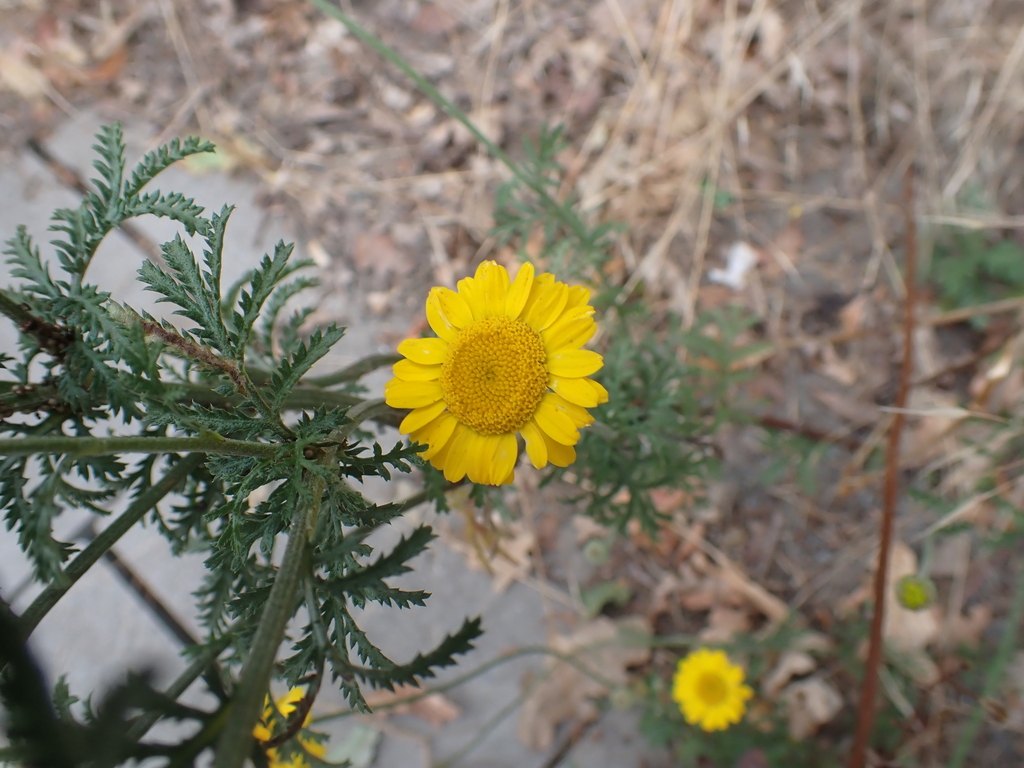
LATIN NAME: Anthemis tinctoria
COMMON NAME: Dyer’s Chamomile
Plant Profile
Dyer’s chamomile is a short-lived perennial, often treated as a biennial, reaching about 60 cm. The foliage is bright green, feathery, finely divided twice and downy beneath, and it is aromatic when crushed, though the smell is medicinal rather than pleasant. The stems are long, thin and angular, and carry yellow daisy-like heads through the summer.
The naming problem is part of the plant. The accepted name is Cota tinctoria, but horticulture still knows it as Anthemis tinctoria, and most catalogues and seed packets use the old name without apology. Other common names include golden marguerite, Boston daisy and Paris daisy, which tells you how widely it has travelled in cultivation.
It is native to Europe, the Mediterranean and western Asia, where it grows on sunny slopes, rocks, railway tracks and walls, usually over limestone. In Britain it is a casual rather than a native, arriving with grain and ballast, and it has established in scattered spots across North America.
Science & Biotechnology
The dye is the point of the species name and the reason it was grown at all. The flower heads contain flavonoid pigments that give yellow, buff and golden-orange on wool and other fibres, and before synthetic dyes this was one of the standard yellows of European cloth. The colour depends on the mordant, so the same plant gives a lemon yellow with alum and a deep old-gold with iron.
The genus has also moved. A study of the family in 1983 began the process of splitting the old, sprawling Anthemis into several genera, and this species went to Cota; later work on the fruits and pollen, and then molecular phylogenetics, confirmed the split. The horticultural trade has simply not caught up.
It hybridises in the wild with scentless mayweed, Tripleurospermum inodorum, producing the hybrid × Tripleurocota sulfurea, and seven subspecies are recognised across its range from Spain to Iran. For a garden plant that seems like a lot of taxonomy, but the subspecies matter if you collect seed from the wild rather than a packet.
Uses & Benefits
In the garden it is grown for the flowers and the foliage together: a mound of bright, feathery green through spring, then a long run of daisies from June into September. The colour is a clean, warm yellow that reads well with blue and purple, and the stems are long enough to cut. It also dries badly, which spares you the temptation.
It has no culinary use and only limited medicinal ones, which is a refreshing change among aromatic composites; the plant was grown for cloth, not for the pharmacopoeia. The white-flowered form is in cultivation, and the seed-raised cultivar ‘Kelwayi’ carries 5 cm yellow flowers on 65 cm plants.
‘E.C. Buxton’, a pale lemon form with a darker centre, has the Royal Horticultural Society’s Award of Garden Merit, and is the one to choose if you want a plant that behaves. The species itself is slightly coarser and more variable, which is either a fault or the point, depending on the garden. Three more Asteraceae sit in the same catalogue: Anthemis arvensis, Osteospermum ecklonis and Gazania rigens.
Growing from Seed
Sow in spring at 15 to 18 °C, surface or barely covered, and expect germination in one to three weeks. The seed is easy and reliable, and a single packet will give more plants than most gardens need. Prick out into modules and plant out after the last frost, 40 cm apart, in full sun and soil that drains.
It likes a limy soil and tolerates drought well once established, but it is short-lived: a plant that flowers well in its first summer often fades in its second. The standard practice is to treat it as a biennial, sowing one year for the next, and to take cuttings of basal shoots in late summer as insurance.
Deadhead hard and it will flower into autumn; leave a few heads and it will self-sow gently in gravel, which suits it better than being coddled in a border. It asks for nothing except drainage and lime, and it will reward neglect more reliably than attention.
Our Take
This is a plant for gardeners who like a bit of history with their flowers. The dye is real and worth trying with children or with wool, and the colour on the plant is the same colour the cloth took, which is a rare and satisfying coincidence.
Do not fight the taxonomy: buy it as Anthemis if that is what the catalogue says, and know that the botanists have moved it to Cota, where it will stay whether the packets follow or not. The plant does not care, and neither will you, once the yellow starts.
Related Reading
Gardeners who grow Dyer’s Chamomile often pair it with these related subjects: