


Salvia farinacea Seeds | Mealycup Sage
LATIN NAME: Salvia farinacea
COMMON NAME: Mealycup Sage
Plant Profile
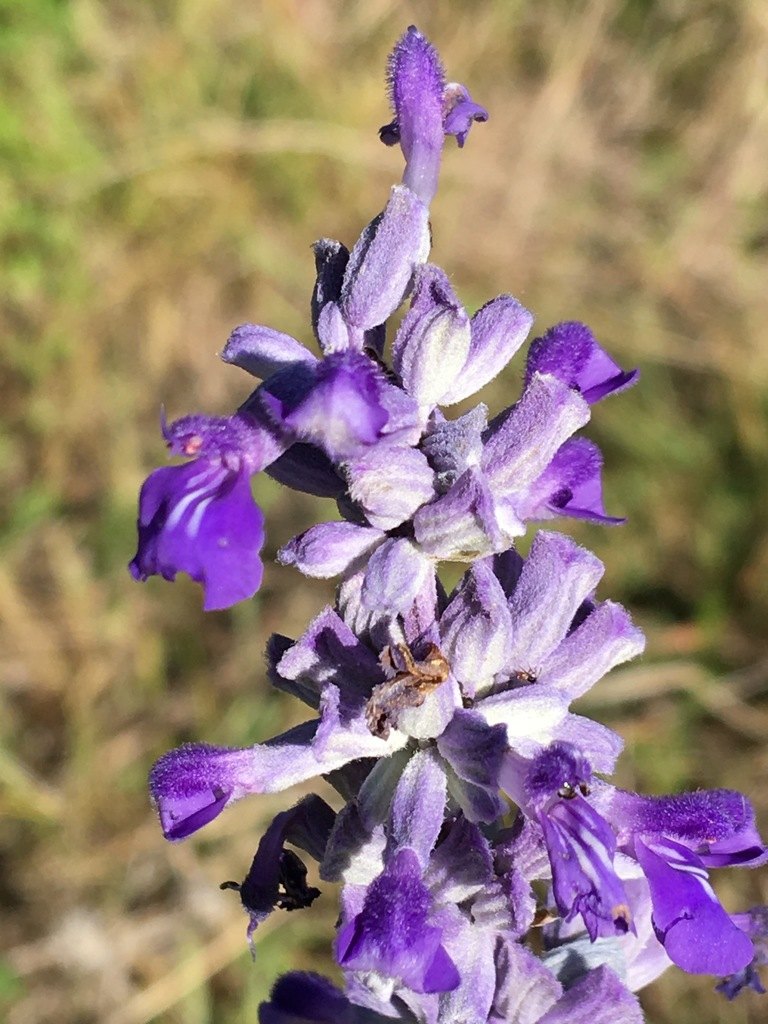
Mealycup sage is a herbaceous perennial from Nuevo León in north-eastern Mexico, with outlying populations in Texas and Oklahoma. It makes a clump 60 to 90 cm tall of narrow, lance-shaped leaves, and from June until frost it carries spikes of violet-blue flowers that are small, slim and glossy, held well above the foliage.
The leaves are the giveaway. Most salvias have velvety, dull foliage; this one has leaves that shine, which is unusual enough in the genus to identify the plant at arm’s length. The calyx is densely covered in blue or white hairs, and the teeth are so short and so buried in that coat that they are barely visible.
It was described by George Bentham in 1833, in a work on the genera of the mint family, and it has been in cultivation ever since. The corolla tube is about 6 cm long and the colour is bright blue-white rather than a deep blue, and it holds when cut, so the cut-flower trade keeps it in production.
Science & Biotechnology
The hairy calyx is a defence. Glandular hairs on the calyx and the flower stalk secrete oils that gum up small insects trying to reach the nectar from outside, and the same hairs reduce water loss in the dry limestone country the plant comes from. It is a small mechanism with a large effect on who can rob the flower.
The species crosses readily with Salvia longispicata, and the hybrids are what most gardens actually grow. Indigo Spires was a chance seedling found in 1979 in a California garden, and it is a bigger, longer-flowered plant than either parent. It is also sterile, so it has to be propagated from cuttings and cannot be raised from seed.
Hardiness is better than the labels admit. The species is listed for zones 8 to 10, but plants on sharp drainage in zone 7 usually survive, especially if the old stems are left standing until late winter. The hybrids with longispicata are hardier still, and they are the safer bet in a cold garden with wet winters. The same family turns up again in Salvia officinalis, Salvia pratensis and Moluccella laevis.
Uses & Benefits
It is a cut flower before it is a garden plant. The stems are stiff, the spikes are long, the colour holds for a week and the foliage does not yellow in the vase. Blue is the hardest colour to find in a summer bouquet, and this plant supplies it for months on end without any special treatment.
In the border it is a vertical accent. The habit is upright and narrow, so it can be planted among lower things without shading them, and the blue reads well against grey foliage, bronze grasses and anything yellow. It is also one of the few blues that does not go muddy in evening light, which is more than most delphiniums manage.
Bees, butterflies and hummingbirds all use it, and it flowers through the hottest, driest part of the summer when most perennials have stopped. That combination makes it a standard in pollinator plantings in the southern states, where it is treated as a long-lived shrub rather than as an annual filler.
Growing from Seed
Sow in late winter at 18 to 21 °C, on the surface, since the seed needs light. Germination takes fourteen to twenty-one days and is uneven. The seedlings are slow at first and then suddenly vigorous, so prick them out as soon as the first true pair is open, before the roots tangle in the tray.
Plant out after the last frost, 30 to 40 cm apart, in full sun and soil that drains. It tolerates poor ground and drought and resents winter wet far more than cold. In a cold garden, lift and pot a plant in October, or take cuttings in late summer as insurance against a wet winter.
Cut the old stems back to the base in late winter rather than in autumn. The hollow stems hold water in wet weather and rot the crown, and leaving them standing gives the plant some protection from frost. Feed once in spring; more than that produces soft growth and fewer spikes.
Our Take
The reason to grow it is the six weeks from August, when the border is tired and the blue spikes are the only thing still standing upright. It is not a plant that will make a garden, but it is one that will hold one together at the end of the season.
Buy named plants rather than seed if you want a specific blue, because the seed strains vary and the hybrids are sterile. Blue Bedder has been sold since 1847 for the good reason that it still works, and it is cheap enough to treat as an annual in a cold climate.
Related Reading
Readers interested in Mealycup Sage frequently explore these as well: