


Salvia coccinea Seeds | Scarlet Sage
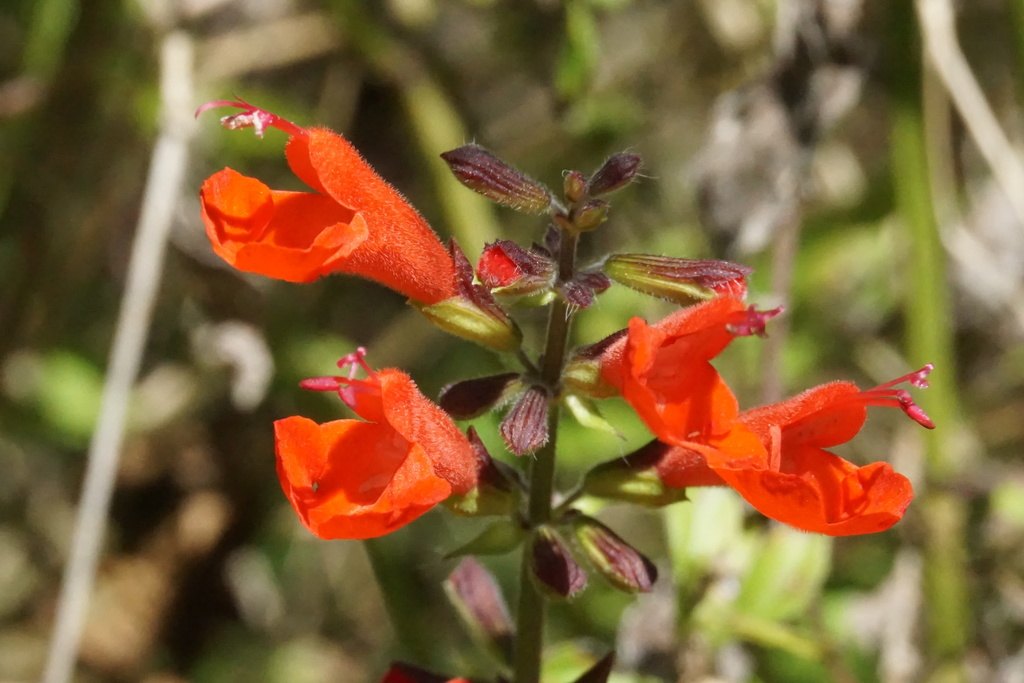
LATIN NAME: Salvia coccinea
COMMON NAME: Scarlet Sage
Plant Profile
Salvia coccinea is a herbaceous perennial of the mint family, native from the southeastern United States through Mexico and Central America to the Caribbean and northern South America. It was once thought to come from Brazil, but its diploid chromosome count points to Mexico as the place of origin, and the Brazilian populations are introductions.
It grows 60 to 90 cm tall on square stems, with opposite, ovate, slightly toothed leaves and loose spikes of scarlet flowers 2 to 3 cm long. The flowers are tubular, with a two-lipped mouth, and they are held well above the foliage on slender stems, so the plant reads as a haze of red rather than a solid block.
In a cold climate it is grown as an annual; in a mild one it is a short-lived perennial that may survive two or three years. It self-sows readily, and in the southern United States it has escaped from gardens and naturalised along roadsides and in disturbed ground. In Florida and Texas it flowers almost year-round, and a single plant can reach 1.5 m in a rich, irrigated border, which is twice the size it reaches in a cold climate. The family connection runs to Salvia japonica, Salvia farinacea and Mentha pulegium.
Science & Biotechnology
Salvia is the largest genus in the Lamiaceae, with nearly 1,000 species, and it is divided into subgenera and sections on the basis of stamen structure. S. coccinea belongs to the subgenus Calosphace, the group that radiated in Mexico and Central America and that includes most of the red-flowered sages.
The stamens are the key to the genus. In S. coccinea they have a long connective that acts as a lever: when a hummingbird or a bee pushes into the flower, the lever pivots and deposits pollen on the visitor’s head or back. That mechanism has evolved independently in several sage lineages, so the genus is a model for the study of pollination.
The red colour is produced by pelargonidin and cyanidin derivatives, and it ranks among the few true scarlets in the mint family, most of whose members are blue or purple. The shift to red is associated with hummingbird pollination, and it has evolved repeatedly in the American sages.
Uses & Benefits
It is a plant for the middle of a border, a container or a cutting garden, where its red can be seen from a distance and its long season keeps colour going into autumn. It combines well with yellow and blue, and it ranks among the few reds that does not clash with magenta.
In North America it ranks among the best hummingbird plants, and a patch of it in August will be defended by a single bird that treats the flowers as its territory. In Europe, where hummingbirds are absent, the flowers are visited by bumblebees, which push into the tube for nectar, and by hawk moths at dusk.
The cultivar Lady in Red is compact and early, Snow Nymph is white, Coral Nymph is a soft coral-pink, and Pink Preference is a pale pink that is almost unique among sages. All of them are grown from seed and flower in the first year. In a container it stays compact and flowers earlier, so it is a standard plant for summer pots in northern Europe, where the season is too short for it to reach full size in the ground.
Growing from Seed
Sow indoors eight to ten weeks before the last frost at 20 to 24 °C, covering the seed lightly. Germination takes 10 to 21 days and is improved by light, so do not bury the seed deeply. Prick out into 7 cm pots and grow on at 18 °C.
Pinch once to encourage branching, then set them out 30 cm apart once the frost has gone, in full sun. The plant tolerates poor soil and drought, and it flowers best in a lean site; rich soil produces leaf at the expense of flower.
The first flowers open about twelve weeks after sowing, and they keep coming until the frost. Deadhead to keep it going, or leave the last spikes to set seed; in a mild climate it will self-sow and return. In a cold one, take cuttings in late summer and overwinter them under glass, or simply resow each spring.
Our Take
Scarlet sage is the best red for a hot summer, and one of the best plants for hummingbirds in North America. It is easy from seed, generous with its flowers, and it self-sows without becoming a nuisance. Grow it in the middle of a border, where its height and its red can be seen, and let it seed. It will come back, and the hummingbirds will find it.
Related Reading
Continue exploring with these related plants: