


Clinopodium chinense Seeds | Chinese Clinopodium
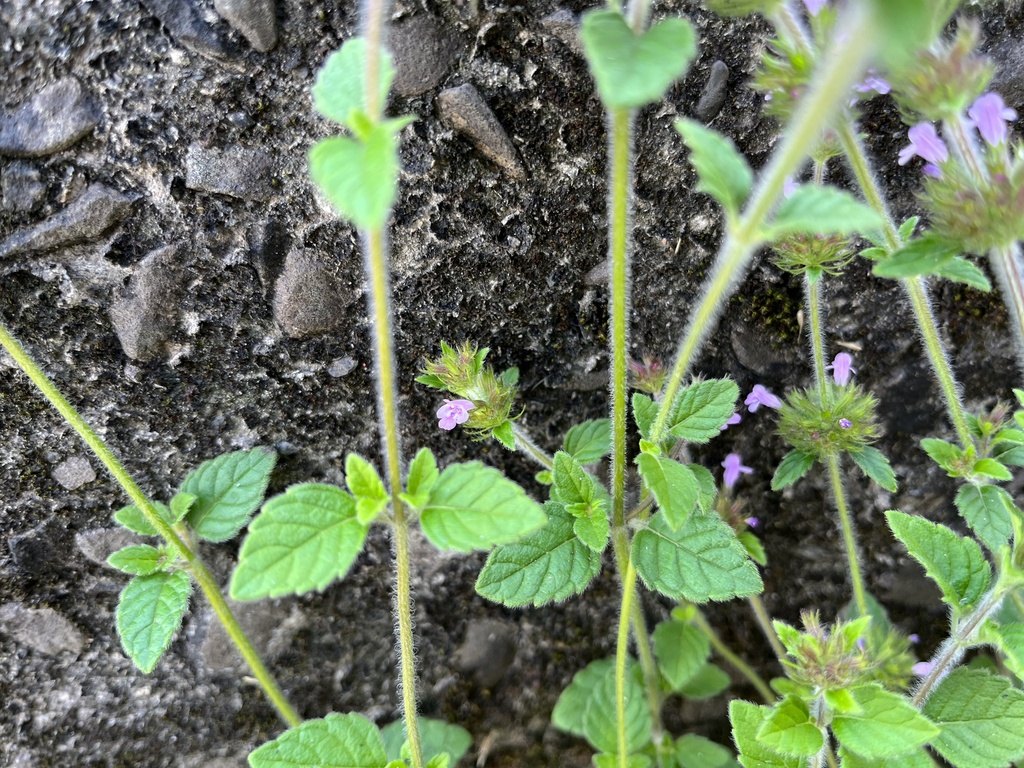
LATIN NAME: Clinopodium chinense
COMMON NAME: Chinese Clinopodium
Plant Profile
Clinopodium chinense is one of the common mints of the East Asian hills, a hairy perennial thirty to eighty centimetres tall that carries rounded heads of magenta flowers through the summer. Bentham named it as a Calamintha in the 1830s, and Kuntze moved it to Clinopodium in 1891, where molecular work has kept it.
The plant builds a clump of upright square stems with ovate, toothed, softly hairy leaves that carry the expected mint smell, weaker than garden basil but recognisably of the same guild. From June into August the leaf axils and stem tips crowd with dense many-flowered cymes, their purple-magenta lips working steadily for weeks.
The distribution is broad and mostly cool: the Amur region and Sakhalin, Korea, the Japanese archipelago from the lowlands to the mountains, and through central China south to the hill country of northern Myanmar. It favours woodland edges, thickets, road banks and grassy slopes, and in Japan field records make it one of the most frequently observed wild mints in the country.
Commonness has not translated into ornamental fame, which is a small puzzle: a hardy, long-flowering, pollinator-friendly perennial with a medicinal record a page long should be in every catalogue, and instead it waits at the edge of the trade while showier, weaker mints sell out their spring stock.
Science & Biotechnology
Chemical surveys of the plant report oleanolic and ursolic acids, a set of flavonoids and a modest essential oil, a profile behind its pharmacology. Extracts show antibacterial and anti-inflammatory activity in laboratory settings, and the herb’s traditional applications line up neatly with what the assays suggest.
The taxonomic company it keeps has shifted twice in a century. It began as a Calamintha, moved to Clinopodium, and the enlarged molecular concept of Clinopodium has since absorbed most of the old Calamintha and part of Satureja, leaving this species as a well-behaved member of a much bigger, untidier genus.
Reproduction is unspecialised and effective. Bees and small butterflies work the cymes, seed sets generously, and the clump also creeps slowly by short rootstocks, so populations thicken from two directions. Its abundance in managed and disturbed landscapes, from road banks to orchard edges, reflects that double strategy.
Uses & Benefits
In the Chinese dispensary the herb is feng lun cai, listed for cooling the blood, stopping bleeding and easing enteritis, and used as a gargle for sore throats. Regional preparations made from the whole flowering plant are still sold in southern China as a minor antibacterial and haemostatic drug.
In the garden the case is simple. It is hardy, tolerant of half shade, carries magenta bloom from June to August on plants that never need staking, and draws bees and butterflies in numbers. Used as an edging in front of taller perennials, its heads knit into a low colour band that repeats all summer.
The foliage can be used as a mild culinary herb the way its cousin wild basil is, though the flavour is rougher than garden herbs. Livestock leave it alone, deer browse it little, and the plant’s only vice is a slow tendency to widen from the rootstock, which a spade solves. Lamiaceae is well covered here, with Mentha requienii, Mentha × piperita and Lavandula pinnata alongside.
Growing from Seed
The seeds are small and germinate readily without stratification. Sow in spring on the surface or barely covered at warm temperatures, and seedlings appear within two to three weeks. Grow them on in cells and plant out after the last frost, since young plants make quick roots in warm soil.
Site it in sun or light shade and any average soil, moist ground tolerated better than drought, at thirty-centimetre spacing for a solid edging. The clump begins flowering in its first summer from an early sowing and reaches full breadth in its second, creeping gently outward from the crown.
Cut the first flush of heads back hard when they fade and the plants produce a second, tidier wave of colour in late summer. Divide the crowns every three or four years in spring to keep the centre dense, and pot up the rooted edge pieces as new plants for free.
Our Take
The plant is proof that the commonest thing in the local flora can be a genuinely useful garden subject that nobody has bothered to market. Everything about it, hardiness, bloom length, pollinator value, medical record, is documented and boring in the best sense.
Sow warm in spring, set out in sun or half shade, and shear the first flush of cymes when they fade for a second wave. Divide every few years, and the clump will quietly anchor the front of a border for a decade.
Related Reading
If Chinese Clinopodium appeals to you, these related plants are worth a look: