


Caryopteris incana Seeds | Bluebeard
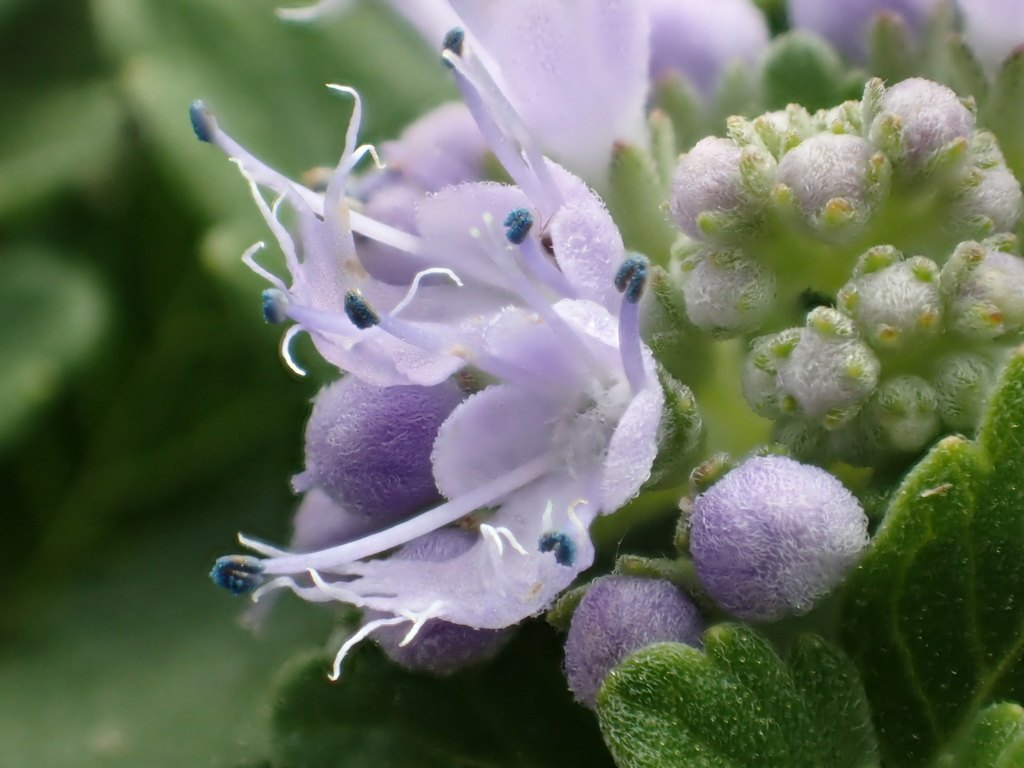
LATIN NAME: Caryopteris incana
COMMON NAME: Bluebeard
Plant Profile
Caryopteris incana is an aromatic subshrub of the mint family, native to central and southeastern China, Taiwan, Korea and western Kyushu in Japan, where it grows on dry slopes and in scrub at 100 to 800 m. It reaches about 50 cm in the wild, though garden forms such as Jason reach 80 cm.
The leaves are opposite, grey-green and covered with fine hairs, and they give off a strong, resinous scent when crushed, which is the origin of the common name bluebeard and of the older name blue spirea. The flowers are small, five-lobed and violet-blue, carried in dense clusters at the tips of the stems in late summer and autumn.
It is one of the parents, with Caryopteris mongholica, of Caryopteris x clandonensis, the blue-mist shrub, which is the plant most gardeners actually grow. The hybrid is more compact, more floriferous and hardier than either parent, and it has largely replaced them in the trade.
Science & Biotechnology
Caryopteris is a small genus of about 16 species, all Asian, and it was long placed in the Verbenaceae before molecular work moved it to the Lamiaceae. The move is supported by the aromatic foliage, the square stems and the two-lipped flowers, all of which are characteristic of the mint family.
The blue colour is a delphinidin-based anthocyanin, and it is unusual in being stable in alkaline soil, so the plant keeps its colour where a blue hydrangea would turn pink. The grey-green foliage is produced by dense hairs that reflect light and reduce water loss.
The hybrid C. x clandonensis was raised at Clandon Park in Surrey in the 1930s, and it is one of the most successful garden shrubs of the twentieth century. Its cultivars, including Kew Blue, Arthur Simmonds and Ferndown, are selected for deeper colour, compact habit and hardiness, and they are propagated by cuttings because they do not come true from seed.
Uses & Benefits
It is a plant for the front or middle of a border, where its late-season blue can be seen against grasses and against the fading flowers of summer. It combines well with sedums, with ornamental grasses and with late daisies, and it is one of the few blue-flowered shrubs that flowers in September.
The aromatic foliage is a secondary attraction, and the plant is one of those that can be brushed past in the evening to release scent. The flowers are visited by bees and by late butterflies, and the plant is a useful source of nectar at a time when most shrubs have finished.
It is not edible, and the essential oil is strong enough to be irritating in quantity. In a cold climate the top growth dies in winter and the plant regrows from the base in spring, which means it should be treated as a herbaceous perennial rather than a shrub.
In a cold garden the plant is best treated as a herbaceous perennial, cut to the ground in spring and mulched in autumn, and it will flower on the new growth by August without any further attention. The flowers open from the base of the cluster upwards, so a single head is in bloom for three weeks, and the plant continues to produce new clusters until the first frost. It shares the family with Plectranthus, Mentha pulegium and Nepeta tenuifolia.
Growing from Seed
Start them indoors eight to ten weeks before the last frost, at 18 to 21 °C, with a thin covering. Germination takes 14 to 30 days and is often uneven. The seed is short-lived, so use a fresh packet. Transfer to 7 cm pots and grow on at 15 °C. Plant out after the last frost, 45 cm apart, in full sun and well-drained soil. The plant tolerates poor, dry ground and needs no feeding; rich soil produces soft growth that dies in winter.
Prune hard in early spring, cutting back to a low framework, because the plant flowers on new wood and old wood becomes bare. In a cold climate, mulch the crown in autumn and expect the top growth to die. Take cuttings in late summer from non-flowering shoots if you want to keep a particular form.
Our Take
Bluebeard is a plant for the September border, when the garden is running out of colour and the bees are still working. It is easy, drought-tolerant and aromatic, and it asks for nothing except sun and a hard prune in spring. Grow it with grasses and sedums, cut it back in March, and enjoy the blue when everything else is going over. It ranks among the most useful small shrubs for a dry garden.
Related Reading
Readers interested in Bluebeard frequently explore these as well: