


Euryops pectinatus Seeds | Golden Shrub Daisy
LATIN NAME: Euryops pectinatus
COMMON NAME: Golden Shrub Daisy
Plant Profile
Euryops pectinatus is one of those plants whose common name tells you almost everything and nothing. Golden Shrub Daisy, sold in English-speaking gardens under exactly that label, is a South African shrub of the sunflower family, described first under a Linnaean basionym and moved into Euryops by Cassini early in the nineteenth century.
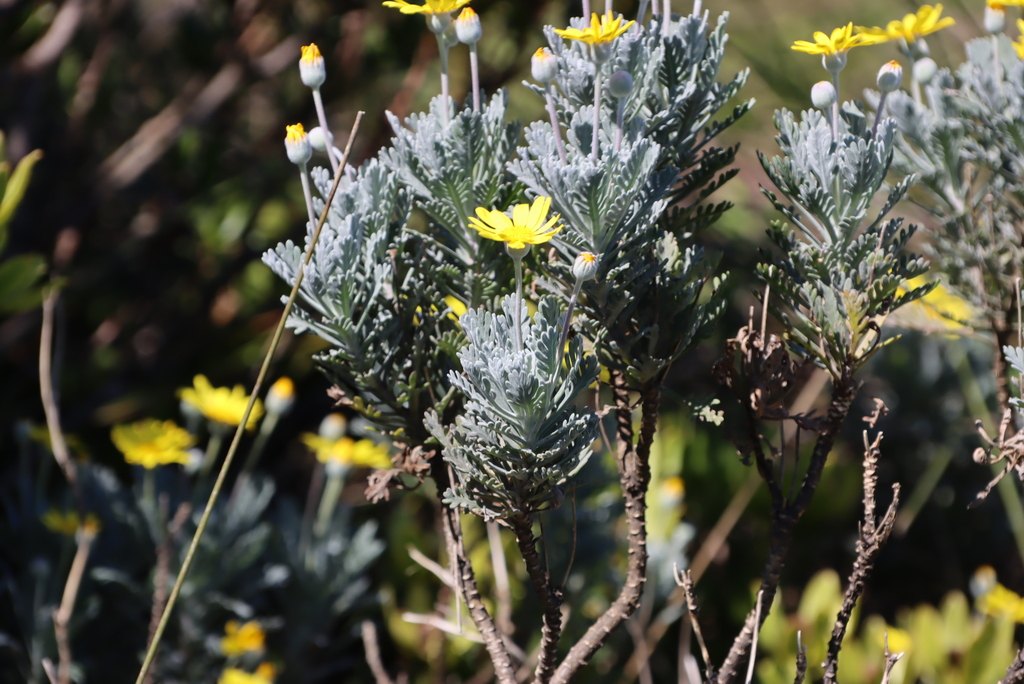
The shrub makes a dense evergreen dome up to two metres tall and as wide, though garden plants are usually kept smaller. Its leaves are deeply cut into narrow lobes and covered in fine grey hair, which is where the specific epithet comes from: pectinatus means comb-like. The flower heads are yellow daisies about five centimetres across.
Wild plants are confined to rocky sandstone slopes in the Western Cape, from the Gifberg in the north down to the Cape Peninsula. That range sits inside the winter-rainfall zone, where summers are dry and hot and the soil is coarse, acidic and lean. The plant’s whole constitution follows from those conditions.
The genus name joins two Greek words, eurys for wide and ops for face, a reference to the broad flower heads. Each head sets a single seed, and the achene is either smooth or covered in hairs that swell into slime when wetted, sometimes topped by a pappus of white or brown bristles.
Science & Biotechnology
A euryops head is a composite in the strict sense: a ring of female ray florets around a centre of tubular disc florets, all packed onto a common receptacle. The flat, open face makes an easy landing platform, and the nectar sits shallow enough for short-tongued flies and beetles as well as honeybees.
The slime hairs on the seed are the detail worth knowing. Myxogenic trichomes swell and rupture on contact with water, releasing a mucilaginous sheath that glues the achene to soil particles or to a stone. In a habitat where rain arrives in sudden winter fronts, sticking in place beats being washed downhill.
Flowering is famously open-ended. Wild plants carry buds and open heads through most of the year, with a pause in the driest weeks. Garden records show two peaks, one in April and another in October and November, which reflects two hemispheres of cultivation as much as the Cape’s own rhythm. The family connection runs to Brachyscome iberidifolia, Dimorphotheca pluvialis and Argyranthemum frutescens.
Uses & Benefits
Its garden value is winter colour in mild climates. Where frost is rare, the shrub opens yellow daisies in December and January, when almost nothing else in a Mediterranean border is doing anything at all. The Royal Horticultural Society has given it an Award of Garden Merit, and municipal plantings use it heavily.
Coastal gardens suit it because salt wind does not mark the foliage, and dry gardens suit it because the roots resent summer irrigation. It works as a low hedge, a container specimen for a sunny terrace, or a silver foil behind darker-leaved perennials, and the flowers hold well enough for cutting.
The catch is frost. A hard winter blackens the foliage and can kill the plant outright, so it belongs in the sheltered, warm corner rather than the open lawn. Plants also age: after five or seven years the centre opens up and the wood goes leggy, which means replacement or a hard cut in spring.
Growing from Seed
Seed is the slow route. Each achene carries a pappus that makes it awkward to handle, and the seed itself is small and short-lived. Rub the pappus off, surface-sow onto a gritty mix, press the seed down without covering it, and hold the tray near twenty degrees in bright light, since germination depends on it.
Expect seedlings in two to four weeks, unevenly. Prick them out at the first true leaf, because euryops resents root disturbance later, and grow them on in compost with a third of grit by volume. Plant out after the last frost, in full sun, on ground that never puddles.
Cuttings are quicker and truer. Take half-ripened shoots of about eight centimetres in late summer, strip the lower leaves, and strike them in gritty compost under cover with gentle bottom heat. They root in three or four weeks, and the plants flower within a season, which seedlings rarely manage.
Our Take
Golden Shrub Daisy answers a narrow question: what flowers on a dry, sunny, frost-free wall in the dead of winter. It answers that question completely and asks for nothing except drainage. Feed it and you get soft growth and fewer flowers. Water it in summer and you risk the crown.
Plant it once, in the warmest spot you have, and then leave it alone. If the winter is kind it will be in flower while the hellebores are still thinking about it, and if the winter is not kind you will know inside a fortnight, which is at least honest.
Related Reading
Continue exploring with these related plants: