


Argyranthemum frutescens Seeds | Marguerite Daisy
LATIN NAME: Argyranthemum frutescens
COMMON NAME: Marguerite Daisy
Plant Profile
Argyranthemum frutescens comes from the Canary Islands, where it grows on rocky slopes and in scrub on several of the islands in the group. It is a subshrub, woody at the base and herbaceous at the tips, reaching about a metre in a mild climate, with deeply divided, blue-green leaves and a rounded, well-branched frame.
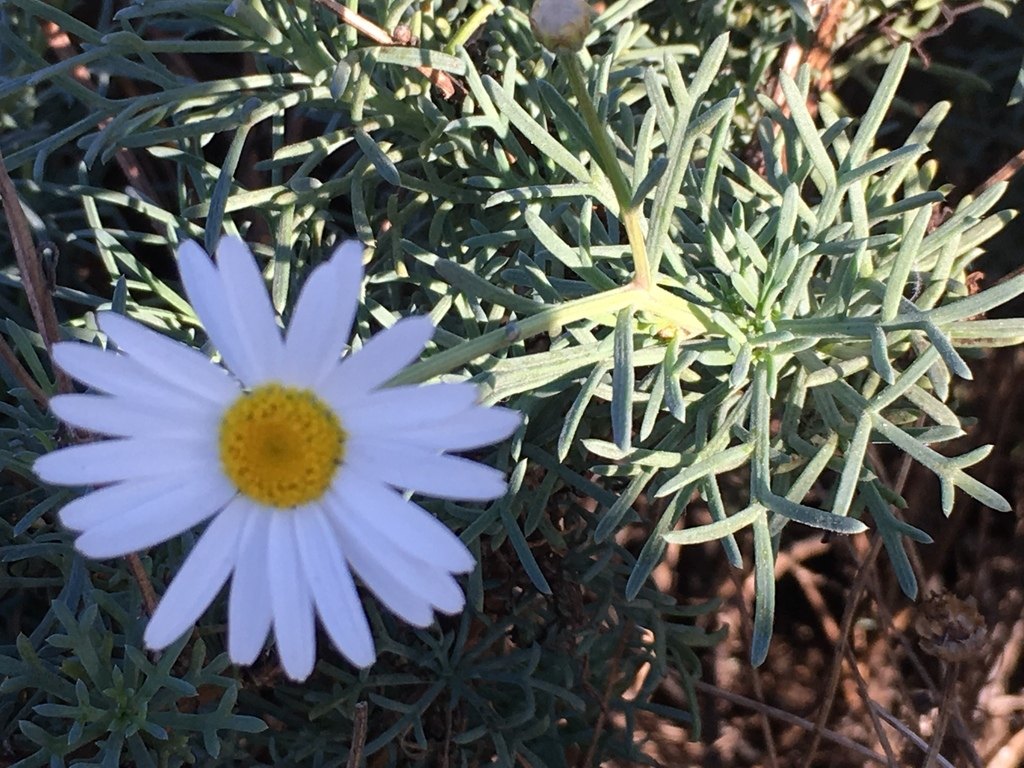
The flowers are daisies 4 to 6 cm across, white with a yellow disc in the wild type, and they are produced so freely over such a long season that the plant has been a fixture of cool conservatories since the eighteenth century. Named forms extend the range to pink, cream and semi-double, and some have almost fern-like foliage that is worth growing for itself.
The genus was split from Chrysanthemum in the 1990s on the basis of chromosome number and fruit structure, and the old name is still used by some growers and in some catalogues. The plant is not a chrysanthemum in the florist’s sense, and it does not respond to the same day-length treatments, so it flowers continuously rather than on a schedule.
Science & Biotechnology
The Canary Islands are a small archipelago with a large number of endemic plants, and Argyranthemum is one of the most conspicuous. The genus has about 24 species, all endemic to the islands or to the Salvage Islands, and they have diversified into a range of habits from low cushions to shrubs, mostly in the laurel forest and the dry scrub above it.
The garden marguerites are hybrids between several species, principally A. frutescens and A. foeniculaceum, and they are bred for compact habit, flower size and colour. The pink forms carry anthocyanins that the white species lack, and the intensity of the pink depends on temperature: plants grown cool produce deeper colour than those grown warm, so a spring crop is pinker than a summer one.
Argyranthemum is one of the few Asteraceae in which the ray florets are female and fertile while the disc florets are bisexual, a combination that produces the daisy’s characteristic seed set. The seed is an achene without a pappus, so it does not blow far, and the plant spreads mainly by cuttings and by garden escape rather than by wind. The rest of the Asteraceae here runs to Achillea ptarmica, Helipterum roseum and Zinnia angustifolia.
Uses & Benefits
In a cold climate it is grown as a summer bedding plant or in a large container; in a mild one it becomes a permanent shrub for a sheltered border. Either way it is used where a long, unfussy display of white is wanted: against dark hedges, in pots by a door, along the front of a terrace.
It responds well to clipping and can be kept to a tight dome, which makes it useful for formal plantings where a rounded shape is wanted without the stiffness of box. In Italy and southern California it has escaped from gardens and naturalised along roadsides, which tells you how well it suits a Mediterranean climate.
It is not edible, and the foliage can irritate skin in sensitive people. Its value is ornamental and seasonal: it fills the gap between the spring bulbs and the summer perennials, and it keeps flowering through the heat that shuts most spring plants down.
Growing from Seed
Sow indoors eight to ten weeks before the last frost at 18 to 21 °C, covering the seed lightly. The tray greens over in two to three weeks. The seed is variable, and plants from a packet will differ in habit and flower size, so if you want a particular form, buy a cutting-raised plant instead.
Prick out into 9 cm pots and grow on at 15 to 18 °C in bright light. Pinch the growing tips twice to build a bushy frame; without pinching the plant makes a single stem with a flower on top and nothing else. Plant out after the last frost, 40 cm apart, in full sun.
Water regularly in containers and feed every two weeks with a high-potash fertiliser once flowering starts. Deadhead to keep the flowers coming, and cut the plant back by a third in late summer if it becomes leggy. In a mild climate, take cuttings in late summer for next year’s plants, since old plants become woody and flower less.
Our Take
The marguerite is the most reliable white daisy you can grow, and the least demanding. It flowers for months, takes clipping, tolerates wind and salt, and looks good in a pot by a door with no more care than water. Its one fault is that old plants become bare at the base and need replacing every three or four years.
Grow it where you will see it every day, in a pot or at the front of a border, and take cuttings each summer. That is the whole of the work, and the reward is a plant that flowers from May to October without a pause.
Related Reading
Gardeners who grow Marguerite Daisy often pair it with these related subjects: