


Tragopogon pratensis Seeds | Meadow Salsify
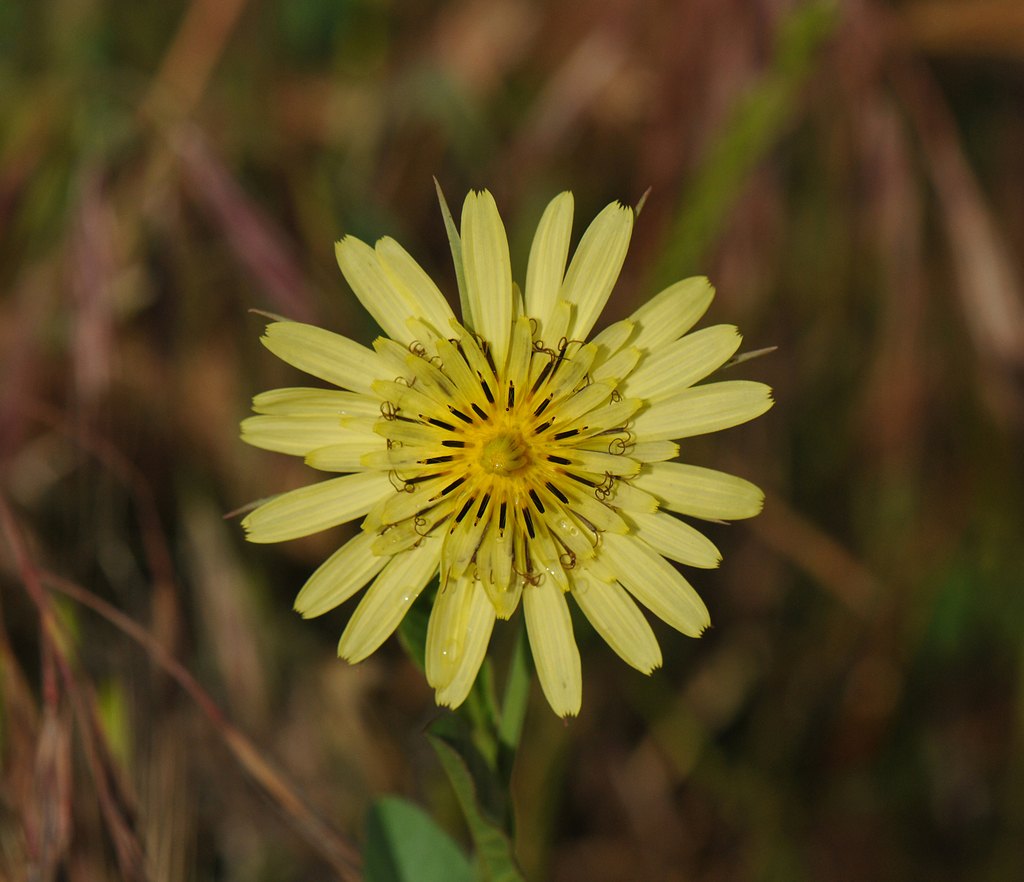
LATIN NAME: Tragopogon pratensis
COMMON NAME: Meadow Salsify
Plant Profile
Meadow salsify is a biennial of up to 76 cm, with lanceolate, keeled, grey-green lower leaves 10 to 30 cm long, hairless and pointed, each with a white midrib. The upper leaves are shorter and more erect, and the whole plant exudes a milky latex when cut, in the usual manner of its part of the daisy family.
It carries yellow flower heads 15 to 25 mm across from June to October, and the heads open only in the morning sunshine, closing by midday. That habit gives the plant the best common name in British botany: Jack-go-to-bed-at-noon. A dull June day keeps it shut entirely.
It is European, from Scandinavia south to Spain and east to the Caucasus, Siberia and Iran, in meadows, pastures, dunes, roadsides and waste ground. In North America it is an introduced weed of fields, and it is in Britain everywhere except the coastal edges of Scotland and Ireland.
Science & Biotechnology
It is the only British dandelion-type flower with grass-like leaves, which is the quickest way to identify it before it flowers: a rosette that looks more like a bluegrass than a daisy, then a bud on a swollen hollow stalk. Once open, the bracts separate it from its relatives, since they are long and pointed, while in viper’s-grass, Scorzonera humilis, they are short and pale green.
The seed head is a blowball like a dandelion’s but larger and finer: each achene carries a long beak topped with a radiating pappus whose side hairs interweave like a spider’s web, so the whole sphere holds together until a gust takes it as one unit. That engineering moves seed a long way on an open day.
The genus also holds one of botany’s textbook events. Introduced North American populations of three Tragopogon species, including this one, hybridised in the mid-twentieth century and produced two new polyploid species that botanists watched form within a human lifetime. It is the clearest documented case of speciation in the wild, and it happened in a weed. For more of the Asteraceae, the list offers Arnica americana, Tithonia and Pycnosorus globosus.
Uses & Benefits
It is an edible plant with real history. The root can be boiled and eaten like potatoes, the fresh stems and buds cooked like asparagus, and the young leaves eaten raw. The related salsify, T. porrifolius, is the cultivated vegetable, but this meadow version was gathered wherever it grew.
In the garden its use is as a meadow or wild-garden plant: a biennial that flowers in its second summer, feeds early bees in the morning, and turns into a decorative blowball in August. Sown with oxeye daisies and knapweed it fits in without taking over, because it makes no runners and dies at the end of its second year.
It is not for a formal border. The flower is brief, the foliage is grassy and unremarkable, and the plant is only remarkable in company, in a setting where the morning-open habit and the seed heads are the point rather than the colour.
Growing from Seed
The seed is a beaked achene and germinates without pretreatment. Sow in late spring or early summer on the surface of firmed ground, barely covered, and expect germination in one to three weeks. The first year is a rosette; the flower and the seed head come in the second summer, so plan the gap in the sward accordingly.
It wants full sun and ordinary to poor soil, and it grows in everything from sand to clay as long as the site is open. In a meadow, sow into gaps after the spring cut; in a garden, give it a bare patch and remove nothing else. It dislikes shade and will not flower in it.
Collect the blowballs before the wind does, or let them go and thin the seedlings next spring, which is less work and roughly as effective. In a small garden, though, gather at least some, because the wind does not respect bed boundaries. Plants are pulled easily, and the taproot comes up whole from loose soil, which matters where you do not want it colonising.
Our Take
It is a plant to grow for the name alone, and the plant justifies the name. Watch a bud open at seven, stand wide at ten, and fold by one, and you understand why rural Britain bothered to name it.
Grow it in a meadow or an untidy corner, eat a root if you are curious, and leave some for the goldfinches, which take the seed. A biennial with a two-hour flowering day sounds like a bad deal until you have a patch of it and find you are out there every morning checking the time.
Related Reading
More species in the same orbit as Meadow Salsify: