


Reseda muricata Seeds | Mignonette
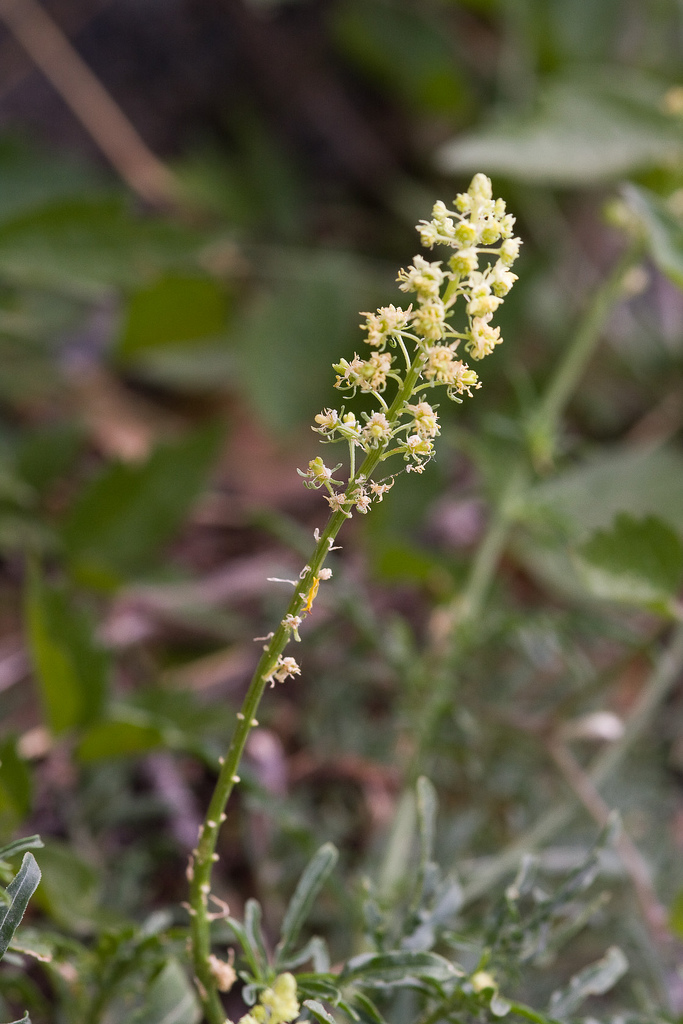
LATIN NAME: Reseda muricata
COMMON NAME: Mignonette, Reseda
Plant Profile
Reseda muricata is a desert mignonette of the Arabian Peninsula, a low grey shrub with spikes of small cream flowers through spring. It grows from the Hijaz and Yemen through Oman and the Emirates to southern Iran and Pakistan, on gravel, sand and rocky ground in wadis and on the edges of escarpments, often where there is a little winter runoff. The plant reaches 30 to 80 cm, with woody stems at the base and upright annual shoots carrying narrow, entire or lobed leaves that are rough to the touch. The flowers are small, greenish-white, with fringed petals and a ring of stamens that opens in succession, and they are held in a narrow spike that lengthens as it flowers. The fruit is a capsule that opens at the top to release small black seed. The whole plant dries to a stiff, pale skeleton that persists through the summer, and it is one of the few green things in a hard desert spring.
Science & Biotechnology
Reseda muricata belongs to the mignonette family, a small group in the order Brassicales, and like the cabbages it produces glucosinolates, though in much lower concentrations. The flowers are adapted to small bees and flies rather than to large pollinators: the petals are cut into fringes, the stamens ripen in a ring around the ovary, and the nectary sits at the base of the flower where a short-tongued insect can reach it. The plant is a drought-avoider rather than a drought-tolerator, since it keeps a woody base and puts out new shoots only when rain comes, flowering within weeks and setting seed before the heat peaks. Its seed coat is hard and the seed can wait in the soil for several seasons. The species is one of a group of Reseda that radiated into the arid belt from the Mediterranean, and the genus is best known in Europe for the dyer’s rocket, whose yellow flavonoids were used to dye wool before synthetic colourants existed.
Uses & Benefits
The plant is grazed by camels and goats in the brief window when it is green, and it is one of the desert species that herders know by name because it appears reliably after good rain. In local medicine a decoction of the aerial parts is used for stomach complaints and as a wash for sore eyes, and the dried plant is burned as a fumigant in some households. Related species in the genus yield a yellow dye from the leaves and stems, and it is likely that R. muricata was used the same way, though the records are thin. In a dry garden it makes a curious, short-lived specimen for a gravel bed, with an airy spike of flowers and a scent that is faint but distinct. It is not a plant for rich soil or irrigation, which makes it useful in the parts of a garden that get no water at all. It has no commercial value and is grown only by collectors of desert flora.
Growing from Seed
Sow in autumn in a sandy mix, barely covering the seed since it needs light, and keep at 18 to 22 degrees. Germination is usually quick and uneven, and the seedlings are small and slow for the first month. Prick them out into deep tubes with a gritty mix and grow them on in full light, keeping the compost on the dry side. Plant out into gravel or sand in a frost-free, sunny position, and water only while the plant is establishing. In cold climates grow it in a pot in an alpine house and bring it under cover for winter, since it dislikes both frost and winter wet. Do not feed it, and do not add compost to the planting hole. Let it set seed, because the plant is short-lived and the seed will carry it forward.
Our Take
A small, rough-leaved desert mignonette with cream spikes and a scent of its own. Made for gravel and no water.
Related Reading
More species in the same orbit as Mignonette: