


Iris pseudacorus Seeds | Yellow Flag
LATIN NAME: Iris pseudacorus
COMMON NAME: Yellow Flag, Yellow Flag Iris, Water Flag
Plant Profile
Yellow flag iris is beautiful enough that gardeners planted it on three continents, and troublesome enough that several regions now list it as an invasive weed to control. The very trait that makes it useful at the water’s edge, its tough creeping rhizome that holds banks together, is the trait that lets it smother native wetland plants once it escapes, a contradiction worth knowing before you put it in the ground.
The thick, branching rhizome stores starch and sends up new fans a short distance from the parent each year, so a single planted clump becomes a wall of foliage. Understanding that storage organ explains both the plant’s bank-stabilising value and its difficulty once it is removed from a site.
In its native European wetlands yellow flag is simply part of a healthy reed bed, supporting amphibians and holding soft banks, and that is the setting where its vigour is an asset rather than a threat. The lesson for growers is to match the plant to a contained, managed edge rather than an open, connected waterway where it can run.
In gardens where it is welcome, grow it in a buried root barrier or a contained bog, and never compost or ditch the rhizomes where they can reach wild water. Deadhead spent blooms to limit self-sown spread, and lift a portion of the clump every few years to keep it from crowding the waterline.
The blooms are excellent as short-lived cut flowers and last longest if cut at the coloured-bud stage and the stems are recut under water. A few stems from a contained clump supply the house without ever threatening a waterway, which is the responsible way to enjoy the plant’s colour.
Science & Biotechnology
Because it grows with its roots in water, Iris pseudacorus is studied and used in constructed wetlands for phytoremediation, taking up excess nutrients such as nitrogen and phosphorus and some heavy metals from runoff. That service is real, but it must be balanced against the plant’s invasive tendency outside its native range, so contained systems are the responsible setting.
Uses & Benefits
The rhizome contains iridoid and isoflavonoid compounds, including irisin-like constituents, and it is distinctly bitter and mildly toxic. This chemistry underlies the traditional use of iris rhizome as a purgative and warns against any culinary use; the plant is ornamental and historical, not edible, and the sap can irritate skin.
The rhizome once supplied a yellow dye, and the flowers are a mainstay of the ornamental water garden. The warning is simple: in North America, Australia, and New Zealand the plant is regulated or discouraged, and growers there should choose native iris instead or keep it contained behind a barrier.
Growing from Seed
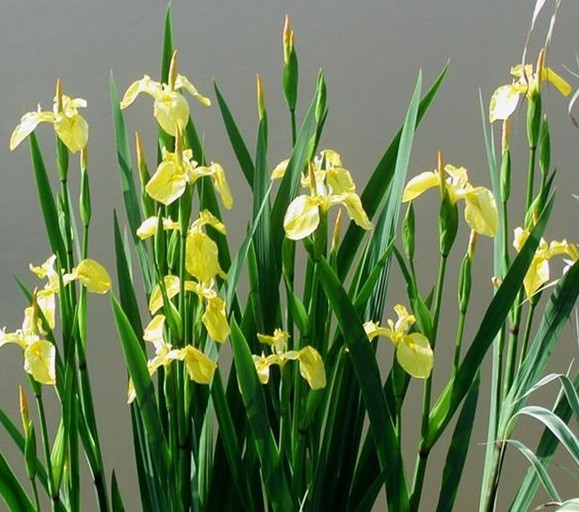
The plant is a rhizomatous perennial with upright, sword-shaped grey-green leaves that can top a metre and a half. It loves the margins of ponds, streams, and ditches, tolerating both saturated soil and shallow standing water, and it forms dense clumps that spread year by year from the knobby rhizome.
The flower is a classic iris: three drooping falls marked with a brown or purple signal patch, and three smaller upright standards, in clear golden yellow. Bees are drawn to the patch and effect the pollination; the show runs from late spring into early summer and repeats on side shoots in a good season.
The species name pseudacorus means false acorus, because its sword leaves resemble those of sweet flag, Acorus calamus, a totally unrelated bog plant. That mix-up is old and botanical, and it is a reminder to check the flower, not just the leaf, before naming a waterside plant.
After flowering the plant forms large green capsules packed with flat brown seeds. The seeds are buoyant and are carried by water, which is the main way yellow flag colonises new stretches of shoreline and, unfortunately, new continents where it was never meant to grow.
Sow fresh seed in a moist, open medium at the water’s edge, or divide an established clump by cutting a section of rhizome with a growing tip. New plants are identified once several sword leaves have formed; thin them so clumps do not crowd the waterline and so airflow lowers fungal pressure.
Give the plant full sun to light shade and soil that stays wet; a marginal shelf in a pond is ideal. Feed lightly with a balanced aquatic fertiliser and divide congested clumps every few years to keep flowering strong and the stand from turning into a solid mass.
Lift a clump after flowering, cut the rhizome into pieces each with a fan and roots, and replant at the water margin. This is the fastest route to more plants and the easiest way to keep a planting from overwhelming its neighbours, and it also refreshes flowering that fades in over-dense stands.
Our Take
For waterside colour without the invasiveness worry, the bearded Iris germanica, the Japanese Iris ensata, and the roof Iris tectorum are all safer, lovelier companions for a mixed border.
Related Reading
Gardeners who grow Yellow Flag often pair it with these related subjects: