


Iris albicans Seeds | White Iris
LATIN NAME: Iris albicans
COMMON NAME: White Iris
Plant Profile
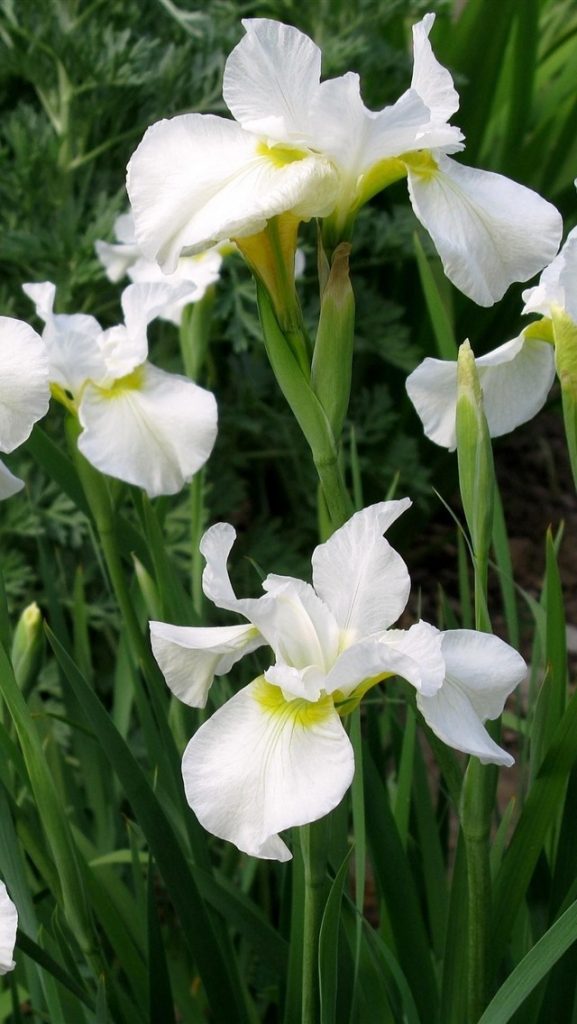
White iris is a rhizomatous bearded iris of the Arabian Peninsula, grown for so long that its wild origin is uncertain, and it is almost always sterile. It makes a fan of grey-green, sword-shaped leaves about forty centimetres tall and, in spring, sturdy stems carrying two or three pure white flowers with a faint cream beard and a slight violet flush at the base. The flowers are strongly scented, and the plant increases only by rhizome, never by seed. In Yemen and Saudi Arabia it is planted on graves and around mosques, and it has followed the spread of Islam into North Africa, Spain and the Balkans, where it is still found in old cemeteries. It is one of the toughest irises for a dry garden, taking heat, drought and poor soil without complaint.
Science & Biotechnology
Iris albicans is a natural hybrid, most likely between Iris germanica and Iris variegata, and it is triploid, which explains its sterility and its vigour. Because it sets no seed, every plant in cultivation is a clone, and the whole population across three continents is genetically almost identical, which makes it an unusual case of a widely distributed sterile crop plant. Its spread is entirely anthropogenic, and its distribution maps the history of Islamic burial practice rather than any natural range. Cytological work consistently reports a triploid count, and the plant reproduces only vegetatively. Its rhizome carries stored carbohydrates that allow it to flower in the second year after planting, and it is susceptible to rhizome rot in wet soil. Its dryland tolerance has made it a subject in breeding for drought-hardy bearded irises.
Uses & Benefits
The plant is used as a cemetery and mosque planting, as a dry border iris and as a cut flower, and its rhizome has a history in medicine as an irritant purge, though it is not used now. In the garden it is one of the best irises for a hot, dry bank, a gravel garden or the foot of a wall, where it needs full sun and sharp drainage. It multiplies steadily, and clumps can be lifted and divided every three or four years, which is the only way to propagate it. The flowers are excellent for cutting, opening successively over two or three weeks. It is not a plant for wet soil or deep shade, and it should be planted with the top of the rhizome exposed to the sun.
Growing from Seed
There is no seed to sow, since the plant is sterile: buy rhizomes and plant them in late summer, with the top third of the rhizome above the soil surface and the roots spread out below. Choose a site in full sun with sharp drainage, and add grit to heavy soil. Water once after planting and then only in the first summer. Space the rhizomes thirty centimetres apart, with the fan facing the direction you want it to grow. Divide the clumps every three or four years, discarding the old centre and replanting the young outer pieces. Cut the leaves back to fifteen centimetres at planting to reduce water loss. Keep the rhizome dry in winter to avoid rot.
Our Take
A sterile white iris that travels only by rhizome, and a fixture of cemeteries from Sanaa to Seville. Dry, sunny and shallow-planted.
Related Reading
Gardeners who grow White Iris often pair it with these related subjects: