


Angelica keiskei Seeds | Ashitaba
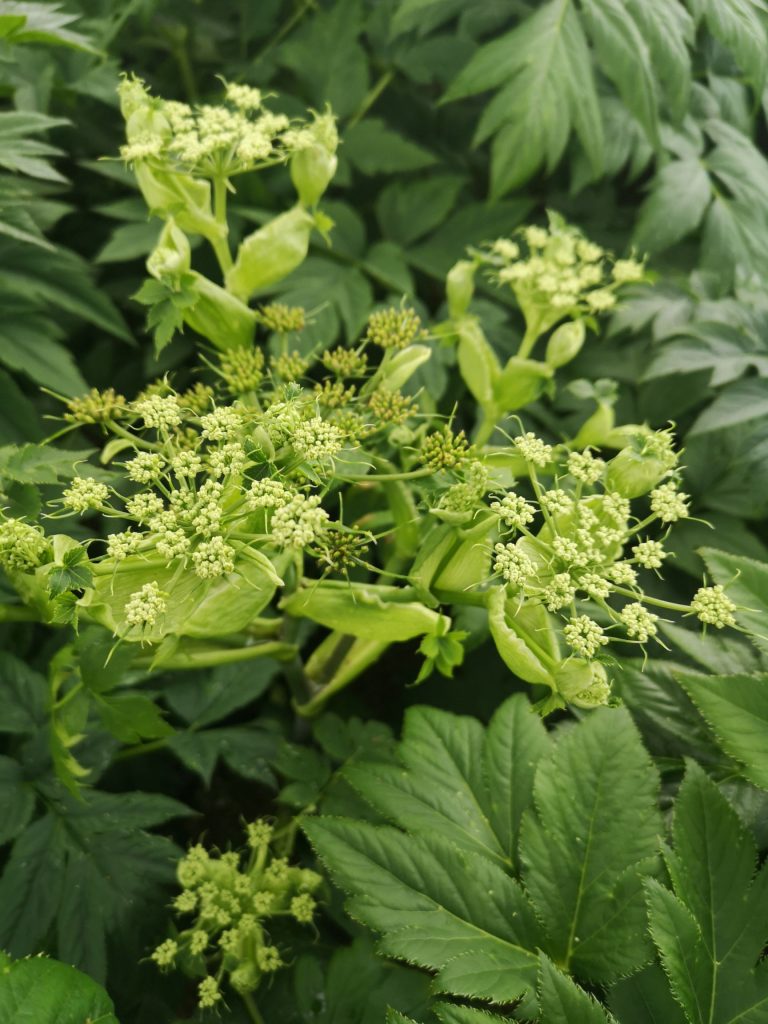
LATIN NAME: Angelica keiskei
COMMON NAME: Ashitaba, Tomorrow’s Leaf
Plant Profile
Ashitaba is a robust umbellifer from the Izu Islands of Japan, grown as a vegetable and a health plant for its leaves and for the bright yellow sap that runs when a stem is cut. It grows one to one and a half metres in a season, with large, deeply divided, glossy green leaves on thick, hollow stalks, and in its second year it sends up a stout stem topped by broad umbels of small white flowers. The whole plant smells of celery and angelica. It is short-lived, usually biennial or triennial, and it dies after flowering, so a patch needs to be kept going from seed or by dividing the crowns. On Hachijojima it has been eaten for centuries, and the yellow sap is the reason it has become a supplement crop.
Science & Biotechnology
The yellow sap contains chalcones, chiefly xanthoangelol and 4-hydroxyderricin, which are unusual among umbellifer compounds and which have been studied for anti-inflammatory, anti-diabetic and anti-tumour activity in cell and animal models. The plant also contains coumarins and furanocoumarins, the latter of which cause photosensitivity in sensitive people, and the leaves are rich in vitamin B12 and in flavonoids. Ashitaba is a short-lived perennial that behaves as a biennial, and its flowering is triggered by cold, which is why growers in warm climates keep it vegetative by removing the stems. The species is a tetraploid and is closely related to Angelica sylvestris, and it hybridises with other Angelica species where they meet. Research on its chalcones is promising but has not yet produced clinical evidence.
Uses & Benefits
The leaves and stems are eaten fresh in salads, blanched, stir-fried or dried for tea, with a slightly bitter, celery-like flavour. The yellow sap is dried and sold as a powder and a supplement, and the leaf is used in Japanese folk medicine for digestion and for skin conditions. In the garden it is a bold foliage plant for a damp, shaded corner, where its glossy leaves and tall umbels look well against darker planting. It is also a useful cut-and-come-again vegetable, since the outer leaves can be taken without killing the plant. It needs rich, moist soil and shade from strong sun, and it will bolt in heat, which ends the crop. Pregnant women and people on medication should avoid the supplements.
Growing from Seed
Sow fresh seed, since it loses viability within months, on the surface of a rich, moist mix and cover with a bare two millimetres. Keep at eighteen to twenty degrees in shade; germination takes two to four weeks. The seedlings grow fast and need deep pots and steady water. Grow on in half shade with rich compost, and plant out into moist, humus-rich soil in dappled shade. Keep the plants watered and mulched, and remove any flowering stems to prolong the leaf harvest. In hot climates, grow it as a winter annual. Divide the crowns every two years, or sow a fresh batch each spring to replace plants that have bolted.
Our Take
A Japanese leaf vegetable with yellow sap and a supplement trade behind it. Rich, damp shade, and cut the flower stems off.
Related Reading
Continue exploring with these related plants: