


Gleditsia triacanthos Seeds | Honey Locust
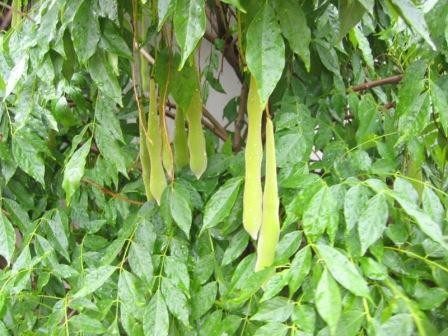
LATIN NAME: Gleditsia triacanthos
COMMON NAME: Honey Locust, Sweet Bean Tree
Plant Profile
The wild honey locust defends itself with thorns like nothing else in a temperate woodland: stout, branched spikes up to twenty centimetres long that fork from the trunk and branches in a way the species name triacanthos literally describes as three-thorned. Those same trees also hang long, twisted pods whose pulp is genuinely sweet, a combination of armour and candy that shaped the tree’s whole human history.
The branched thorns are modified shoots, not simple prickles, and on open-grown wild trees they arm every limb. Cultivated thornless forms exist, but the wild prototype is a bristling thing that once discouraged both browsers and fence builders alike, and the thorns persist on the wood long after the tree is cut.
The leaves are bipinnately compound, each leaflet small and many, giving a fine, light canopy that casts dappled shade and lets grass grow beneath it. The flat, often curled pods hold a sticky, sweet pulp between the seeds; this pulp, not the seed, is what gave the tree its name and its old use as a forage and a sweetening.
Wild honey locust favours the rich, occasionally wet soils of stream bottoms and the drier edges of the prairie, a broad native range that explains its tolerance of both periodic flooding and summer drought once established. That adaptability is the reason it was planted far outside its home ground.
As a legume, honey locust forms root nodules with nitrogen-fixing bacteria, enriching poor ground where it grows. This trait, shared with its relative Gleditsia sinensis, makes it useful on degraded sites and explains its value in reclamation plantings.
Science & Biotechnology
The seeds and pod walls are rich in saponins, the foam-forming compounds that have drawn interest as natural surfactants, while the seed endosperm yields a galactomannan gum comparable in behaviour to guar. These molecules explain the traditional use of ground pods in washing and in crude industrial processes, and they keep the species on the roster of useful non-food crops.
The sweet pod pulp is palatable to cattle and sheep and was once an important range feed; analyses show it is sugar-rich. Modern work looks at the pulp and gum as low-cost feed and bio-product inputs rather than as a human sweetener, and at the pulp sugars as a fermentation substrate.
The heartwood is dense and reddish, and unusually resistant to rot and to attack by termites, a durability that made the timber a favourite for fence posts, rails, and stable flooring. That same trait shows up in studies of naturally durable wood extractives within the genus, where the tree’s resistance is compared with other naturally durable hardwoods.
The galactomannan from the seed has thickening and stabilising uses much like guar gum, and breeding for higher gum yield has been explored where the tree is grown as a multi-purpose resource. That side of the species keeps it interesting to non-timber forest product researchers as well as to foresters.
Uses & Benefits
Thornless, narrow-crowned cultivars such as ‘Skyline’, ‘Shademaster’, ‘Moraine’, and the golden-leaved ‘Sunburst’ turned a wild prairie tree into a city street standard, valued for light shade and salt tolerance. The dense, durable wood also served as fence posts and rails long before the ornamental forms appeared.
Because the wild thorns are a liability in gardens, every popular form is a thornless sport or selection. Buy seed of named cultivars if you want a predictable tree; seedling rows will throw both armed and thornless individuals, and only grafting guarantees the thornless habit.
Beyond the light shade, the tree shrugs off road salt, compacted urban soil, and reflected heat, which is why it lines streets and car parks across the midwest and beyond. That urban toughness, paired with the thornless cultivars, explains most of its modern planting and keeps it in constant demand at municipal nurseries.
Growing from Seed
The hard, glossy seed needs its impermeable coat weakened before it will take up water; nicking the coat or a brief hot-water soak does the job. Sow in a warm, well-drained bed and cover moderately. Seedlings are identified once the first true bipinnate leaf unfurls, and are then thinned to give each room to develop a straight leader.
Give honey locust full sun and a deep, adaptable soil; it tolerates alkaline ground and drought once established. Water young trees through dry spells and avoid waterlogging. The nodulating roots mean little nitrogen feed is needed, and a light formative prune sets a clean trunk.
First-year seedlings are the most frost-tender; mulch the root zone and site them out of harsh wind. Established trees are rugged across a wide climate range and need little beyond occasional formative pruning to keep a single dominant stem.
Our Take
If you like nitrogen-fixing shade trees, pair honey locust with the Asian Gleditsia sinensis or the redbuds Cercis chinensis and Cercis siliquastrum, all of which bring spring colour to the same open ground.
Related Reading
Continue exploring with these related plants: