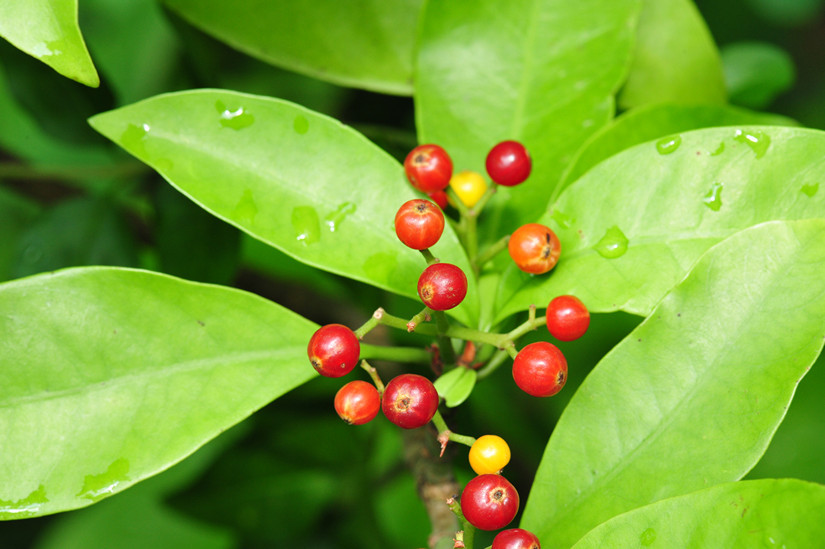
Psychotria mucosa seed
Psychotria mucosa: A Tropical Shrub of Traditional Wisdom, Ecological Balance, and Hidden Value
During a trip to the rainforests of St. Lucia a few years back, I spent a week hiking with a local guide who taught me to spot the “quiet plants”—the ones that don’t have showy blooms or exotic fruits but are deeply woven into the fabric of the ecosystem and local life. One afternoon, as we trekked along a damp trail near Morne la Sorcière, he pointed to a small, bushy shrub growing at the base of a tall palm, its glossy green leaves arranged in neat opposite pairs and tiny, star-shaped white flowers clustered at the leaf axils. “That’s Psychotria mucosa,” he said, brushing a leaf with his finger to show me its slightly sticky surface. “We call it ‘mucosa’ because of that slimy texture when you crush the leaves. It’s been here longer than our villages, and we’ve always found ways to use it.” That casual introduction stuck with me, and over the days that followed, I learned more about this underappreciated member of the Rubiaceae family—its tangled taxonomic history, its role in traditional healing, and its quiet contribution to the rainforest’s health. It’s a plant that’s easy to miss, but once you learn its story, you can’t help but admire its resilience and utility.
First, let’s get to know Psychotria mucosa beyond its name. This evergreen shrub (sometimes growing into a small tree) is native to the Neotropics, with a range that spans the Caribbean—including St. Lucia, where I first encountered it—and parts of South America, such as Brazil’s Pará and Mato Grosso regions, and Venezuela’s Amazon basin. It’s a member of the same family as coffee and gardenias, and like many Psychotria species, it has a complex taxonomic past, with several synonyms over the years, including Callicocca mucosa, Cephaelis muscosa, and Palicourea muscosa, reflecting how botanists have reclassified it as our understanding of plant relationships has evolved. Growing 1 to 3 meters tall, it thrives in the understory of tropical rainforests, particularly in terra firme areas—higher ground that doesn’t flood—and campinarana ecosystems, where it tolerates sandy soils and dappled sunlight. Its leaves are elliptical, thick, and leathery, with a slightly sticky or “mucous” texture (hence its species name, mucosa) when crushed, and its small, actinomorphic (radially symmetric) flowers have five petals, blooming in clusters that emit a faint, sweet scent. By late summer, the flowers give way to small, round drupes that ripen from green to red or black, tempting birds like the golden-olive woodpecker to eat them and disperse the seeds.
For indigenous and local communities across its native range, Psychotria mucosa is a trusted medicinal resource, with uses passed down through generations. During my time in St. Lucia, an elder showed me how they harvest the leaves and stems, drying them in the shade to preserve their properties. “We make a tea from the dried leaves for coughs and bronchitis,” she explained, handing me a small bundle of crumbled foliage that smelled earthy and slightly bitter. “It soothes the throat and clears the chest—perfect for the rainy season when colds are common.” This aligns with what I later learned from botanical studies: like many Psychotria species, mucosa contains bioactive compounds, including alkaloids and flavonoids, which give it anti-inflammatory and antimicrobial properties. Local communities also use crushed fresh leaves as a poultice for minor skin irritations, insect bites, and even small wounds, as the sticky texture helps the paste adhere to the skin and speed healing. In some South American communities, it’s also used to treat gastrointestinal issues like stomachaches and ulcers, a common use for many members of the Psychotria genus. Unlike some medicinal plants that require complex preparation, Psychotria mucosa is simple to use—no fancy tools or ingredients, just the plant itself and a little traditional knowledge.
While its medicinal uses are vital to local communities, Psychotria mucosa also plays an important ecological role in the tropical rainforests it calls home. As a native understory shrub, it contributes to the biodiversity of these fragile ecosystems, providing food and shelter for a range of wildlife. Its small, fragrant flowers are a valuable source of nectar for bees, butterflies, and small insects, which are essential for pollinating other native plants. The ripe fruits are a favorite food source for birds, which eat the drupes and disperse the seeds across the forest, helping the shrub colonize new areas and maintain healthy populations. It also serves as a host plant for certain fungi, such as Melio la eveae, forming symbiotic relationships that benefit both the plant and the fungus. Its dense foliage provides cover for small amphibians, reptiles, and insects, offering a safe haven from predators and the harsh midday sun. In campinarana ecosystems, where vegetation is often sparse, Psychotria mucosa helps stabilize sandy soils and add organic matter as its leaves decompose, creating better growing conditions for other plants.
Beyond medicine and ecology, Psychotria mucosa has a few practical uses tied to local culture, though they’re less common than its medicinal applications. Some communities use the flexible stems to weave small baskets and mats, as the wood is sturdy yet easy to bend. The leaves are sometimes used as a natural insect repellent, placed in homes or stored with clothing to keep mosquitoes and other pests at bay—their slightly sticky texture and faint scent deter insects without being harsh. I also noticed that some local artisans use the plant’s leaves to add a subtle green dye to textiles, creating soft, earthy hues that complement traditional fabrics. These uses are simple, but they reflect how deeply the plant is integrated into the daily lives of the communities that live alongside it.
Growing Psychotria mucosa is possible in tropical and subtropical regions that mimic its natural rainforest habitat, but it’s not a plant for casual gardeners. It thrives in moist, well-drained, humus-rich soil and partial shade—too much direct sunlight can scorch its leaves, while too much shade can make it leggy and reduce flower production. It prefers high humidity, so in drier climates, misting the leaves regularly or placing a tray of water near the plant can help keep it healthy. Propagation is typically done through seeds or stem cuttings; seeds should be sown in a warm, moist soil mix, while cuttings should be taken from healthy, mature stems and rooted in a well-draining medium. I tried growing a few cuttings in a small greenhouse during my trip, and I quickly learned that overwatering is its biggest enemy—soggy soil leads to root rot, which can kill the plant quickly. It’s also relatively resistant to pests and diseases, but aphids and scale insects can occasionally be a problem; a gentle spray of soapy water usually takes care of the issue without harming the plant or its pollinators.
One thing that struck me during my time learning about Psychotria mucosa is how little it’s known outside of its native range. Unlike some tropical plants that are prized for their exotic appearance or commercial value, this shrub remains underappreciated, even though it’s a treasure trove of traditional wisdom and ecological value. It’s also worth noting that, like many rainforest plants, its wild populations face threats from habitat destruction—deforestation for agriculture and development is shrinking its natural range, putting both the plant and the traditional knowledge associated with it at risk. Local communities and conservation groups are working to protect it, promoting sustainable harvesting practices and growing it in community gardens to reduce pressure on wild populations. As someone who’s seen firsthand how it benefits both people and the planet, it’s disheartening to think that such a useful plant could be lost if we don’t take care to preserve it.
To me, Psychotria mucosa is more than just a shrub—it’s a symbol of the deep connection between tropical communities and their natural environment. It’s a reminder that some of the most valuable plants are the ones that don’t demand attention, but quietly provide for the people and ecosystems that depend on them. Every time I think of its glossy leaves, faint fragrant flowers, and sticky texture, I remember the elder’s hands holding dried foliage, the way birds feasted on its fruits, and the quiet hum of pollinators around its blooms. It’s a plant that teaches patience, respect, and the importance of valuing the small, unassuming treasures of the natural world. Whether you encounter it in a rainforest in St. Lucia, a village garden in Brazil, or read about it in a botanical text, Psychotria mucosa is a plant worth getting to know—for its practical uses, its ecological importance, and the stories it carries of the tropical regions and their people.