


Lavandula angustifolia Seeds | Munstead Lavender
LATIN NAME: Lavandula angustifolia
COMMON NAME: Munstead Lavender
Plant Profile
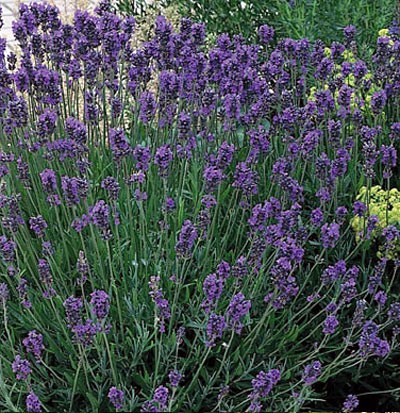
‘Munstead’ is a compact selection of English lavender raised at Munstead Wood and tied to the garden writer Gertrude Jekyll, and it stays shorter and earlier-flowering than the wild type, which is exactly why it became a standard edging plant. The shrub carries the narrow, grey-green, evergreen leaves of its species along short woody stems, and in early summer it bears short, dense spikes of violet-blue, two-lipped flowers at the stem tips. Compared with the broader Lavandula x intermedia lavandins, ‘Munstead’ is smaller, hardier in cold, and earlier, making it the dependable choice for a northern border that must survive winter.
The flowers are structured for bees: a two-lipped corolla with the lower lip acting as a landing stage and the four stamens and style pushed forward, so pollinators brush the anthers as they reach the nectar at the tube base. The whole spike is a dense nectar source through its bloom window, and a row of ‘Munstead’ becomes a small wildlife feature within a week of opening. The grey foliage also holds its colour through winter, giving the border structure when little else is green.
The prized scent of true English lavender oil comes from a high linalool and linalyl acetate profile with only trace camphor, which is what sets L. angustifolia oil apart from the sharper, camphor-rich oils of some Mediterranean species and from the lavandin hybrids that carry more camphor and 1,8-cineole. Steam distillation of the flowering spikes yields the sweet, rounded oil used in perfumery and cosmetics, and ‘Munstead’, being a true angustifolia, sits in that low-camphor, high-linalool class that perfumers pay a premium for.
Science & Biotechnology
Lavender is well served by propagation science: semi-hardwood cuttings taken from the non-flowering shoots root reliably and hold the cultivar true, while micropropagation protocols exist for mass clean stock. Selection work across the genus focuses on oil yield and chemotype, and L. angustifolia lines are screened for the linalool-to-camphor balance that defines quality, with ‘Munstead’ valued for both its compact habit and its dependable flower colour. The dwarf form also means more plants per row and a tighter hedge for the same ground.
Uses & Benefits
Use ‘Munstead’ as a low hedge, a path edging, or a knot-garden line where its tidy mound and early colour carry the scheme; the cut spikes dry for sachets, drawer bags, and a softly scented potpourri, and the flowers flavour shortbread, honey, and cream. In the landscape it is a pollinator staple, drawing bees in numbers that make a lavender row a small wildlife feature. Because the plant is evergreen and drought tolerant once rooted, it also earns a place in dry, sunny, low-input plantings and in gravel gardens where few shrubs thrive.
True English lavender is the flower that gives the commercial herbes de Provence blend its floral note, used sparingly among the thyme, marjoram, and rosemary. For the best oil and colour, cut the spikes in the morning after the dew has dried and just as the lower florets open; dry them quickly in shade and loose layers, because slow drying in damp air lets the colour brown and the scent flatten.
Growing from Seed
Sow the seed slowly, on the surface of a very free-draining compost and pressed in lightly, kept barely moist, because lavender seed is erratic and the seedlings grow slowly at first. Far more reliably, propagate ‘Munstead’ from cuttings taken from non-flowering side shoots, which root in a gritty medium. Set plants about 30 to 40 cm apart in a row for a hedge, or wider for specimen mounds, once they carry several pairs of true leaves and show good rooting. Lavender demands full sun and a sharply drained, alkaline to neutral soil; it fails in heavy, wet ground, where the base rots, so raise the bed or add grit if your soil is clay. Water to establish, then withhold because the shrub is drought tolerant. Trim the spent spikes soon after flowering and give a light overall cut in spring, but never cut into old bare wood, which may not regrow. Watch for lavender shoot blight and for yellowing in wet, poorly drained sites, and favour morning sun that dries the foliage.
Our Take
‘Munstead’ is my early, compact lavender for edges; I take cuttings each summer and never bother with seed. For neighbours in the same genus see English Lavender, Hidcote Lavender, and Provence Blue Lavender.
Related Reading
If Munstead Lavender appeals to you, these related plants are worth a look: