


Lonas annua Seeds | Yellow Ageratum
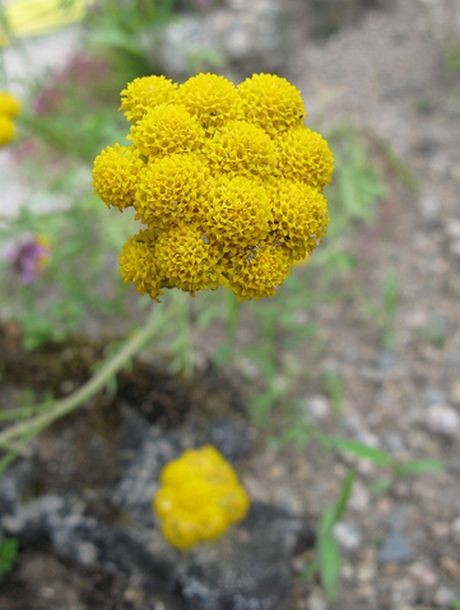
LATIN NAME: Lonas annua
COMMON NAME: Yellow Ageratum
Plant Profile
The German name Gelber Leberbalsam, “yellow liver balm,” is a complete misnomer, because Lonas annua is not a balm at all but a small yellow aster from the Mediterranean that buttons its flowers into tight golden spheres. What makes it a florist’s friend is that the clustered heads hold their colour and shape as they dry, so a summer cutting becomes a winter arrangement without any pressing. The plant is a monotypic genus, the only species in Lonas, and its airy mounds of gold read as a finer, warmer cousin of the blue ageratum it is often mistaken for in seed catalogues.
The plant is a bushy annual with finely divided, feathery grey-green leaves and dense rounded clusters of tiny golden-yellow disc florets, with few or no rays. Each head is a small dome that stays firm as it matures, and the whole plant forms a tidy mound 30 to 50 cm tall. The seed is slender and sheds freely when the heads are fully ripe, which is why a single planting can return along the edge of a warm bed for a second season.
The blue bedding ageratum belongs to a different genus, and though the two share a soft, clustered look, Lonas carries yellow button heads with a sharper, more open habit. The mistake in the name is old and persistent, which is why the German trade name survives on seed lists even though the botany is clear. Gardeners who expect blue and receive gold are usually pleased by the warmer tone once the plants are in bloom.
Science & Biotechnology
The aerial parts yield a small amount of volatile oil dominated by monoterpenes, and the plant has been screened in passing for antioxidant activity, but it is far less studied than the major ornamentals. Its real commercial value lies in the cut-dried market rather than in any extracted compound, and most research notes are taxonomic or horticultural. The dried head keeps its colour because the pigments are stable long after the moisture is gone.
Growers select for denser, more uniform heads and for a compact mound, and the seed is sold as a mixed or a selected strain for drying. Because the plant is an outbreeding annual, named strains are held by isolated seed increase rather than by cloning, and the open-pollinated forms show a gentle range in height that suits a natural mixed border.
Uses & Benefits
The clusters are cut just as they firm up and hung or stood to dry for winter work, where they keep a clean yellow for months. In the garden the plant fills the front of a sunny border and pairs with other small daisies and with cosmos for a loose, airy scheme that the bees visit all season. The muted gold also sits well among silver foliage, where the button heads read as tiny lights.
Unlike many everlastings that need a desiccant or a press, Lonas dries standing in the garden if the stem is cut at the right moment and hung in a dry, airy place. The colour holds with little fading, making it a dependable backbone for winter wreaths and dried posies. Growers often mix it with statice and with strawflower for a classic dried palette, though the airy habit of the golden button gives those heavier forms a lighter frame.
Growing from Seed
Broadcast the fine seed over the surface of a warm, free-draining bed after the chill leaves and thin to one plant every 15 to 20 cm once seedlings show four to six true leaves. The plant grows fast in warmth and dislikes cold, wet soil at the start, so a sunny, protected pocket gives the best stand and the earliest buttons.
Cut stems in the morning once the heads feel firm and before they fully brown, and strip the lower leaves before hanging. A second sowing a few weeks later stretches the cutting season into the cooler months, and the later stems often dry with a deeper, richer gold than the first flush.
Our Take
Yellow ageratum is my secret weapon for dried work, and the gold holds far better than most everlastings. For companions in the same airy style try the Kenikir Cosmos, the Cosmos bipinnatus, and the New England Aster.
Related Reading
Continue exploring with these related plants: