


Catananche caerulea Seeds | Cupid’s Dart
LATIN NAME: Catananche caerulea
COMMON NAME: Cupid’s Dart
Plant Profile
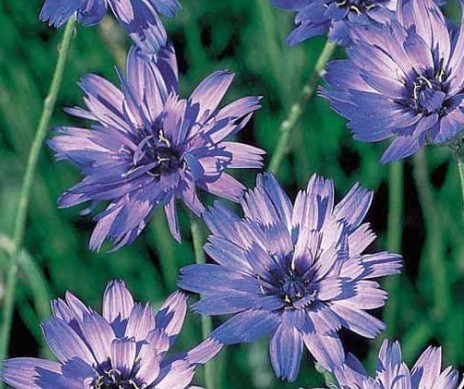
Most gardeners first read Cupid’s Dart as a blue cornflower, but the resemblance is a trick of the bracts. Catananche caerulea belongs to the dandelion tribe, Cichorieae, which means every floret in its head is a strap-shaped ligule and there is no central disc of tiny tubules at all. The plant fools the eye by wrapping those straps in a stiff, silvery, papery involucre that looks exactly like a cornflower’s helmet, and the effect is a flower that seems familiar until you count the parts.
In the Cichorieae the capitulum is built entirely from ligulate florets, each one a narrow ribbon tipped with five small teeth. Catananche pushes this further than most: the outer florets open broader and brighter, the inner ones stay smaller, and the whole head reads as a single layered star. The ovary below each floret swells into a slender achene, and because the tribe is consistently ligulate, the seed set is simple and uniform. This is the trait that separates the plant from true knapweeds, which carry two kinds of florets.
The involucral bracts are dry and chaffy from the moment they form, with a pale, almost metallic sheen. That dryness is why a cut stem keeps its shape and colour for months in a warm shed without any special treatment. The bracts also protect the florets as they open, so the head stays neat even in wind. Gardeners who dry flowers prize exactly this combination of papery case and lasting pigment.
Below the stems the plant makes a low rosette of narrow, linear, grey-green leaves that feel almost grass-like, while the flowering shoots rise on wiry, unbranched stems to roughly knee height. A slim taproot anchors the clump and carries a thin, milky latex when cut, another mark of the dandelion tribe. The latex is bitter and mildly defensive, which helps the plant hold its ground in a grazed hillside.
Beyond the botany, the plant earns its place as one of the most reliable dried flowers in the cottage and cutting garden. The papery heads hold their blue through the winter and mix well with other airy stems, while the open face is a standing cup for passing bees through the summer.
Cut the stems when the first florets have opened and hang them in a dry, airy place; the bracts keep their structure and the blue fades only slightly. The result is a stem that works in both fresh and dried arrangements, which is unusual for a true blue in the summer border.
Science & Biotechnology
The chemistry of the dandelion tribe shows up clearly here. The taproot stores inulin, a fructose polymer that stands in for starch in many Cichorieae, and the latex carries the tribe’s signature sesquiterpene lactones, bitter compounds such as lactucin and lactucopicrin that discourage herbivores and give the cut stem its characteristic acrid note.
These bitter lactones are not unique to Cupid’s Dart, but they mark the plant as a true member of the chicory alliance rather than a knapweed. Researchers screening Asteraceae for defensive chemistry routinely find the same lactone profile across the tribe, and Catananche fits the pattern. The compounds are the reason the foliage is left alone by most grazing animals.
Uses & Benefits
Once seedlings reach a few centimetres and show their first true leaves, thin them to stand as single plants with room to breathe, because crowded clumps invite crown rot. Keep a row of replacements going so the short-lived nature of the plant never leaves a gap in the border. Pair it with cornflower for a blue duet, with strawflower for the dried bouquet, and with China aster for late-season fullness.
Growing from Seed
Catananche caerulea is a plant of dry, open, sun-baked ground from the western Mediterranean basin. Its natural range runs through Portugal and Spain, along the southern French coast, into Italy, and across the strait to coastal north Africa, where it sits in garrigue, rocky clearings, and the poorer soils that hold little summer moisture.
In its home climate the plant is a dependable perennial, but gardeners in cooler regions treat it as short-lived, often refreshing the border from seed every couple of seasons. It dislikes wet, heavy ground in winter and will rot at the crown if drainage fails, which is why it travels north more successfully as a managed annual than as a permanent resident.
Cupid’s Dart is raised almost entirely from seed because the clump divides reluctantly and cuttings root slowly. The seed is fine and light-sensitive, so the method matters more than the calendar.
Press the seed onto the surface of a gritty, free-draining mix and keep it bright, since covering it deeply suppresses the seedlings. In the open ground choose the sunniest, poorest bed you have, and avoid rich soil that only encourages floppy growth.
Our Take
I treat Cupid’s Dart as a generous but temporary guest. Every other season I sow a fresh tray and tuck the seedlings into the sunniest gap, and the reward is months of a true blue that asks for almost nothing once it is up. If your soil holds winter wet, grow it on a raised ridge of grit and walk away, because it is far happier dry than coddled.
Related Reading
Gardeners who grow Cupid’s Dart often pair it with these related subjects: