


Bellis perennis Seeds | English Daisy
LATIN NAME: Bellis perennis
COMMON NAME: English Daisy
Plant Profile
The most enduring thing about the English daisy is its place in childhood: the small white-and-yellow heads picked by the hundred and threaded into chains, the flower held up to ask whether it loves or loves not. That folk life sits on top of a real and rather clever little plant that holds a lawn together with a flat rosette.
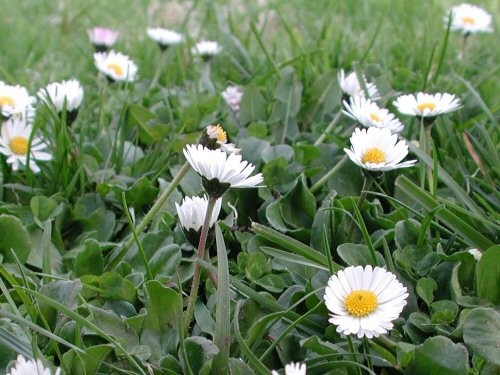
All the leaves sit in a low rosette pressed close to the ground, each one spoon-shaped with a rounded tip and a narrowing base. The rosette is the reason the plant survives mowing and foot traffic, because the growing point stays protected at the centre just above the soil.
Bellis perennis is native across Europe and has travelled with lawns and pastures to temperate regions everywhere. It is so at home in short turf that many gardeners meet it first as a weed of the grass, yet it is also one of the oldest cultivated border daisies.
Breeding has produced double and pompon forms such as the ‘Tasso’ and ‘Pomponette’ series, where the ray florets multiply into a quilled or buttoned head. These selections turn the humble lawn flower into a tidy bedding plant while keeping the same rugged constitution.
The species also varies in flower size and in the red flush of the rays, and breeders have selected both miniature forms for alpine pans and large-flowered types for bedding display. Whatever the form, the constitution stays tough, which is why the daisy moves so easily from lawn weed to show bench without losing its hardiness.
Science & Biotechnology
The plant carries triterpene saponins and sesquiterpene lactones typical of its tribe, along with flavonoid glycosides in the petals, and it has become a useful model for studying how a capitulum is assembled. The daisy is therefore both a chemical subject and a developmental one.
The yellow disc and the white rays both contain flavonoid glycosides such as apigenin derivatives, the pigments and protective compounds that colour the flower and shield it from light damage. These are the same broad class found across many white-and-yellow Asteraceae blooms.
Because the daisy packs two floret types into one head, it is a natural system for asking how a flower decides which florets become showy rays and which become the fertile disc. Researchers use Bellis to probe the gene networks that pattern the capitulum, much as others use related composites.
This developmental work also has a practical side for breeders, because understanding the ray-disc switch helps explain why some selections produce extra-quilled heads while others stay simple. The humble lawn daisy is, in other words, still teaching gardeners how a composite flower is built.
Uses & Benefits
The young leaves and flowers are edible and have been used in salads and as a traditional bitter green, while the plant itself makes a neat edging or a spring bedding block. Its small scale suits the front of the border and the edge of a path.
Picked in quantity, the small heads read as a cheerful scatter in a casual bouquet, and in the garden they knit together other spring bulbs and auriculas. The doubled forms hold their shape longest when cut.
Growing from Seed
Each head is a classic daisy: a ring of white ray florets around a dense golden disc of tiny tubular florets, sometimes tinted pink or red in selected forms. The rays are female and the disc is bisexual, a division of labour that packs both seed set and show into a single small capitulum.
Grow the daisy in the moist, ordinary soil it likes, in sun or light shade, and raise it from the fine seed sown on the surface. It is forgiving of the average garden bed and asks mostly for even moisture.
Divide established clumps in the cool part of the year, replanting the outer rosettes into fresh ground to keep the patch young and floriferous. Division is the quickest way to increase a named form and to refresh a tired centre.
Thin the fine seedlings once they carry a clear pair of leaves, keeping the strongest spaced so the rosettes develop fully rather than competing. Good Asteraceae companions include calendula, ox-eye daisy, and China aster.
Our Take
I let English daisies edge the paths where their rosettes shrug off the mower and the foot, and I lift a few doubles each spring for the house. They are about as undemanding as a flower gets, asking only for moisture and a little division now and then.
Related Reading
Continue exploring with these related plants: