


Calendula officinalis ‘Calypso Series’ Seeds | Calypso Calendula
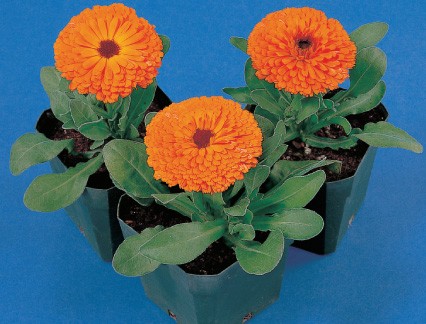
LATIN NAME: Calendula officinalis ‘Calypso series’
COMMON NAME: Calypso Series Calendula
Plant Profile
Most bedding calendulas open a loose, open-centered daisy and call it a flower. The Calypso Series does something sharper: it stacks a ring of glowing orange ray florets around a disc that reads almost chocolate-brown, and it does so on every plant in the row at the same moment. That repeatable look is the reason the series holds a place in catalogues beside the older cottage types.
The central disc of a Calypso head is packed with hundreds of tiny tubular florets that mature from lemon yellow at the rim to a deep brown toward the centre, so the eye reads the whole disc as chocolate. The surrounding ray florets are a saturated orange, sometimes with a paler band at the base, and they stand flat rather than drooping. The contrast is what separates Calypso from the paler, uniform gold of many old pot marigolds.
Unlike the loose, reflexed rays of many open-pollinated pot marigolds, the Calypso rays keep their tips slightly rolled inward, which gives the bloom a fuller, more constructed look. This trait is fixed in the hybrid and shows up whether the plant is grown cool or warm, so the flower reads as a single designed shape rather than a casual daisy.
The orange colour lives almost entirely in the ray florets, where carotenoid pigments accumulate in the plastids. The green leaf carries chlorophyll and only trace carotenoids, so the colour you see in the petal is not a leaf trait at all but a floral one.
Science & Biotechnology
Beyond colour, the petals hold triterpene esters built around faradiol and arnidiol, compounds that have drawn steady pharmacological interest for their soothing behaviour on skin. Calendula flower extracts standardized to these esters are the basis of many skin salves, and the Calypso petal carries the same chemistry as its open-pollinated relatives despite its showier form.
Holding that chemistry and the flower form together takes disciplined breeding. The parent lines are selfed for generations until they breed true, then crossed; the hybrid seed is what the grower buys, and saving seed from a Calypso plant will not return a Calypso plant the next season because the uniformity breaks apart in the second generation.
Uses & Benefits
The Calypso Series is sold as a uniform F1 hybrid, which means every plant in a pack carries the same growth habit, the same flower size, and the same orange-over-dark-eye colour pattern. This uniformity is the point: the line was built for the bedding and cut-flower trade, where a mixed tray of uneven plants sells poorly. Two inbred parent lines are crossed to make the seed, and the first-generation plants show hybrid vigour while keeping the flower form steady.
Calypso is short and sturdy enough for the front of a border, yet its stems are long enough to cut. That dual role is what keeps the series in demand among growers who want one crop for both the bed and the bucket.
The papery ray florets keep their orange for a long stretch once cut, and the dark disc keeps the arrangement from looking washed out. For a cut-flower bench the stems are taken when the first ring of disc florets has opened, not before, so the head finishes opening in water.
Compared with the plain pot marigold grown for petals and the Erfurter type raised for dried herb, Calypso is the showy bedding sister. It trades some petal mass for a cleaner, more marketable flower that photographs well and ships without bruising.
Growing from Seed
The seed is small and flattened, and it wants light to sprout, so it is pressed onto the surface of a fine, moist seedbed rather than buried. A cool glasshouse or a shaded outdoor bench in spring gives the steadiest stand and the least stretch in the seedlings.
Seedlings are moved to individual pots once the second pair of true leaves is clear, because calendula resents a cramped root run. From there they go to the border when they have filled the pot with roots and the risk of a cold snap has passed.
The soft, glandular-hairy leaves that give calendula its resinous smell also attract aphids and, in damp weather, powdery mildew. Good air flow and a dry leaf surface are the simplest defence, and a sunny site keeps the foliage from staying wet overnight.
Our Take
I grow Calypso where I want a reliable block of colour that also cuts, and I treat it as the ornamental face of a genus better known for the apothecary. For the open-pollinated parent and the dried-petal forms, see our pieces on Calendula officinalis and the Erfurter type; the field marigold and French marigold round out the daisy border.
Related Reading
Gardeners who grow Calypso Series Calendula often pair it with these related subjects: