


Echinacea purpurea Seeds | Purple Coneflower
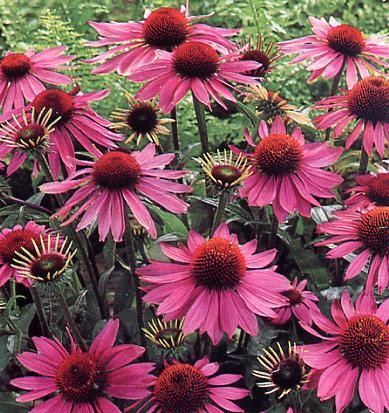
LATIN NAME: Echinacea purpurea
COMMON NAME: Purple Coneflower
Plant Profile
Purple coneflower is a prairie plant from the central United States, and it grows accordingly: a deep, fleshy root, coarse leaves, and stems that stand 60-120 cm without staking. The flower head is a composite, with drooping rose-pink ray florets around a raised, spiny cone that starts green, turns orange-brown and darkens as it ages. Echinacea purpurea is the most adaptable of the genus and the easiest to grow in a wetter climate than its homeland.
The plant is long-lived but slow to establish. The first year is mostly root; flowering starts properly in the second season and peaks in the third and fourth, after which a clump can carry thirty stems. Plants in the wild are found on limestone and in prairie remnants, which explains why they want full sun and object to being crowded.
Science & Biotechnology
Echinacea is the most clinically tested immune herb in the world, and the evidence is genuinely contested rather than settled. A widely cited meta-analysis of fourteen studies reported about 58 per cent lower odds of catching a cold and roughly 1.4 days shorter illness. A Cochrane review of twenty-four trials found no statistically significant prevention effect and at most weak benefit for some preparations. Both are defensible readings of the same literature, and the discrepancy comes down to which products were tested.
Three groups of compounds carry the research: lipophilic alkamides, caffeic-acid derivatives such as chicoric acid, and water-soluble polysaccharides. Which fraction dominates depends on species, plant part and how the material was extracted, and a tincture of the root is chemically not the same product as a pressed juice of the aerial parts. Germany’s Commission E approved E. purpurea herb for supportive treatment of colds and the EMA maintains a monograph; allergic reaction in people sensitive to the daisy family is the main safety concern.
Uses & Benefits
In the border it is a backbone plant rather than a novelty. Coneflowers hold their shape through August, tolerate heat and drought once rooted, and the seed heads stay standing into winter, which is worth more to birds than most gardeners realize. Goldfinches work them systematically in autumn.
The flowers are also unusually good for pollinators because the cone is a platform, and the nectar is accessible to short-tongued bees as well as butterflies. Medicinally the root and aerial parts are used in tinctures and teas, and the plant has become a standard subject in tissue-culture and phytochemistry teaching because it responds predictably in vitro.
Growing from Seed
Coneflower seed germinates best after a cold, moist period. Mix it with damp sand, refrigerate for four to six weeks, then surface-sow onto a free-draining mix at 20-25°C; light helps, so press the seed in without covering it. Germination runs from ten to twenty-one days, and it is uneven even with stratification.
Pot the seedlings on into deep containers, since the plant builds a substantial taproot and resents root disturbance later. Plant out in spring or early autumn, 40-50 cm apart, in full sun. Water through the first summer and then leave them alone: established plants are drought-tolerant, and too much richness produces floppy stems that need staking.
Our Take
Grow it as a garden plant first and a remedy second, and it will not disappoint. The herbal claims are interesting and unresolved; the plant’s performance in a hot, dry border is neither.
Related Reading
More species in the same orbit as Purple Coneflower: