


Cosmos sulphureus Seeds | Kenikir
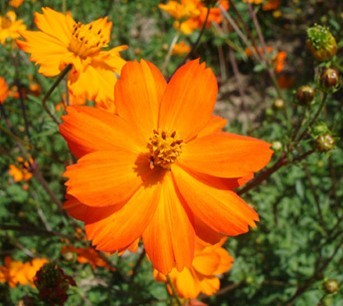
LATIN NAME: Cosmos sulphureus
COMMON NAME: Kenikir
Plant Profile
Where the tall, pale Cosmos bipinnatus fills cottage borders with pastel pinks, Cosmos sulphureus brings a hotter palette: clear yellow, gold, orange, and red, often in the same seed mix. The regional name kenikir travels with this plant through Southeast Asian markets, where the same genus is also grown as a leafy green in related species.
This is a heat-loving annual that flowers without pause once the weather warms, and it asks for little beyond sun and a freedraining root run. Its strength is exactly that reliability through the hottest part of the year.
The leaves are pinnately divided into narrow leaflets, giving a fine, airy texture that keeps the plant from looking heavy despite its height. The wiry stems hold the open-faced flowers well above the foliage, which is what makes the colour read from across the garden.
The flower head is an open-centered daisy with a ring of ray florets around a small disc, never the shaggy double of some bedding types. The disc often darkens as it matures, adding a bit of contrast to the bright rays that give the species its common name.
The open discs are built for butterflies and bees, and a drift of sulphureus will pull in more winged visitors than many frillier flowers. The stems are also long enough to cut, so the plant serves the border and the vase from one sowing.
A drift of sulphureus also makes a good backdrop for lower annuals, because its fine foliage does not crowd neighbours and its height gives the border a finished edge. Cut a few stems and the rest of the row barely notices, which suits a picking garden where the beds are raided weekly.
Science & Biotechnology
The yellow and orange colour comes from carotenoid pigments in the ray florets, while flavonoid glycosides of the luteolin and apigenin type add to the chemistry of the petal. These are the compounds that give the flower both its hue and its share of antioxidant interest in extract studies.
The aerial parts carry a light essential oil dominated by monoterpenes such as alpha-pinene, beta-pinene, and limonene, with ocimene adding a sweet lift. The scent is faint on the warm border but becomes clear when a stem is crushed, and it is part of what draws the insect visitors.
Laboratory studies of the petal extract report measurable antioxidant and antimicrobial activity, which keeps C. sulphureus in the phytochemistry literature alongside its showier garden relatives. The work centres on the same flavonoids and pigments that colour the bloom.
The same extracts that draw laboratory attention also explain the plant’s traditional use as a wash and a poultice in parts of its native range, though the garden grower is more likely to meet the chemistry as the faint scent released when a stem is bruised.
Uses & Benefits
In parts of Southeast Asia the young leaves and flowers of Cosmos species are cooked as a vegetable, and the name kenikir is attached to that use in the market. The close relative Cosmos caudatus is the more common leafy form, but the orange-flowered species shares the regional kitchen tradition.
The leaves carry the same aromatic, slightly bitter note as the flower and are cooked young so the texture stays tender, a practice that turns a border plant into a genuine dual-purpose crop in tropical and subtropical home gardens.
Sulphureus sits naturally with other warm-season daisies: French marigold for the front, zinnia for the middle, and sunflower for the back. Together they make a long-blooming, heat-proof band that needs little attention once established.
Growing from Seed
The seed is sown once the soil has warmed, pressed lightly into a fine surface because it needs light to sprout. A warm bed brings a quick, even stand, while a cold one simply rots the seed in the ground.
Seedlings are moved to the border when they have reached a workable height and the risk of cold has passed, because cosmos resents a check at the root. Set out by measured height rather than by a fixed calendar date, and they establish without a stall.
Spent heads are removed regularly so the plant keeps pushing new buds instead of putting energy into seed. In heat and sun the response is dramatic: a well-deadheaded row of sulphureus flowers almost continuously until the first cold.
Our Take
Kenikir is my hot-weather workhorse for colour that does not quit. Grow it with Cosmos bipinnatus for contrast, and fill the rest of the daisy border with French marigold, zinnia, and sunflower.
Related Reading
Readers interested in Kenikir frequently explore these as well: