


Glebionis coronaria Seeds | Garland Chrysanthemum
LATIN NAME: Glebionis coronaria
COMMON NAME: Garland Chrysanthemum
Plant Profile
In Japan the leafy form is called shungiku and treated as a vegetable first and a flower second. The same plant that brightens a border with yellow daisies is pulled young for the hotpot, the stir-fry, and the salad, which makes it one of the rare garden chrysanthemums grown more for the leaf than the bloom.
The species straddles two worlds: in the Mediterranean it is a wild wayside daisy, while in East Asia it is a market green with named leafy cultivars. That split identity is the most interesting thing about it, because the flower and the vegetable are the same organism.
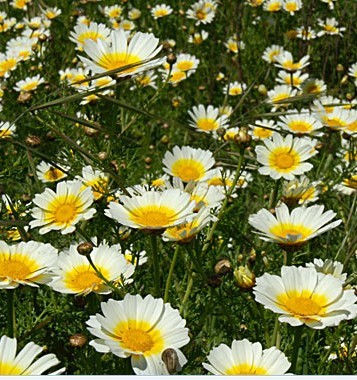
The flower head is a true daisy with a yellow disc and yellow to golden ray florets, sometimes near white in a few forms, but the classic type is all yellow. The open-centered head is single or semi-double and sits above the leafy stem through the cool season.
The Cantonese-market form known as Tong Ho is a selected leafy type of this same species, grown for a broader, more tender leaf. It sits in the same genus as the corn marigold Glebionis segetum, a close wild relative with a similar look.
Glebionis segetum, the corn marigold, shows the same yellow daisy on a leaner wild plant, and the two are easy to confuse in flower until you note the cultivated form’s broader, more deeply cut leaf and its willingness to be cut repeatedly.
Science & Biotechnology
The aroma and the slight bitterness come from sesquiterpene lactones, with coronopilin and related arteglasin-type compounds among the markers of the species. These molecules are the chemical signature that gives shungiku its characteristic bite and that researchers measure in the leafy extracts.
The bitter lactones concentrate in the mature leaf and the flowering stem, which is why very old growth tastes sharper than young shoots. Growers time the cut to the tender stage, before the compounds build and the stem turns stringy.
Alongside the lactones, the shoot carries flavonoid glycosides such as acacetin- and luteolin-type compounds, plus a useful load of beta-carotene and mineral content that makes the green more than a flavouring. This is part of why it holds a place in the kitchen garden rather than only the flower bed.
Uses & Benefits
The leaves are deeply lobed and feathery, almost fern-like, and they carry a distinctive aromatic, slightly sage-and-chrysanthemum scent when crushed. The flavour is what defines the cooked green and what sets it apart from blander salad leaves in the wok.
The plant’s journey from a Mediterranean wayside weed to an East Asian vegetable is a long one, carried by trade and by the appeal of its cooked leaf. Today it is as likely to be found in a market in Seoul or Guangzhou as on a Greek roadside.
In the kitchen the young shoots go into nabemono hotpots, Korean ssam wraps, and quick stir-fries, while the petals are scattered as a slightly bitter garnish. The leaf is cooked rather than eaten raw in quantity, because heat softens both the fibre and the strongest lactone bite.
Growing from Seed
The seed is fine and is sown on the surface of a moist, freedraining bed, then kept lightly covered with grit. A cool part of the season suits it best, because heat pushes the plant to flower and toughens the leaf sooner than the cook would like.
For a continuous pick the outer leaves are taken with a scissors and the central crown is left to keep producing, a cut-and-come-again habit that stretches the harvest. This also delays the moment the plant bolts and turns bitter.
As the days lengthen and warm, the plant shifts from leaf to flower and the stems lengthen; once that happens the leaf quality drops. Succession sowing through the cool months is the simple way to keep tender shoots on the table.
Because the plant is grown for the leaf first, many gardeners never let it flower, cutting it back hard to force a fresh flush of tender growth. Left to bloom, though, it still earns its place as a cheerful yellow daisy that ties the edible patch to the ornamental one.
A second cut often follows the first within a few weeks, giving the cook a steady supply through the cool months and keeping the plant in its tender, pre-bolt stage for longer.
Our Take
I grow shungiku for the wok before the flower, and I succession-sow to stay ahead of the bolting. The wild and leafy kin are worth knowing: Glebionis coronaria seed, corn marigold, Chrysanthemum morifolium, and the Tung Ho form.
Related Reading
Continue exploring with these related plants: