


Verbena officinalis Seeds | Vervain
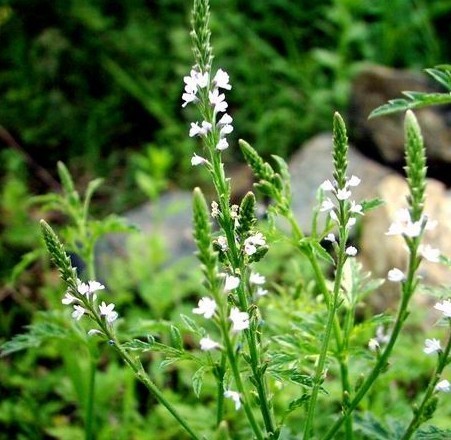
LATIN NAME: Verbena officinalis
COMMON NAME: Vervain
Plant Profile
Vervain was the sacred plant of the Roman state, gathered by the attendant of the fetial priests and used to dress the altar before a treaty or a war. Pliny records it being carried in processions and laid on the table of hospitality, and the same plant turns up in Druidic and Christian lore as a herb of the cross. Verbena officinalis is a wiry wayside weed with small pale flowers, yet few plants carry a heavier load of ritual history than this one, and its chemistry finally explains why it was kept close: the bitter iridoids it carries are exactly the sort that calm the gut and the nerves.
The plant is an erect, branching perennial with rough, deeply cut leaves and slender spikes of tiny five-lobed flowers in lilac or white that open a few at a time from the base upward. The stem is square in section, a mark of the family, and the whole plant is sparsely hairy and bitter to the touch. The small nutlets fall near the parent when ripe, which is why the plant forms steady colonies along the edges of paths and fields.
Verbena officinalis is the wild, medicinal species with narrow spikes, unlike the bedding Verbena hybrida with its flat colourful clusters, and unlike the tall Verbena bonariensis with its airy violet plates. The three share the square stem but differ sharply in flower shape and in how they are used, and only the wild species carries the verbenalin that traditional medicine relied upon.
Science & Biotechnology
The aerial parts hold verbenalin and hastatoside, iridoid glycosides that give the herb its characteristic bitter note and that are the standard markers for identity and quality. Extracts are examined for mild sedative and antioxidant activity in lab models, continuing the traditional use of the plant as a calming infusion. The volatile oil is low-yield and not a commercial perfume source, so the herb is valued for the dried leaf and flower rather than for any distilled product.
Because the marker content swings with harvest time, work on the dried herb measures iridoid levels to set a specification for tea and tincture. Clonal lines have been raised in research to hold a steadier chemistry than open-pollinated field lots, and growers are advised to cut the aerial parts at the early-flower stage when the iridoid concentration is at its peak.
Uses & Benefits
The herb was a staple of old European polypharmacy and appears in countless household receipts for teas meant to steady the nerves and settle the stomach. Its bitter principle is mild enough that the infusion is pleasant rather than medicinal in taste, which helped it persist in folk use long after the formal pharmacopoeias dropped it. Modern growers value the plant as much for that continuity as for any measured effect.
The dried aerial parts are used as a mild tea and as a component of traditional bitters, while the plant itself is grown in the herb garden and the wild patch for its history as much as its look. It pairs with other bee plants and with low perennials, and the small flowers feed solitary bees through the season. A few stems dried and hung keep their subtle scent in the house through the winter.
Growing from Seed
Sow the fine seed on a lean, free-draining surface in spring and thin to one plant every 25 to 30 cm once seedlings reach 8 to 10 cm. The plant likes full sun and tolerates poor ground, so avoid rich feeding that only pushes soft, floppy growth. A gravelly, well-drained bed gives the most compact and floriferous plants.
Cut the spikes back as they fade to push a fresh flush of slender stems, and lift and replant the crown every few seasons when the centre shows signs of tiredness. The plant self-sows along the edge of the bed where the soil is bare, and the seedlings are easy to move while still small.
Our Take
Vervain earns its spot by story as much as by flower, and I keep a row near the bee patch for both. For more of the family, the Blue Vervain and the Verbena bonariensis extend the season, and the Red Valerian shares its love of hot, lean ground.
Related Reading
Gardeners who grow Vervain often pair it with these related subjects: