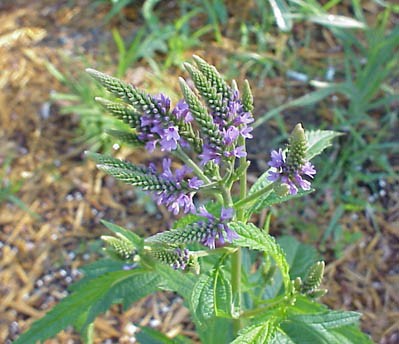
Verbena hastata Blue Vervain
.jpg)
LATIN NAME: VERBENA HASTATA
COMMON NAME: Blue Vervain, Simpler’s Joy
The blue vervain is a tall and graceful herb of the damp meadows, and its slender, candelabra-like spikes of the blue-purple flowers have made it a treasured plant of the wild garden. It grows as an upright, branching, herbaceous perennial of the verbena family, reaching up to a metre and a half or more, with upright, square, branching stems bearing opposite, narrow, lance-shaped, toothed, dark-green leaves and, from the mid-summer into the autumn, the tall, upright, candelabra-like spikes of the many small, five-petalled, blue-purple flowers, followed by the small, dry nutlets. It is a species of the flowering herb, native to the damp meadows and the stream banks of North America, while it is grown for its tall, graceful spikes and its long history of use in the traditional ways of the region, and it is known as the blue vervain.
Scientific Research & Plant Biotechnology
The blue vervain has a real and distinguished place in research. It has been studied in the chemistry of natural products and the traditional use, since the blue vervain has a long history of use in the traditional medicine of the native peoples and the settlers of the region, and the researchers have examined the plant and its constituents, while the traditional uses of the blue vervain have drawn attention in the international pharmaceutical and botanical press, and the study of the blue vervain and its chemistry has been of continuing interest, and the plant is best appreciated as a subject of study and a graceful flower of the meadow rather than a casual remedy. The plant has also been studied in botany and ecology, since it is a native of the damp meadows and the stream banks of North America, and its relationships, its distribution and its role in the wild have been examined, while the ecology of the meadow herbs has been of continuing interest, and the tall, candelabra-like spikes of the blue-purple flowers have been of the greatest interest to the botanists and the bees alike. The species has also been studied in the horticulture and the value of the flowers to the wildlife, since the blue vervain is one of the finest of the meadow plants of the garden, and the researchers have examined its value in the wildflower garden, while its tall, graceful spikes have drawn attention in the international horticultural press. For a plant of such graceful value, the blue vervain has a rich and distinguished record of research.
Ecological & Economic Value & Wide Applications
To grow the Blue Vervain from seed, ecologically, the blue vervain is a generous plant of the garden. Its tall, candelabra-like spikes of the blue-purple flowers feed the bees, the butterflies and the many insects of the late summer, and its small, dry nutlets feed the birds, while its tall, leafy growth gives a fine cover and a shelter to the small creatures, and its graceful, blue spikes have made it a treasure of the wildflower meadow. Its economic value is real: the blue vervain is prized for its tall, graceful spikes and its long history of use in the traditional ways of the region, and its value has drawn attention in the international pharmaceutical and botanical press, while its value in the wildflower garden has also made it a friend of the meadows of the world. To raise the blue vervain, sow the fine seeds into pots of moist, free-draining compost in an open, sunny place, keep them lightly watered, and grow the little plants on in the sun.
sow the fine seeds into pots of moist, free-draining compost in an open, sunny place, keep the young vervains lightly watered, and grow the little plants on in the sun.
LATIN NAME: Verbena hastata
COMMON NAME: Blue Vervain
The blue vervain is a tall, stately, upright perennial of the damp meadows, and its slender, wand-like spikes of the small, blue-violet flowers have made it a valued plant of the wildflower garden. It grows as a perennial herb, reaching up to a metre and a half or more, with the tall, erect, square stems bearing the opposite, lance-shaped, sharply toothed leaves and, through the summer, the slender, upright, branched spikes of the many small, blue-violet flowers, opening from the base upwards, followed by the small, dry nutlets. It is a species of the flowering plant in the verbena family, and it is native to the central and the eastern North America, while it grows in the damp meadows and the water margins, and it is known as the blue vervain.
The blue vervain belongs to the verbena family, Verbenaceae, and it is a species of the perennial herb, native to the central and the eastern North America, while it grows in the damp meadows, and it is known as the blue vervain. It is prized for its tall, stately spikes of the blue-violet flowers and its value in the wildflower garden.
Scientific Research & Plant Biotechnology
The blue vervain has a real and growing place in the research. It has been studied in the horticulture, since its tall, stately spikes of the blue-violet flowers have made it a valued plant of the wildflower garden, and researchers have examined its growth, its flowering and its cultivation, while its stately bloom has drawn attention in the international horticultural press as a plant of the wildflower garden. The plant has also been studied in the botany and the ecology, since it is a native of the damp meadows of the North America, and its relationships, its distribution and its role in the meadow have been examined, while the ecology of the meadow plants of the region has been of continuing interest, and the study of the wildflowers has been of value to the gardeners. The species has also been studied in the chemistry of the natural products and the traditional use, since the aerial parts of the blue vervain have a long history of use in the folk ways of the region, and researchers have examined the plant and its constituents, while the traditional uses of the vervains have been of continuing interest, and the plant is best appreciated as a subject of study and of the garden rather than a casual remedy. For a plant of such stately charm, the blue vervain has a rich and continuing record of study.
Ecological & Economic Value & Wide Applications
Ecologically, the blue vervain is a generous plant of the garden. Its slender, wand-like spikes of the blue-violet flowers feed the bees, the butterflies and the many insects, and its tall, leafy stems give a fine presence to the damp meadow and the back of the border. In the wildflower meadow it stands tall among the grasses, its blue-violet spikes drawing the bees all through the summer.
Its economic value is real. The blue vervain is prized for its stately, long-flowering spikes, and its value has drawn attention in the international horticultural and ecological press as a plant of the wildflower garden, while its tall, upright habit has also made it a valued back-of-border plant. For a grower, the blue vervain is an easy and rewarding plant, and for a gardener it brings a tall, stately, blue-violet bloom through the summer. The seeds are easy to start — press them gently into the surface of moist, free-draining compost in the light, keep them lightly watered, and theyll be sprouting readily, growing on into a tall, stately, blue-violet-flowered plant.
oil Medicinal
Blue Vervain has a calming, relaxing effect on the system which aids in breaking down obstructions and with a stimulating effect helps to expel waste from the system. It is reported to have particular influence over the nervous system, being both sedative and restorative in affect.
Blue Vervain, as with so many other of the herbal remedies dates back in time of use to ancient times. The root was used for malaria and dyentery in China, they used the stalk and leaves for blood conditions and for relieving congestion and helping to cleanse out body toxins.
Blue Vervain was used as a cure all and by some as being a sacred plant. The leaves of the Blue Vervain were used to make a tea by the American Indians as a female tonic. They also used it for colds, fevers, and complaints of bowel problems.
*Blue Vervain is a quieting herb that helps calm coughing and is a natural tranquilizer.
*Blue Vervain is a mild laxative, causes perspiration and has the over-all effect of inducing relaxation.
*Blue Vervain has the ability to alleviate fevers, settle the onset of a cold, especially with upper respiratory inflammation of the lungs.
*Blue Vervain will aid in expelling phlegm from the throat and chest.
*Blue Vervain is helpful at expelling worms and often works where other remedies fail