


Aquilegia vulgaris Seeds | European Columbine
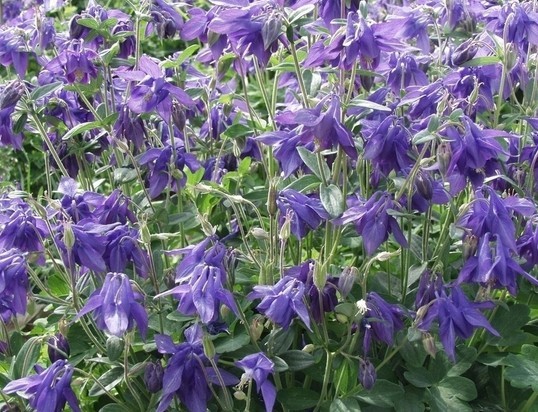
LATIN NAME: Aquilegia vulgaris
COMMON NAME: European Columbine, Granny’s Bonnet
Plant Profile
Columbine is a short-lived perennial that behaves like a generous self-sower, so a planting perpetuates itself year after year. The leaves are finely divided and blue-green, with a soft, almost fern-like texture that looks good long before the flowers appear. The plants form low clumps from which the wiry flowering stems rise and nod their spurred blooms in shades of blue, purple, pink or white.
No other common border plant has the combination of rounded, divided leaves and backward-pointing nectar spurs, which makes columbine easy to tell from lesser impostors in the cottage garden. The spurred flower is the single reliable field mark, and gardeners use it to separate true Aquilegia from the many look-alikes that lack the tails.
Breeders have pushed columbine far beyond the wild blue, producing doubles, bi-colours and forms with quilled or ruffled spurs. The double-flowered sorts lose the open nectar access that bees rely on, so they are grown for show rather than for the pollinator border. Seed saved from a mixed planting will not come true, which is why named colours are raised from selected stock rather than from the open-pollinated row.
Botanists treat the columbine spur as a textbook case of pollinator-driven evolution, because the length and shape of the nectar tube track the tongue length of the bees and hummingbirds that visit each species. Aquilegia vulgaris, with its moderate spurs, sits among a radiation of European and North American species that diverged largely by tuning this one floral part. That makes the common columbine not just a pretty border plant but a living example of how a single structure can drive the splitting of a whole genus.
Science & Biotechnology
Inside each flower the stamens mature and present their pollen in a staged sequence, so a bee working the spurs picks up fresh pollen on each visit while the receptive stigma waits its turn. This tidy separation of sex roles within one bloom reduces self-pollination and keeps the seedling population varied, which is part of why columbines hybridise so freely in the garden.
Uses & Benefits
The columbine’s flowers are a puzzle with a purpose. Each blossom carries five hollow spurs trailing behind the petals, and those spurs are not decoration but nectar reservoirs shaped for a specific visitor: the long-tongued bumblebee that can reach the sweet drop at the tip. A short-tongued insect simply cannot, which is why the flower’s architecture quietly selects its pollinator. The spurs also give the plant its common name, since the clustered nectar horns were said to resemble a ring of doves, columba in Latin.
Columbine has been grown in European gardens since the Middle Ages, prized as much for its curious spurred shape as for its colour. Medieval gardeners valued it among the few reliable spring perennials, and it appears in period herbals and illuminated borders as a flower of the enclosed garden. The plant’s willingness to self-sow meant it moved easily from one cottage plot to the next, carrying its mixed blues and pinks along lanes and hedgerows without needing a gardener’s hand.
Growing from Seed
Dust the dust-fine seed over the surface of a cool, shaded seedbed and press it in without covering, since the seed needs light to stir. Keep the medium evenly moist and shaded while it sits, and resist the urge to bury it. The slow, fine emergence is normal, and a second sowing improves the odds of a strong batch.
Once seedlings have made two pairs of true leaves, move them to their final spacing while they are still small, because columbine resents root disturbance once established. Set them into soil that stays cool and moist but drains, with a little leaf mould to echo the woodland edge they favour.
Young columbine foliage is a favourite of slugs, so watch the spring border and protect new clumps. Leaf miners can also trace pale tunnels through the leaves; pick and dispose of affected foliage rather than composting it. Given a cool root and an open top, the plants shrug off most trouble and flower freely.
Our Take
For a different species in the same genus, see Aquilegia viridiflora, and for other cottage-garden verticals try black hollyhock or the double hollyhock. A late bee plant such as wild bergamot rounds out the border.
Related Reading
More species in the same orbit as European Columbine: