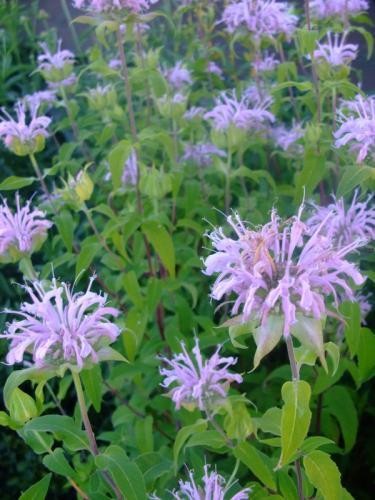
Wild Bergamot Monarda fistulosa
.jpg)
LATIN NAME: MONARDA FISTULOSA
COMMON NAME: Wild Bergamot, Bee Balm
The wild bergamot is one of the finest of the flowers of the prairie, and its lavender-pink, ragged blooms and its aromatic leaves have made it a treasured plant of the wild garden. It grows as an upright, clump-forming, aromatic perennial of the mint family, reaching up to a metre and a half or more, with upright, square, branching stems bearing opposite, oval, pointed, toothed, grey-green leaves, which give the scent of the bergamot when bruised, and, in the mid-summer, the many small, tubular, two-lipped, lavender-pink flowers in the ragged, round-topped clusters at the tops of the stems, followed by the small, dry nutlets. It is a species of the flowering herb, native to the prairies and the open woodlands of North America, while it is grown for its fine flowers and its aromatic leaves, and it is known as the wild bergamot.
Scientific Research & Plant Biotechnology
The wild bergamot has a real and distinguished place in research. It has been studied in the ecology and the study of the prairies, since the wild bergamot is one of the great flowers of the North American prairie, and the researchers have examined its growth, its place in the prairie ecosystems and its value in the restoration of the native meadows, while the study of the prairie flowers has drawn attention in the international ecological and botanical press, and the wild bergamot has been a fine model in the study of the meadow. The plant has also been studied in the chemistry of the essential oils, since the aromatic leaves of the wild bergamot give the scent of the bergamot, and the researchers have examined the leaves and their oil, while the value of the aromatic leaves has drawn attention in the international food and botanical press, and the leaves have a long history of use in the traditional ways of the region, and the plant is best appreciated as a subject of study and a fine flower of the meadow rather than a casual remedy. The species has also been studied in botany, since it is a native of the open woodlands of North America, and its relationships and its many forms have been examined, while the ragged, round-topped clusters of the lavender-pink flowers have been of interest to the botanists. For a plant of such fine value, the wild bergamot has a rich and distinguished record of research.
Ecological & Economic Value & Wide Applications
To grow the Wild Bergamot from seed, ecologically, the wild bergamot is a generous plant of the garden. Its ragged, round-topped clusters of the lavender-pink flowers feed the bees, the butterflies and the many insects of the mid-summer, and its small, dry nutlets feed the birds, while its aromatic, leafy growth gives a fine cover and a shelter to the small creatures, and its long, late bloom has made it a treasure of the meadow garden. Its economic value is real: the wild bergamot is prized for its fine flowers and its aromatic leaves, and its value has drawn attention in the international ecological and botanical press, while its value in the restoration of the native meadows has also been of the greatest interest, and the plant is a beloved friend of the wild garden. To raise the wild bergamot, sow the fine seeds into pots of moist, free-draining compost in a bright, sunny spot, keep them lightly watered, and grow the little plants on in the sun.
sow the fine seeds into pots of moist, free-draining compost in a bright, sunny spot, keep the young wild bergamot lightly watered, and grow the little plants on in the sun.
LATIN NAME: Monarda fistulosa
COMMON NAME: Wild Bergamot, Bee Balm, Horse Mint
Wild bergamot is a flower of the North American prairie, and its shaggy, lavender bloom is one of the great sights of the summer meadow. It grows as a tall, branching perennial of the mint family, reaching a metre or more, with square stems, aromatic, toothed, green leaves and, from midsummer, showy clusters of tubular, pink to lavender flowers, each cluster topped with a paler collar of bracts. The flowers are a magnet for bees, hummingbirds and butterflies, and the aromatic leaves have a long history of use as a tea and in traditional medicine. It is a tough, generous plant of the open prairie.
Wild bergamot belongs to the mint family, Lamiaceae, and it is widespread and abundant as a native plant across much of North America. It is grown as a honey plant, a medicinal plant and a garden ornamental, and despite its name it has no relation to the citrus bergamot.
Positive & Encouraging Seed Germination Guide
Growing wild bergamot from seed is easy and very rewarding. The seeds are small and germinate best after a period of cold, moist conditions, so sow them in pots of seed compost in autumn and leave them outdoors through winter, or chill them in the fridge for a month first, then bring them into warmth and light. Germination usually begins within two to four weeks. Pot the seedlings on as they grow and plant them out in a sunny spot in well-drained soil. The plants are hardy and drought-tolerant, and within a season they will reward you with their shaggy lavender bloom.
Scientific Research & Plant Biotechnology
Wild bergamot has a genuine and growing place in both ethnobotanical and chemical research. The aromatic leaves have been used by indigenous peoples of North America for centuries as a tea and in traditional medicine, and researchers have studied the plants chemistry, identifying the volatile oils and other compounds that give it its scent and its traditional uses, including thymol and related substances, which have been studied for their potential antimicrobial and other biological activity. The plant has also been studied in ecology, since it is an important native flower of the North American prairie and a valuable nectar plant for bees, hummingbirds and butterflies, making it of interest in research on pollinators and their conservation. In horticulture, wild bergamot has been studied for its cultivation and its value in prairie and wildflower gardens. For a flower of such beauty and such usefulness to both people and pollinators, wild bergamot has a bright and growing record of research.
Ecological & Economic Value & Wide Applications
Ecologically, wild bergamot is a keystone of the prairie. Its lavender flowers feed bees, hummingbirds and butterflies through the summer, and its aromatic foliage adds to the rich life of the open meadow, while its tough, spreading growth gives shelter for insects and small animals.
Its economic value is real and varied. It is a beloved garden ornamental, grown for its shaggy lavender bloom and its value in prairie and wildflower gardens, and it is a valuable honey plant, while the aromatic leaves are used as a tea and have a long history of use in traditional medicine. For a grower, wild bergamot is a beautiful and useful plant, and for a gardener it brings the shaggy charm of the prairie and a magnet for bees and butterflies.
Wild Bergamot Monarda' is an upright growing plant which spreads out, it haqs lovley pink-violet blossoms and distinctively aromatic folage. Drought tolarent, grows well allmost snyplace.
Culinary/Medicinal/Beverage/Aromatic/Industrial Lavender flowers; strong fragrance. Used for tea and for flavouring meat.