


Monarda punctata Seeds | Spotted Beebalm
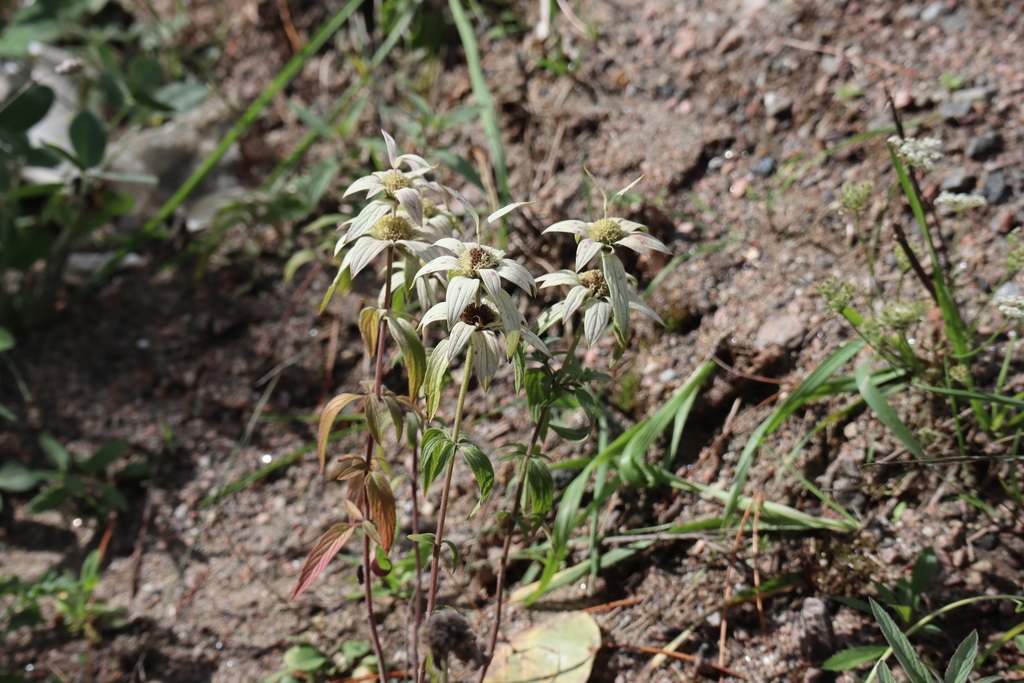
LATIN NAME: Monarda punctata
COMMON NAME: Spotted Beebalm
Plant Profile
Spotted beebalm and horsemint: the first name describes the flowers, the second the smell, which is thyme and not mint. It is native from Ontario and Quebec through the eastern United States to northeastern Mexico, and it grows in dry sand, thin prairie and open woodland edges rather than in the damp places where its better-known relatives live.
The plant is thyme-scented throughout, and the scent is strong enough to find with a hand waved over the leaves on a warm evening. Stems are square, as in all Lamiaceae, and the whole plant is usually 40 to 80 cm tall, sometimes taller in good ground and much shorter on poor sand, where it can flower at 20 cm and still set seed.
Nine varieties are described, separated on hairiness, bract colour and geography. Punctata is the eastern form, occidentalis the western one, and several of the others are narrow endemics of a single state or river system. The differences are real but small, and most garden plants are somewhere between them.
Science & Biotechnology
The inflorescence is the interesting part. Most Monarda species carry a single head on a stem; this one stacks whorls up the stem, with a ring of bracts radiating beneath each whorl. The bracts are white to light pink, longer than the flowers, and they do the advertising. The flowers themselves are small, yellow and brown-spotted, and only visible at close range.
That division of labour is unusual and efficient: the bract provides the visual signal from a distance, and the flower provides the nectar at close range. A bee approaching sees a white platform and lands on it, then walks inward to the small yellow tubes. The plant has separated attraction from reward.
The plant contains thymol, the antiseptic and fungicide that gives thyme its character. Before synthetic production, horsemint was among the North American plants from which thymol was obtained commercially, and the oil was used as a mouthwash and a dressing. The chemistry that makes the plant smell good is the same chemistry that makes it useful. The Lamiaceae thread continues with Mentha × piperita, Lavandula pinnata and Prunella grandiflora.
Uses & Benefits
Its pollinator list is unusually heavy on wasps, including predatory species that hunt grubs and caterpillars. That is an argument for planting it near vegetables, and an argument that requires some nerve, because most gardeners treat a wasp as a problem rather than as an employee. The plant recruits the ones that do the work.
One bee depends on it entirely. Protandrena abdominalis collects pollen from Monarda punctata and from nothing else, which makes the plant a single point of failure for that species. Where the plant is cleared, the bee goes with it, and no substitute flower will do.
Medicinally it has a long record: stomach upsets, colds, diarrhoea, neuralgia and kidney disease, in the manner of nineteenth-century American domestic practice. Little of that has been tested, and the plant is now grown for its flowers and its insects rather than its uses. The thymol is real; the rest is tradition.
Growing from Seed
Sow on the surface, because the seed needs light, at 18 to 21 °C. Germination takes two to three weeks, and four weeks of cold and damp before sowing improves both the percentage and the evenness. Fresh seed is best; stored seed loses vigour quickly in a warm room.
The seedlings are slow and small at first, and they do not tolerate drying out. Prick them out as soon as they can be handled into individual pots and grow them on under glass, potting on once. A plant that stalls at the seedling stage rarely catches up, so keep them moving without forcing them with feed.
Plant out at 30 cm in full sun and sharp drainage, and keep the compost off the crown. Winter wet kills more plants than cold does; a gravel mulch around the collar is the difference between a perennial and an annual in a heavy soil. In sand it will self-sow and make its own decisions.
Our Take
It is the best Monarda for a dry garden and the least planted, which is an odd combination. The scarlet beebalm gets the attention and then gets mildew; this one gets neither. It is shorter, tidier, longer in flower and it brings in insects that the red one never does.
Leave the stems standing through winter. The whorls keep their shape under frost, the seed feeds small birds, and the hollow stems are used by overwintering insects. Cutting everything down in October is the tidiness instinct again, and in this case it costs more than it gives.
Related Reading
More species in the same orbit as Spotted Beebalm: