


Ratibida columnifera Seeds | Yellow Coneflower
LATIN NAME: Ratibida columnifera
COMMON NAME: Yellow Coneflower
Plant Profile
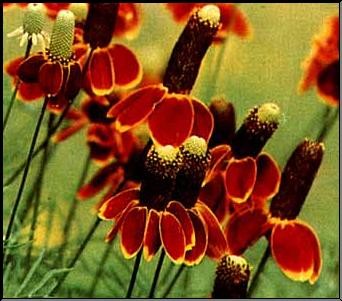
The common name Mexican hat comes from a shape no other coneflower quite matches: a tall, domed central cone in grey-brown sits above a ring of drooping yellow or red-and-yellow rays, so the whole head reads like a wide hat with a raised crown. Ratibida columnifera is a prairie native that shrugs off heat and thin soil where flashier relatives fail, and it blooms for months once the warm season settles in. Its long, protruding cone is the single most reliable field mark in the genus, and the plant will keep flowering even when rainfall is scarce enough to shut down most of its neighbours.
The plant is a slender perennial with finely divided, almost ferny leaves and solitary heads on wiry stems. The ray florets hang downward and may be solid yellow or banded red at the base, while the disc florets pack a column that lengthens as it matures. The fruit is a small, dry achene with no pappus, shed directly from the cone rather than carried on the wind like the seeds of many prairie daisies.
In the garden the Mexican hat is used in prairie and meadow schemes, where its months-long bloom supports pollinators and its curious form draws comment. The heads dry to a firm cone that holds in arrangements, and the plant pairs with other aster-family natives for a layered, naturalistic look. A drift of it among grasses gives the border a movement that tighter perennials cannot match.
Science & Biotechnology
Ratibida species are screened for flavonoids and for olefinic compounds, with extracts examined for antioxidant and mild antimicrobial activity in lab assays. The work is early-stage compared with the well-studied Echinacea, but the genus is of interest to prairie-restoration ecologists for its drought resilience and its value to native bees. The disc florets are a concentrated nectar source through the hottest part of the summer.
Restoration programmes collect local seed and test emergence and stand persistence on degraded grassland, favouring strains that hold the long cone and the drooping ray. The plant’s low water need makes it a candidate for dryland meadow mixes where irrigation is impractical, and its deep root helps hold loose prairie soil against wind erosion through the dry months.
Uses & Benefits
Unlike the purple coneflower, Ratibida carries a long, narrow cone rather than a rounded one, and unlike black-eyed Susan it lacks a feathery pappus on the seed. The leaves are far more dissected than either cousin, which is the quickest way to tell the three apart in a mixed prairie planting. The red-banded ray form is particularly sought after and is sometimes sold under the name “red Mexican hat” in seed lists.
Growing from Seed
The plant asks for almost nothing once established, which is why it is a favourite for low-input meadows and for roadside mixes that must survive without irrigation. Its long blooming window means a single sowing can carry a border from early summer to the first frost, and the seed is cheap enough to treat as a filler even where the plant is perennial. Bees work the cones through the hottest part of the day when other flowers have closed.
Sow the seed on the surface of a lean, free-draining bed in spring and thin to one plant every 25 to 35 cm once seedlings reach 8 to 10 cm. The deep root tolerates dry spells, so water only to establish the young plant and then let the soil dry between rains. Light aids the seed to break dormancy, so press it to the surface rather than burying it under a thick layer of mix.
Deadhead spent heads during the season for a longer show, or leave the final cones for seed and for winter interest. The crown survives cold winters and sends new shoots from the base each spring without division, and the standing cones feed small finches that pry the achenes from the dried column.
Our Take
Mexican hat is my go-to for the hot, poor corner where little else keeps blooming, and its hat-shaped heads never stop drawing questions. For a fuller prairie palette try the Purple Coneflower, the Black-Eyed Susan, and the Gaillardia.
Related Reading
Continue exploring with these related plants: