


Cerastium Seeds | Snow-in-summer
LATIN NAME: Cerastium
COMMON NAME: Snow-in-Summer
Plant Profile
Every surface of the leaf and stem carries a dense felt of non-glandular hairs, the tomentum that gives the species its name. The hairs trap a layer of still air, cut water loss, and reflect harsh light. Rub a leaf and the white coat comes off on your fingers, revealing the narrow green blade beneath.
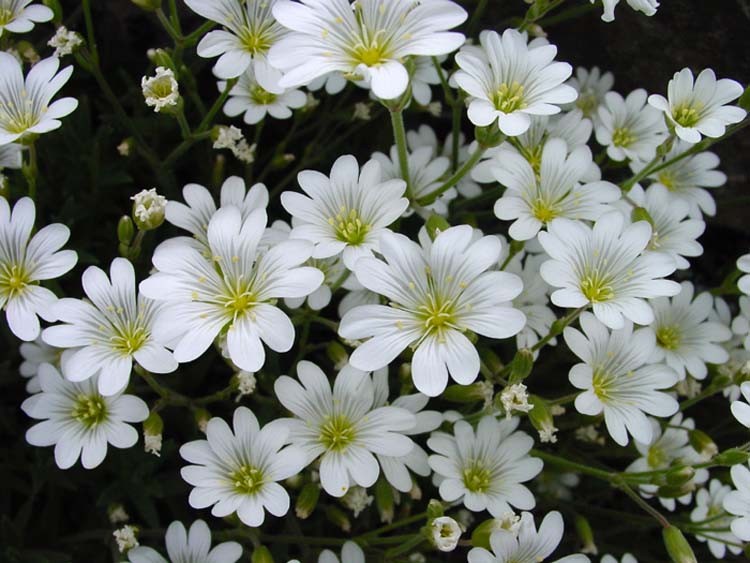
The flowers are five-petalled and notched at the tip, so each reads as a small star rather than a simple cup. They sit in loose clusters at the ends of trailing stems that root where they touch the ground, letting the plant spread as a ground cover as much as it stands as a clump.
Cerastium sits in the Caryophyllaceae, the pink family, alongside Dianthus and Silene. Most of its cousins are green and slender, which makes the woolly silver habit of tomentosum unusual in the family. The genus Cerastium holds some two hundred species worldwide, nearly all temperate, and tomentosum is among the few kept for ornament rather than for weediness. The hairs are the key adaptation that lets it claim the driest, brightest niches, and in its Alpine home the plant grows above the treeline where ultraviolet light is intense, exactly the stress the white coat helps it survive.
Gardeners sometimes confuse the silver mat with a mossy saxifrage or a white alyssum, but the five-petalled notched flower and the trailing, rooting stem are Cerastium marks. True saxifrages carry different leaf shape and tighter rosettes, and they prefer cooler, moister footing than this sun-lover.
Science & Biotechnology
Like many Caryophyllaceae, Cerastium contains saponins in its tissues, the soapy compounds that foam in water and deter grazers. The plant was long gathered for washing cloth in parts of Europe, where its common names point to soap rather than snow. The saponins also give the foliage a mildly bitter, protected character that few animals will eat.
The reflective coat lowers leaf temperature and slows transpiration, letting the plant hold moisture through dry spells that brown neighbouring greens. This is the same principle behind the silver leaves of many Mediterranean and alpine plants, and it explains why Snow-in-Summer thrives in the lean, hot seam of a wall. Growers also use the silver mat as a living mulch, because the reflective leaves lower the soil temperature at the crown and protect the shallow roots from baking.
Uses & Benefits
Its silver appearance comes from dense hairs on the foliage, not from a pale flower pigment. Set plants where rain can drain through the root zone, and use stones or a raised edge to keep neighboring groundcovers from closing over the crown during the wet season.
Growing from Seed
Snow-in-Summer earns its name twice over. In early summer the plant is buried under a sheet of white star-shaped flowers, and for the rest of the year its leaves are so thickly coated in white hairs that the mat looks dusted with frost even in full sun. That silver coat is not decoration; it is the plant’s sunscreen and water shield, and it is why Cerastium tomentosum can carpet a hot, dry wall where green-leaved plants scorch. A single rooted piece will run across a square metre of poor ground in a season.
Sow the fine seed on a gritty, sharply drained medium and keep it bright and just moist. The seed is small and needs light, so press it to the surface rather than covering it. Young plants establish fast and begin to run once they root, so they are often quicker from cuttings than from seed for a specific patch.
Scatter the seed across the surface and mist to settle, then guard the tray against moss and algae that would smother the tiny seedlings. Once the plants show a few leaves, move them to the wall or rock ledge where they will spread. Avoid rich compost, which only encourages soft, less silver growth.
After the clump is established, lift and divide the trailing runners in early growth to fill new seams or to renew an old mat that has gone bare in the centre. Shear the plant lightly after the first bloom to keep the silver foliage tight and to prevent it from flopping. Good drainage through winter is the only real demand.
Our Take
Snow-in-Summer is my go-to for the hot, shallow wall where green plants bake. Let it silver the seam, then shear it back after bloom. It pairs naturally with Sea Thrift and the low rock pinks Dianthus deltoides and Dianthus plumarius.
Related Reading
More species in the same orbit as Snow-in-Summer: