


Armeria maritima Seeds | Sea Thrift
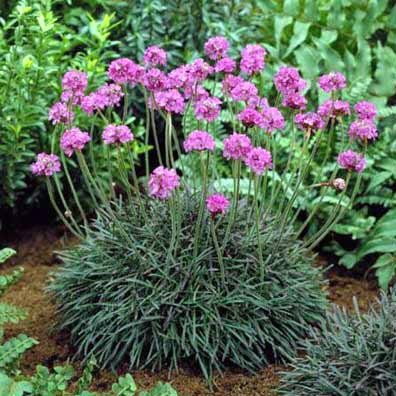
LATIN NAME: Armeria maritima
COMMON NAME: Sea Thrift, Sea Pink
Plant Profile
The old name “thrift” was a compliment, not an insult. Gardeners of the 16th century called the plant thrifty because it asked for almost nothing, and they set its neat hummocks into knot gardens, gravestones, and the seams of stone walls where little else would root. What they were really exploiting was a tolerance for salt and starvation that few flowering plants can match. Armeria maritima clings to ledges sprayed with seawater and to soils so poor and so alkaline that grass gives up, and it still lifts its round pink heads above the spray.
The leaves are slender, almost grass-like, and grow in tight evergreen tufts that sit flat against the ground. From the centre of each tuft rise leafless flowering stems, each topped by a single rounded head of many small flowers wrapped in a papery bract sheath. The effect from a distance is a low cushion dotted with buttons of colour, and the plant holds that shape all winter where the climate is mild.
Each flower head is a cluster of tubular florets rather than a single bloom, and the colour ranges through rose pink, carmine, and white depending on the population. The blooms open through the long spring and summer window and keep coming if the spent heads are removed. Bees work the florets for nectar, and the round habit makes the plant a useful landing pad in a windy site.
Do not confuse sea thrift with the true pinks of the genus Dianthus, which share the common name “pink” and also form low mounds. Dianthus leaves are blunt and paired on a jointed stem, while Armeria leaves are single, narrow, and arise from a central crown. The two also sit in different families, and only Armeria thrives in the salt spray zone.
Science & Biotechnology
The genus name Armeria comes from the Spanish word for a cluster, armazon, a nod to the heads. The chemistry of the family centres on plumbagin, a naphthoquinone stored in the roots and leaves that gives many Plumbaginaceae their antiseptic and defensive character. In Armeria the compound is present at modest levels and is part of why the plant resists grazing and decay in exposed sites.
Researchers have measured plumbagin and related naphthoquinones across Armeria populations, with coastal forms often richer than inland ones. The compound is of interest for its antimicrobial activity, though the garden plant is valued far more for its toughness than for the lab bench. The leaves also accumulate proline and other osmolytes that help the cells hold water under salt stress.
Uses & Benefits
This species belongs to the Plumbaginaceae, the leadwort family, which also gives us the garden plumbago. That placement is a surprise to many growers who assume the grass-like leaves point to a grass or a sedge. The family is defined by its salt-loving members, and Armeria carries the family trademark: a capacity to exclude or tolerate sodium at the root.
Growing from Seed
Sea thrift repays a gritty, lean medium and punishes rich, wet soil. A mix of two parts coarse sand to one part loam, with a little grit on top, mimics the cliff ledge it evolved on. Sow the fine seed on the surface and press it in, because light aids emergence, then keep the medium just moist and airy rather than damp.
The seed is small and should not be buried. Scatter it across the surface, mist to settle, and place the tray where it receives bright light. Young seedlings form a thread-like first leaf and are slow to make the grassy tuft, so resist the urge to overwater. Once the tufts show several leaves, they can move to their final pocket of grit.
Set established plants about twenty-five centimetres apart so the cushions can spread without crowding. In a rock garden or trough they are happy at the edge where rain runs off, and they tolerate a hard shearing after bloom to keep the mound tight. Winter wet is the main enemy, so raise the crown on a slope or in a raised seam.
Our Take
Sea thrift is the plant I reach for when a spot defeats everything else: the dry wall top, the salty step, the shallow trough. Give it grit, give it light, and leave it alone. For companions in the same lean, sunny niche, look at Snow-in-Summer and the low rock pinks such as Dianthus deltoides and Dianthus plumarius.
Related Reading
More species in the same orbit as Sea Thrift: