


Aubrieta cultorum Seeds | Purple Rock Cress
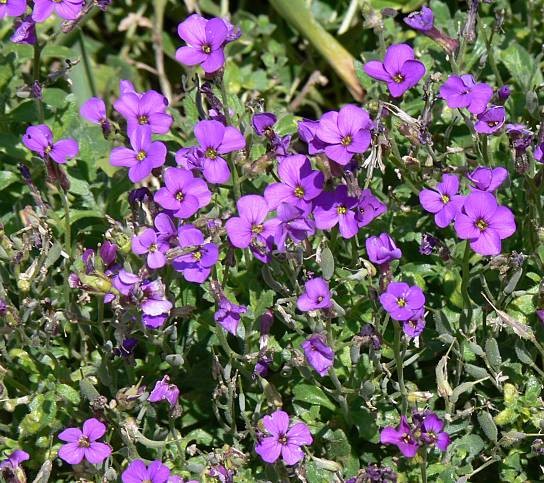
LATIN NAME: Aubrieta cultorum
COMMON NAME: Purple Rock Cress
Plant Profile
Aubrieta is a mat-forming alpine of the cabbage family, 10 cm high and up to 60 cm across, grown for the sheet of magenta, purple or pink flowers it produces in April and May. The leaves are small, grey-green and softly hairy, and they stay evergreen through winter, which is half the reason the plant is worth its space.
The flowers open in succession over five or six weeks, held just above the foliage, and a well-grown plant in full sun becomes a solid cushion of colour. Single flowers are small but there are hundreds of them, and the effect at the edge of a path or over a wall is more impressive than any individual bloom.
Garden aubrietas are a hybrid group, Aubrieta cultorum, derived mainly from A. deltoidea of the Balkan and Turkish mountains. That origin explains the plant’s requirements: sharp drainage, full sun, and a lean soil. In rich or wet ground it rots at the neck within a season.
Science & Biotechnology
Aubrieta belongs to the Brassicaceae, the mustard family, and shares its characteristic four-petalled flowers and mustard-oil chemistry. The pigments are anthocyanins, and the intensity of the purple depends on light and on soil: plants in shade open paler than the same clone in full sun.
The genus is a textbook case of alpine adaptation. The plant grows a deep taproot into rock crevices, keeps its leaves close to the ground to avoid wind, and flowers immediately after snowmelt in its native range, which is why it is so early in a garden. Its hardiness comes from dehydration tolerance rather than from insulation: the crown survives at temperatures that would kill a soft-leaved perennial.
Breeding since the nineteenth century has produced named clones in a narrow colour range. Because the hybrids are largely self-incompatible, seed from a named plant will not come true, and commercially sold seed is a variable mixture.
Uses & Benefits
Aubrieta is a rock-garden plant, a wall plant and a path-edge plant, and it does all three jobs with the same technique: it hangs. Plant it at the top of a retaining wall and it will spill over the face; plant it between paving and it will fill the joints. It also works in a trough or a wide, shallow pot, where the drainage can be controlled.
Bees visit the flowers early in the season, when little else is open, and the plant is a useful nectar source in a cold spring. It combines well with yellow alyssum, dwarf phlox and early tulips. Commercially the plant is sold as seed mixtures for rock gardens and as plug plants for landscape edging.
Growing from Seed
Sow in late winter on the surface of gritty, free-draining compost at 18-20°C; germination takes two to three weeks. Do not cover the seed, and keep the compost on the dry side once the seedlings are up, since damping off is the main risk. Pot on into a mix with at least a third grit.
Plant out at 25-30 cm apart in full sun, on a slope or in a wall crevice, with a handful of grit under the crown. Water for the first month only. Shear the plant lightly after flowering to keep it compact and to stop it opening in the middle; a hard cut into old wood will not regrow. In humid climates, lift and replant every third year from cuttings taken in early summer.
Our Take
A plant for a wall, a step or a gravel edge, where its spring sheet of colour is worth far more than its size suggests. Shear it once in June and it will stay dense for a decade.
Related Reading
If Purple Rock Cress appeals to you, these related plants are worth a look: