


Chrysanthemum Seeds | Dwarf Chrysanthemum
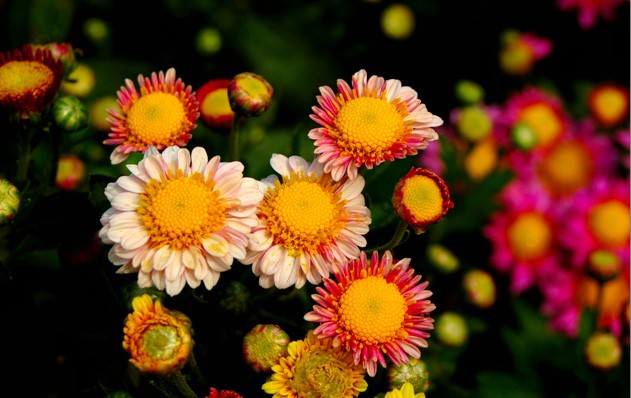
LATIN NAME: Chrysanthemum
COMMON NAME: Dwarf Chrysanthemum
Plant Profile
The dwarf chrysanthemum is the result of centuries of shrinking a giant. Full-sized Chrysanthemum cultivars can reach a metre or more and need staking, but the dwarf forms were selected to sit as neat mounds at the front of the border, blooming when almost everything else has finished. Their value is timing as much as form: they open in the cool of late summer and autumn, the season when the garden needs colour most. In East Asia the chrysanthemum is also a cultural icon, a symbol of longevity honoured in festivals and on porcelain for a thousand years.
The foliage is dark green and finely divided, almost fern-like, which gives the low mound a lacy texture even before bloom. The leaves carry the faint aromatic scent typical of the genus when crushed, and their cut shape helps identify the plant against the broader-leaved daisies.
The dwarf garden forms trace back to Chrysanthemum indicum and its crosses with other Asian species, especially Chrysanthemum morifolium, which carries the garden chrysanthemum trade. The dwarf habit was fixed by selecting compact seedlings over many generations, so the plants stay low without constant cutting.
Tall and dwarf types share the same flower chemistry but differ in growth regulators and branching. The dwarf selections branch low and set flower buds close to the crown, while tall types extend long stems that must be supported. For the small garden, the dwarf line removed the staking problem entirely.
The warm golds and bronzes of the petals come from carotenoid and flavonoid pigments laid down as the bud opens. Breeders select for stable colour and for the doubled form, and the chemistry is well enough understood that colour lines can be held across generations by clonal propagation.
Science & Biotechnology
The genus is chemically famous. Some Chrysanthemum relatives, especially the pyrethrum daisies, store pyrethrins, fast-acting natural insecticides, in the flower. Garden chrysanthemums also contain sesquiterpene lactones such as parthenolide, compounds studied for their biological activity and responsible for the bitter, aromatic quality of the foliage. The yellow pigments are carotenoids and flavonoids laid down in the ray florets.
Pyrethrins are esters built in the flower tissues and break down quickly in light, which is why they are prized as a low-residue crop protection tool. While the dwarf ornamentals are not grown for extraction, they carry the same metabolic pathway that makes the pyrethrum daisies valuable, a reminder that the garden flower and the insecticide crop are close kin.
Uses & Benefits
Each flower head is a classic composite. The outer ray florets may be single or, in the doubled forms, many ranks stacked to make a pompon or a cushion. Colours run through gold, bronze, rust, pink, and white, and the bloom sits close to the foliage because the stems are short. The number of ray ranks is a breed standard: the singles carry one, the anemone types a central cushion, and the doubles many, and the commercial dwarfs are mostly the spray and pompon classes kept for the cut-flower trade.
Growing from Seed
Sow the fine seed on a moist, free-draining medium and keep it warm and bright; the seed is small and should sit on the surface. Young plants grow fast and are best pinched early to build a bushy mound rather than a single stem. Set them out once the risk of cold is past.
Because the seed is tiny, sow it thinly and prick out the seedlings once they reach a few centimetres, moving each to its own cell. Crowded seedlings become leggy, so give them light and air. The dwarf types still benefit from early pinching to branch low and form the rounded cushion.
Pinch the growing tip when the plant is young to force side shoots, and repeat once if needed. This keeps the mound tight and increases the number of blooms at the crown. Feed lightly through the season and keep the medium on the dry side, since wet feet invite rot in the cool autumn.
Our Take
Dwarf chrysanthemums are the easiest way to keep colour in the garden after summer leaves. Pinch early, keep them dry, and enjoy the late show. For more in the genus, see Chrysanthemum indicum, Chrysanthemum morifolium, and the insecticidal Pyrethrum.
Related Reading
Readers interested in Dwarf Chrysanthemum frequently explore these as well: