


Coreopsis tinctoria Seeds | Plains Coreopsis
LATIN NAME: Coreopsis tinctoria
COMMON NAME: Plains Coreopsis
Plant Profile
The specific name tinctoria means “used for dyeing,” and Plains Coreopsis earned it. Long before it was a garden annual, the plant supplied a yellow-to-red dye from its flowers, and the same pigments that stained pioneer cloth still interest natural-dye workers today. What sets Coreopsis tinctoria apart from the many yellow daisies is a pair of flavonoids, marein and the chalcone okanin, that give the petals their two-tone look and their colourfastness. The plant is also a prairie native that blooms for months with almost no care.
The leaves are finely divided and almost thread-like on the upper stem, which gives the plant an airy, feathery look. The slender stems branch freely and carry many small heads, so a single sowing reads as a cloud of colour through the warm months.
Plains Coreopsis is often grown as an annual even though it can persist, because it is short-lived and self-sows so freely that a patch renews itself. Close relatives such as Coreopsis basalis carry a similar yellow dye chemistry, while the taller perennial coreopsis types form lasting clumps and are valued for the border rather than the dye pot.
In practice most gardeners treat tinctoria as an annual, sowing fresh each season for a guaranteed show. The plant completes its cycle fast in warm ground and drops seed that returns the next year, so a single introduction can naturalise along a meadow edge without becoming a nuisance.
Science & Biotechnology
The chemistry behind the colour is a pair of flavonoids. Marein, a glucoside of the chalcone okanin, is the yellow component, while okanin itself gives the red. Together they form a natural dye system that yields yellow on wool with an alum mordant and shifts toward rust and red with an iron mordant, which is why the plant was worth growing for the colour alone.
Okanin is a chalcone, an open-ring flavonoid, and chalcones are uncommon as flower pigments, which makes Coreopsis tinctoria a useful reference for natural-dye chemistry. The pigment binds well to protein fibres, and historical accounts describe the flowers being boiled to extract a fast yellow that deepened with the mordant used.
Uses & Benefits
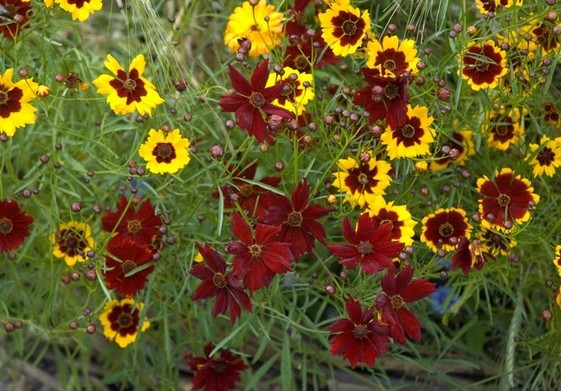
The flower is a classic composite with a ring of ray florets around a central disc. In tinctoria the rays are yellow at the tip and shade to a maroon or red base, while the disc itself is a deep red brown. That two-tone pattern is the field mark and the source of the dye, because the red pigments concentrate near the base of the ray and in the disc.
The epithet was assigned because early botanists noted the plant’s use as a dye source among North American peoples and settlers. The Osage and the Cherokee used the flower as a dye, and 19th-century settlers recorded its use for colouring wool and linen a fast yellow. The same genus name, Coreopsis, comes from the Greek for “bug-like,” a nod to the shaped seed, while tinctoria keeps the memory of the dye pot alive in the Latin.
Growing from Seed
Sow the seed in place on open, light, well-drained ground after the cold has passed, because the plant hates a chill and resents transplanting. Choose a sunny site and work the soil lightly. The plants bloom within a short window and keep going if the heads are cut, so a meadow strip or a cutting row both suit it.
Scatter the seed and rake it into the top layer of soil, then firm the surface. Thin the young plants so air moves between them, which reduces mildew on the fine foliage. Direct sowing beats setting out, since the slender taproot dislikes disturbance and the seedlings establish quickly in warmth.
Cut the stems for the vase in the morning and remove spent heads to push more buds. The more you cut, the longer the plant flowers, often right up to the first frost. Leave a few late heads to drop seed if you want the patch to return without resowing.
Our Take
Plains Coreopsis is the most generous daisy I know for a hot, dry spot, and the dye story is a bonus for anyone with a dye pot. Grow it with Cornflower, the extra Plains coreopsis line, and Coreopsis basalis.
Related Reading
More species in the same orbit as Plains Coreopsis: