


Acacia redolens Seeds | Prostrate Acacia
LATIN NAME: Acacia redolens
COMMON NAME: Prostrate Acacia, Bank Wattle
Plant Profile
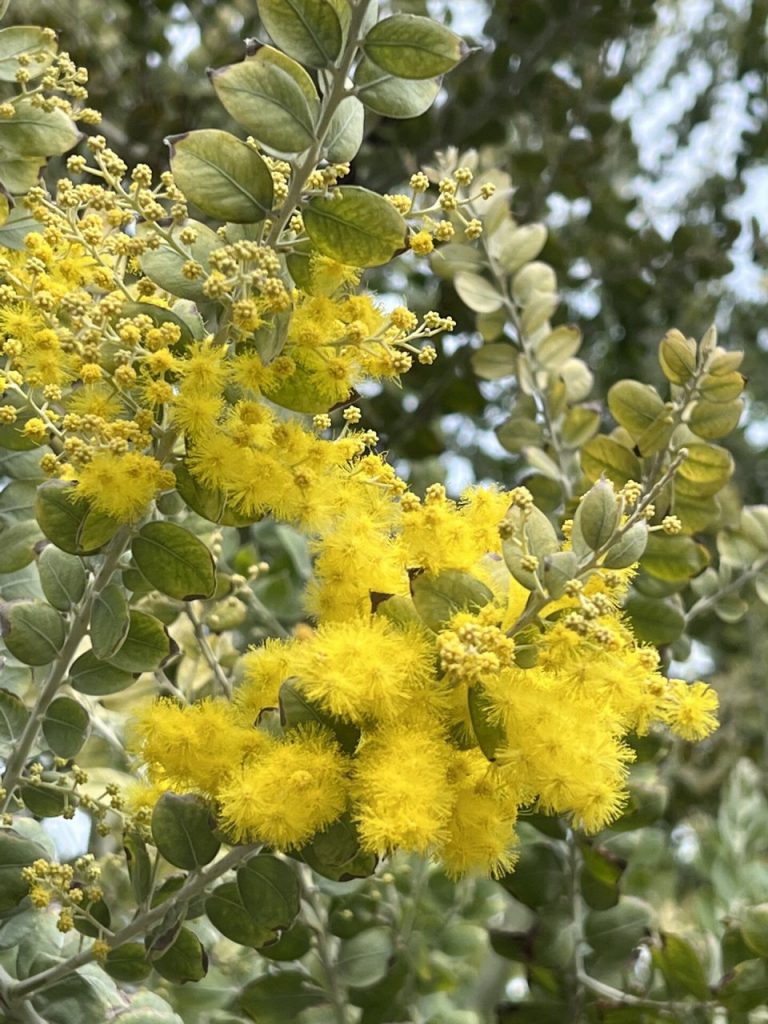
Prostrate acacia is a low, spreading shrub from the sandplains of southwestern Australia, growing no more than a metre tall but spreading three to six metres across on long, ground-hugging stems. Its phyllodes, which are flattened leaf stalks rather than true leaves, are broad, grey-green and leathery, and in spring the plant covers itself in small, globular, bright yellow flower heads. These are followed by narrow, curled pods. The plant roots along its stems, forming a dense mat that holds sand and suppresses weeds, and it tolerates salt, drought, wind and poor soil. It is widely planted as a ground cover in California, Arizona and the Middle East, where it is valued for its ability to cover a hot bank with almost no irrigation.
Science & Biotechnology
Acacia redolens belongs to the Australian acacias, a group in which the true leaves are replaced by phyllodes, and its prostrate habit is an adaptation to exposure on sandplains where a tall plant would be sandblasted or dried by wind. The species is diploid and is one of many Australian acacias that have become invasive outside their range, though this one is less aggressive than most because it sets relatively little seed and does not spread far from the parent plant. Its roots form associations with rhizobia and fix nitrogen, which changes the soil beneath it and can affect the plants that follow. The yellow flower heads are composed entirely of stamens, a feature of the genus, and they are pollinated by bees and by small wasps. In California it has been used on highway embankments and is now widely planted as a low-maintenance ground cover.
Uses & Benefits
The plant is used as a ground cover on banks, roadsides and dry slopes, where it controls erosion and needs no irrigation once established. It is also planted as a low hedge, a car-park island plant and a specimen in a desert garden, where its spring flowering is spectacular. Its flowers are a good source of nectar for bees, and its dense mat gives cover for lizards and small mammals. The seed is eaten by birds, and Aboriginal people in Australia used the seed of related species as food after processing. It has no timber value. It should be planted where its spread can be contained, and it should not be introduced near bushland in regions where Australian acacias are invasive.
Growing from Seed
The seed coat is hard and needs scarifying: pour hot water over the seed and leave it to soak overnight, then sow the swollen ones. Sow one centimetre deep in a sandy mix at twenty to twenty-five degrees; germination takes one to three weeks. The seedling has a long taproot and should be grown in a deep tube. Plant out young, in autumn, into sandy or gravelly soil in full sun, and water for the first summer only. Space plants two metres apart for ground cover. It tolerates salt spray and wind, and it needs no feeding. Prune lightly after flowering to keep the mat dense, and remove any seedlings if the plant is in a sensitive area.
Our Take
A ground-hugging Australian wattle that covers a hot bank in yellow and asks for nothing. Give it sand and sun.
Related Reading
Continue exploring with these related plants: