


Bambusa multiplex Seeds | Hedge Bamboo
LATIN NAME: Bambusa multiplex
COMMON NAME: Hedge Bamboo
Plant Profile
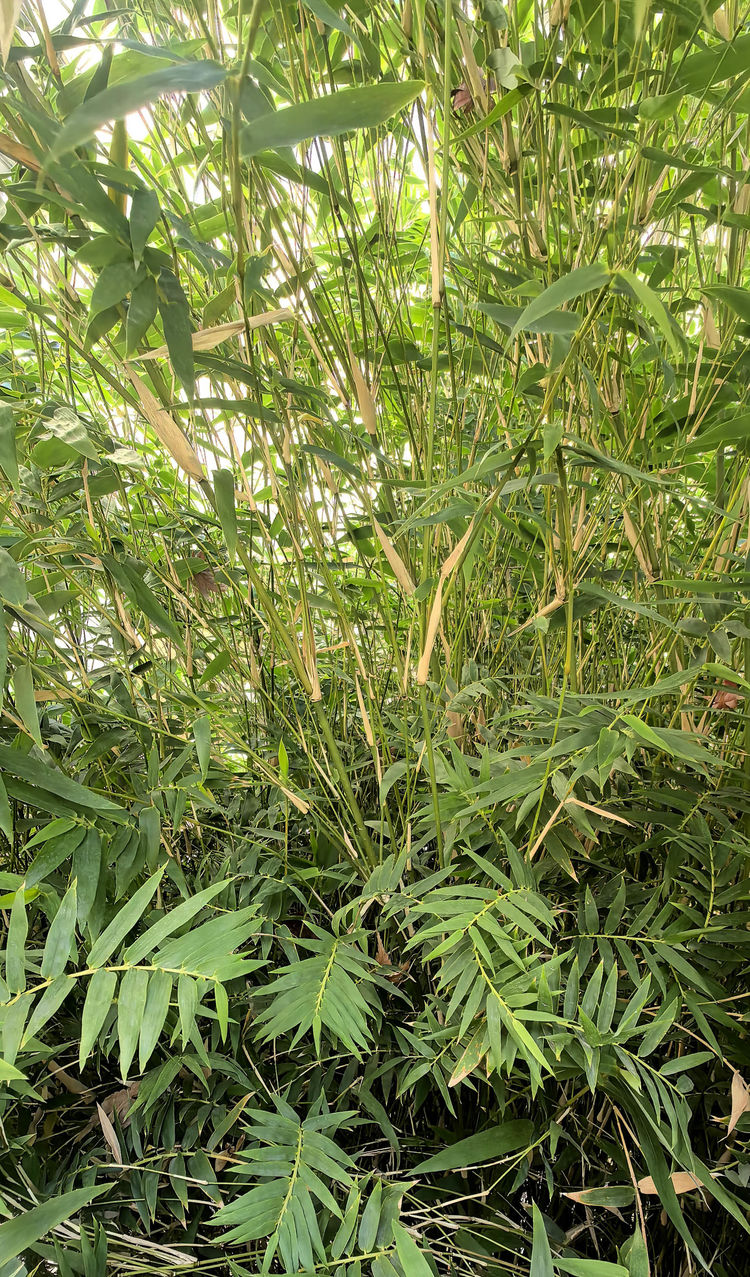
Hedge bamboo is a clumping species from southern China that makes a dense, waist-high thicket of thin green culms and never runs. It grows in the hills of southern China, Vietnam and the eastern Himalaya, and it has been planted for centuries as a boundary hedge, a windbreak and a source of weaving canes, which is why it turns up in gardens far outside its native range. The culms are two to four metres tall and only one or two centimetres thick, closely spaced, with many fine branches from the lower nodes that carry small, narrow leaves in a flat fan. It is one of the few bamboos that flowers and sets seed without dying, and its occasional flowering is not followed by the death of the clump. The whole plant is evergreen, dense to the ground and easily clipped into a hedge, which is rare among bamboos. Cultivars with striped or dwarf growth are common in the nursery trade.
Science & Biotechnology
Bambusa multiplex has pachymorph rhizomes, the short, thick, curved type that turns upward and produces a new culm close to the parent, so the plant forms a tight clump instead of a spreading thicket. That habit is the reason it can be used as a hedge, and it is what separates it from running bamboos such as Phyllostachys, whose leptomorph rhizomes travel several metres a year. The species is unusual in flowering sporadically rather than in the gregarious cycles that kill most bamboos after seeding: individual clumps flower, set a little seed and carry on. The culms are hollow but thick-walled for their size, and they lignify within a season, which is why they are used for light structural work and weaving. Its leaves are small and numerous, and the plant’s density comes from branch proliferation at every node rather than from the culms themselves. It tolerates hard frost for a bamboo and regrows from the rhizome after being cut to the ground.
Uses & Benefits
The plant is a hedge first of all: it clips well, stays dense to the base, and makes a screen two to three metres high within three years. The culms are split for baskets, sieves and light frames, and the whole stems are used for plant stakes, bean poles and fence panels. In southern China the young shoots are eaten, though they need prolonged boiling to remove the bitter compounds. It is also a useful windbreak around vegetable plots and a dust filter along roads, and it is planted to stabilise banks, since its fibrous roots bind soil. In a garden it is the bamboo for someone who wants the look without the fear of it taking over the neighbourhood. It can be clipped twice a year, in late spring and late summer, and it makes a good container subject for a patio.
Growing from Seed
Sow fresh seed, which is rarely available, in spring at 20 to 25 degrees on the surface of a loamy mix, covering it lightly; germination takes two to four weeks and the seedlings are slow for the first year. Most plants are raised from divisions or from basal cuttings taken in spring. Plant in sun or light shade, in moist but well-drained soil enriched with compost, and water well through the first two summers. Space hedge plants 60 to 90 cm apart and cut them back by a third after planting to encourage basal shoots. Clip established hedges in late spring, after the new culms have hardened, and again in late summer if growth is strong. The plant is hardy to about minus ten, with some leaf damage below that, and it regrows from the rhizome. Divide congested clumps in spring, and never let a clump dry out completely in its first year.
Our Take
A clumping bamboo that makes a tight hedge and stays where you put it. Clip it twice a year and it will hold a boundary for decades.
Related Reading
More species in the same orbit as Hedge Bamboo: