


Cleome gynandra Seeds | Cat’s Whiskers
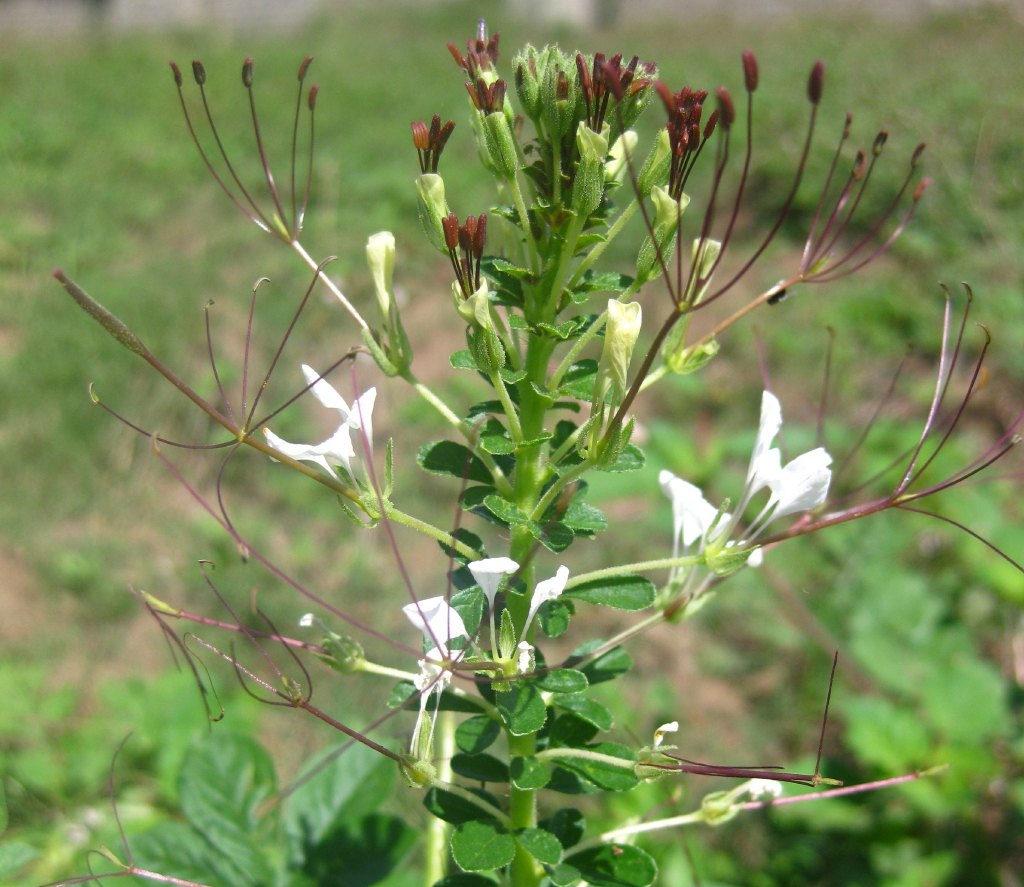
LATIN NAME: Cleome gynandra
COMMON NAME: Cat’s Whiskers
Plant Profile
Cleome gynandra is grown as a leaf vegetable across tropical Africa and much of Asia, and it is known by so many names that the common ones almost obscure the plant. Shona cabbage, African cabbage, spiderwisp, cat’s whiskers and stinkweed all refer to it, and the last of those tells you what some people think of the smell.
It is an erect, branching annual, usually 25 to 60 cm tall but capable of reaching 1.5 m in good conditions. The leaves are sparse and palm-shaped, made up of three to seven oval leaflets. Flowers are white and often turn rose pink as they age, which gives a stand of it a two-tone look in late summer. Both leaves and flowers are edible. The leaves have a strong bitter, peppery flavour that sits somewhere between mustard greens and rocket, and they are cooked rather than eaten raw in most of the cuisines that use them.
Science & Biotechnology
The bitterness comes from glucosinolates, the same family of compounds that gives mustard, cabbage and horseradish their bite. When the leaf tissue is damaged, enzymes convert them into isothiocyanates, so the flavour sharpens the moment you chop or chew rather than while the leaf sits whole.
Unusually for a leafy crop in this group, Cleome gynandra runs the C4 photosynthetic pathway. That is the water-efficient system found in maize, sorghum and amaranth, and it explains how the plant keeps producing leaf through heat that would stall a cabbage. It ranks among the few C4 species grown as a green vegetable.
The fruit is a slender capsule, a silique, up to 12 cm long and less than a centimetre wide. As it dries, tension builds in the two valves, and when they finally split they curl back with enough force to throw seed a metre or more from the parent. In a garden that means one plant becomes a patch within two seasons.
The leaf is nutritionally serious. It is high in beta-carotene, folic acid, ascorbic acid and calcium, carries vitamin E and iron, and runs about 4 per cent protein. A hundred grams supplies between 127 and 484 mg of vitamin C depending on the sample, along with 0.76 mg of zinc. The family sits close to the Brassicaceae, whose most studied member, Arabidopsis thaliana, is a C3 plant. Having a C4 relative that near makes the pair useful for work on how the C4 pathway evolves.
Uses & Benefits
In sub-Saharan Africa the leaves are a standard green, cooked with onion and tomato, or dried and stored for the dry season. The drying matters: the plant is a reliable source of vitamins and minerals in months when little else is available, and the dried leaf keeps most of its value.
The seed is pressed for oil in some regions, and the whole plant is used as fodder. In parts of Asia the leaves are cooked the same way, and the plant is sold in markets alongside amaranth and nightshade greens. In Botswana, Malawi, South Africa, Zambia and Zimbabwe, growers with established recognition supply supermarkets, restaurants and lodges, which is more commercial organisation than most indigenous leafy crops have managed.
In traditional medicine it is used for a long list of complaints, from stomach upset to joint pain. As with most plants in this catalogue, the pharmacological literature contains interesting leads and no proof, and the leaf is better treated as food than as medicine. Related entries here include Cleome spinosa, Tarenaya hassleriana and Iberis umbellata.
Growing from Seed
Sow once soil is warm, above 18 °C, and do not rush it: the seed will rot in cold ground. Direct-sow at 1 cm deep, 30 cm apart, or raise seedlings in cells and set them out when they have four true leaves. Germination takes one to two weeks.
It is not fussy about soil and it tolerates poor ground, which is part of why it matters as a subsistence crop. It does want full sun and it does want water through the first month; after that it is surprisingly tough.
Pick leaves from the top of the plant and leave the lower ones to keep it growing. If you want seed, let a few pods dry on the plant and tie a paper bag over them before they split, or you will be collecting it off the ground.
Our Take
Grow it if you cook West or East African food and cannot buy the greens, or if you want an annual that earns its place twice over: a productive leaf crop in summer and a frothy white-pink flower into autumn. Do not grow it expecting spinach. The bitterness is the point, and it is not to everyone’s taste.
Related Reading
More species in the same orbit as Cat’s Whiskers: