


Prunus dulcis Seeds | Almond
LATIN NAME: Prunus dulcis
COMMON NAME: Almond
Plant Profile
The almond is a deciduous tree of the Rosaceae, three to eight metres tall, native to the dry mountains of Iran, Afghanistan and Central Asia and cultivated around the Mediterranean for at least three thousand years. The leaves are lance-shaped, glossy and folded along the midrib, and they appear after the flowers, so the tree can bloom in late winter on bare wood.
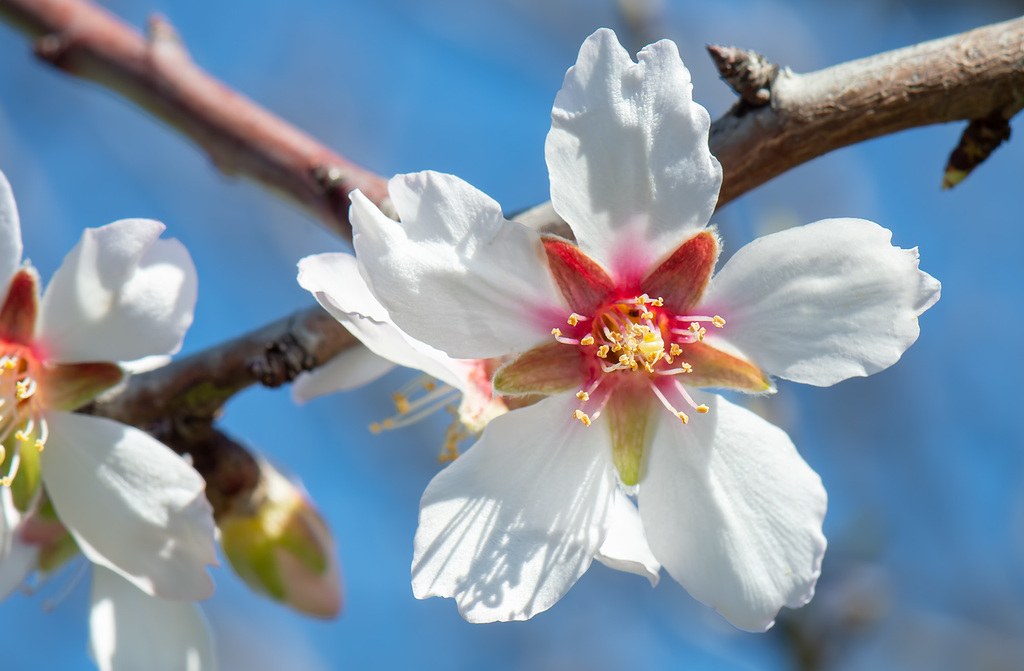
That early bloom is the whole gamble of the crop. A single frosty night in February can take an entire year’s almonds, and the flowering time of a cultivar is the first thing a grower looks at when choosing one. The flowers are white to pale pink, almost sessile on the branch, and they open over two or three weeks.
The fruit is a velvety grey-green drupe that splits in late summer to release a flattened, pitted stone, and the kernel inside the stone is the almond. Botanically it is a seed, not a nut, and the confusion is ancient: the hull, the shell and the kernel are three different things, and shelling is the business of separating the last two.
Science & Biotechnology
The naming of the species is a mess worth knowing about. Prunus dulcis, the name in every catalogue, is illegitimate because it had already been used for something else, and the correct name under the code is Prunus amygdalus, or Amygdalus communis if the genus is kept separate. The trade has ignored the point for two centuries and will probably go on ignoring it.
Sweetness is controlled by a single locus. The bitter allele is dominant, and bitterness comes from amygdalin, a cyanogenic glycoside that breaks down to hydrogen cyanide when the kernel is crushed in water. A sweet almond is a mutant, and one bitter seedling in an orchard is enough to spoil a batch of kernels.
Most cultivars are self-incompatible and need a pollinator of a different variety flowering at the same time, so almond orchards are planted in blocks of two or three cultivars and why beehives are trucked in by the thousand for the three weeks of bloom. Independence, released in the 2000s, was the first widely grown self-fertile almond and changed the planting arithmetic. Its Rosaceae company here includes Prunus mume, Prunus domestica and Prunus cerasifera.
Uses & Benefits
Kernels are eaten fresh, roasted and salted, ground into marzipan, and pressed for oil. They keep for a year in a cool, dark place, and they are one of the few home-grown crops that need no processing at all. Bitter almonds carry amygdalin and are used only as a flavouring after processing, never as a snack, and the almond extract in a bottle is the result of that processing rather than an infusion of the nut.
In the garden the tree is grown for that first blossom and for the light, open shade it casts in summer. It is a good tree for a dry bank, a Mediterranean garden or a warm wall, and it ranks among the few fruiting trees that looks better in flower than most ornamentals.
Most cultivated almonds are budded onto peach rootstock, which is faster and more tolerant of wet soil than almond on its own roots. A seedling almond is a deep-rooted, drought-hardy tree, and it is worth growing where the soil is thin and the rainfall low.
Growing from Seed
Almond seed has little dormancy compared with other stone fruit, but it germinates best after a cold, moist period. Stratify the kernels in damp sand for eight to twelve weeks at about 4 °C, then sow them two centimetres deep in spring. Fresh kernels from a health shop will grow, and they will not produce the variety you bought.
The seedling makes a taproot before it makes height, so sow in a deep pot or in its final position. Plant out in autumn or early spring, at the depth it grew, and water through the first two summers. It will flower in three or four years, and it will fruit better with a second variety nearby.
Prune in the first three winters to build an open goblet, and prune nothing after that except dead wood. Watch for the usual stone-fruit problems: aphids on the young shoots, leaf curl in a wet spring, and squirrels, which will strip a tree in a morning once they have found it.
Our Take
The almond is the first fruit tree of the year and the most uncertain one. It is worth growing for the blossom alone, and worth growing for the kernels only if you have the climate, a pollinator and a frost-free fortnight in February. Everything else is a bargain with the weather, and the weather usually wins.
Related Reading
Continue exploring with these related plants: