


Prunus domestica Seeds | European Plum
LATIN NAME: Prunus domestica
COMMON NAME: European Plum
Plant Profile
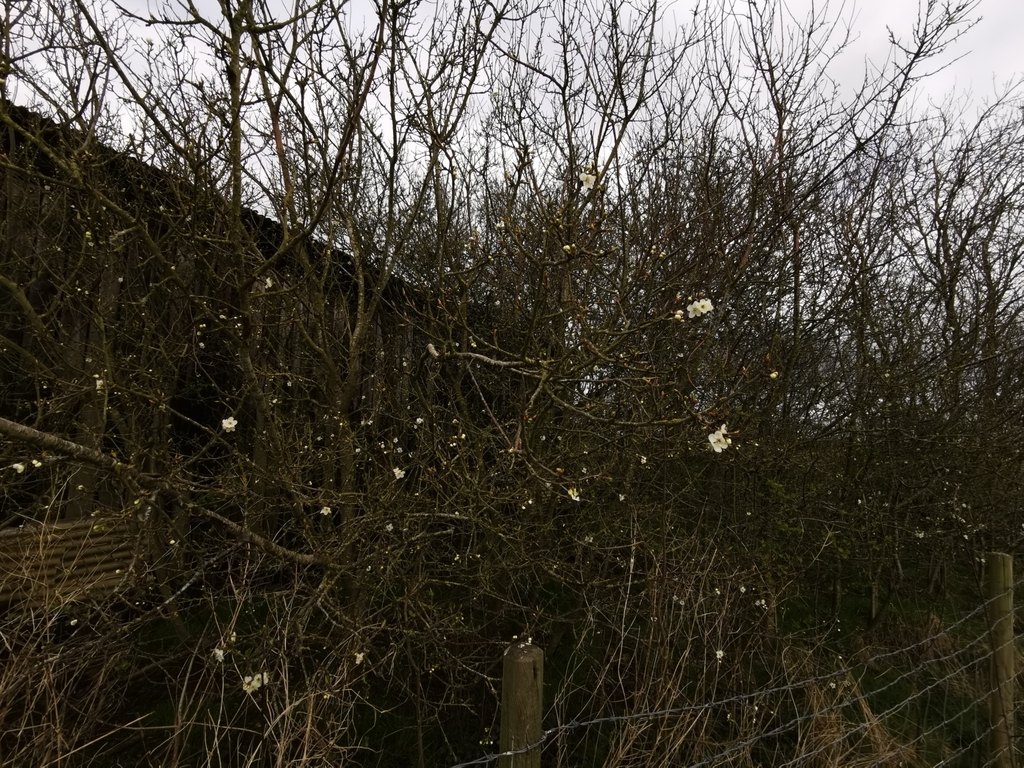
The European plum is a large shrub or a small tree, usually 3 to 8 m, and often thorny while young. The thorns are shortened shoots, and they vanish as the tree settles into bearing. White flowers open in early spring, before or with the leaves, and that timing is its weakness in a cold garden.
The fruit is oval or round, up to 8 cm across in the largest dessert sorts, with a single stone. Skin colour runs from blue-purple through red to yellow-green, and most carry a waxy bloom that rubs off on a thumb. The flesh is usually sweet; the cooking sorts are sour enough to need sugar.
Three subspecies are recognised: domestica for the ordinary plums, insititia for damsons and bullaces, and italica for greengages. They cross freely wherever they meet, so a hedge of old plums is a swarm of intermediates rather than three tidy kinds.
Science & Biotechnology
The cultivated plum is a hexaploid, with six sets of chromosomes rather than the two of its wild relatives. The parentage was long given as a cross between the sloe, Prunus spinosa, and the cherry plum, P. cerasifera. Recent cytogenetic work has undermined that: the evidence points to P. cerasifera alone, in its diploid, tetraploid and hexaploid forms, as the wild stock from which the cultivated hexaploid could have arisen.
That matters beyond taxonomy. A hexaploid can carry three different genomes and still pair its chromosomes, so it tolerates combinations that would leave a diploid sterile, and it buffers deleterious mutations in the spare copies. It also explains why plum breeding is slow: any single trait is buried in six sets, and a cross gives a family rather than a prediction.
Two chemical defences run through the genus. The leaves and the kernel inside the stone contain cyanogenic glycosides, chiefly amygdalin, which release hydrogen cyanide when the tissue is crushed; the bitter taste is the warning and the reason not to chew a plum kernel. The tree also hosts plum pox, a potyvirus spread by aphids that rings and mottles the fruit and is quarantined in most exporting countries.
Uses & Benefits
Plums are eaten fresh, cooked, and dried, and the dried ones are prunes. Most of the world’s prunes come from this species rather than from the Japanese plum, because the flesh is denser and the sugar high enough that drying does not need added syrup.
It is also a rootstock. The vigour-controlling stock sold as St Julien belongs here, most likely to subsp. insititia, and it is why damsons and greengages fit a small garden. A plum on St Julien fruits in four or five years and stays under 4 m with summer pruning.
In Britain the dominant cultivar is still ‘Victoria’, a chance seedling found in a Sussex garden in the 1840s. It is partly self-fertile, which is unusual, and heavy-cropping to the point of breaking its own branches. Most others need a partner that flowers at the same time, and a lone plum that flowers and sets nothing is usually a pollination problem, not a fault in the tree. Other Rosaceae on the list: Prunus mume, Prunus cerasifera and Prunus dulcis.
Growing from Seed
Plum stones have a double dormancy: the embryo is immature at fruit fall, and the stone is hard enough to delay water uptake long after that. The practical route is warm and moist first, 20 °C for eight to twelve weeks, then cold and moist, 2 to 5 °C for another eight to twelve, and germination in spring. Sown straight outdoors in autumn, most will not appear until the second spring.
Clean the flesh off before stratifying, but do not let the stones dry out; a stone that has been on a windowsill since October is usually dead. Sow them in a pot of gritty compost, cover with 1 cm, and leave it outdoors in a shaded frame, where the weather does the work and the mice take their share.
The seedlings will not come true. Every one is a new combination, and most will be sour, late, or both. If you want a named plum, the tree has to be budded onto a rootstock in late summer or grafted in spring. Prune in June and July rather than winter: the wounds heal fast in leaf, and silver leaf, a fungus that enters through winter cuts, is the main reason old plums die back.
Our Take
For fruit, it earns its place in any garden with room for a 4 m tree, and on St Julien it will fit a garden that thought it had no room at all. For ornament alone it is a poor bargain: the blossom is early and brief, and a late frost takes the crop in one night, which in a cold district is the normal outcome.
Grow it for the fruit, choose a cultivar that suits your season rather than the catalogues’, and plant it where the spring sun reaches the wood first. The rest is patience, a net in August, and the discipline not to pick it until the fruit comes away with the stalk.
Related Reading
Gardeners who grow European Plum often pair it with these related subjects: