


Nicandra physalodes Seeds | Apple of Peru
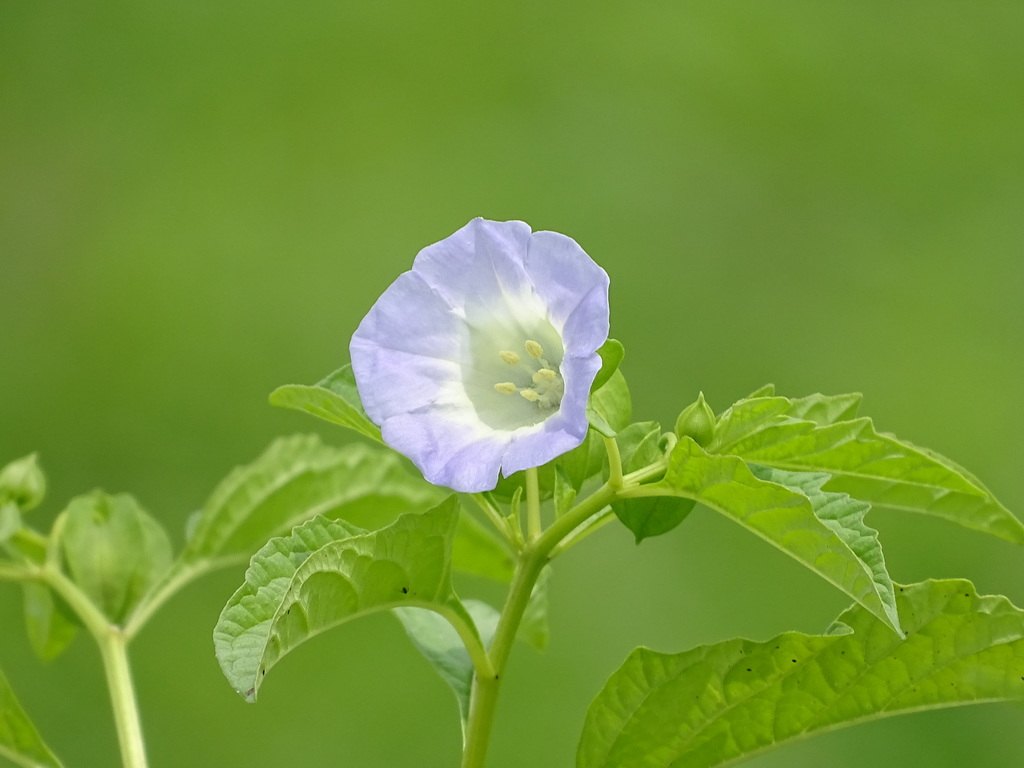
LATIN NAME: Nicandra physalodes
COMMON NAME: Apple of Peru
Plant Profile
Apple of Peru is an annual in the nightshade family, growing to about a metre with spreading branches and ovate, mid-green, toothed leaves that are slightly waved at the edge. It is thought to have originated in western South America, including Peru, and it is now found as an introduced and ruderal species, sometimes a weed, across tropical, subtropical and, to a lesser extent, temperate regions worldwide.
The flowers are bell-shaped and 5 cm or more across, pale blue-violet with a white throat, and they open through summer into autumn. Each lasts a day, but they are produced in quantity and the plant keeps going for months.
The fruit is the reason many people grow it. After flowering, the calyx swells into a papery lantern 2.5 to 3.5 cm across around a berry 1 to 2 cm wide, changing from green to translucent brown, and it holds its shape when dried. Florists use it, and so do gardeners who want something to look at in January.
Science & Biotechnology
The genus Nicandra was long treated as a single species, which made it a curiosity among the nightshades; two further species were described from Peru in 2015, where the genus has its centre. It sits in the subfamily Solanoideae, alongside the physalis and the true nightshades, and the lantern is a structure it shares with Physalis: an inflated calyx over the berry. In Nicandra the fruiting calyx is deeply lobed rather than one undivided bladder, which is the quickest way to tell them apart on a dried stem.
The plant carries withanolides, the C28 steroids that give the genus its insecticidal reputation, along with tropane-related alkaloids such as nicandrenone and hygrine, and it is not edible. A 2017 study isolated 20 withanolides from the aerial parts, 13 of them new. Traditional medicine in China uses the whole plant as a sedative and expectorant, a long way from its Peruvian origin. It is mildly psychoactive in the way of henbane, and the seeds have been used as a fly poison, which is where the common name comes from.
It also has a reputation as an insect repellent. The common name shoo-fly plant refers to the practice of hanging stems indoors, and gardeners have long claimed that whitefly and other glasshouse pests avoid it. The evidence is anecdotal, and the effect, if real, is modest; but the plant is grown for that purpose in several countries.
Uses & Benefits
As an ornamental it is fast, cheap and generous. A single plant fills a gap in a border within six weeks of sowing, and it flowers until the first frost. It is also one of the easiest annuals to dry, because the lanterns need no treatment beyond cutting and hanging.
It self-sows freely, which is either the best or the worst thing about it depending on your view. In a gravel garden or a wild corner the seedlings are welcome; in a carefully mulched border they are a nuisance, and once you have it you will keep having it.
The dried stems are used in flower arranging and in Christmas wreaths, and they last for years if kept dry. The lanterns also take well to being sprayed or painted, so they turn up in craft catalogues every autumn. Cut them with a long stem and they will keep their shape for a decade. The same family turns up again in Solanum texanum, Petunia hybrida and Physalis peruviana.
Growing from Seed
Sow in spring, 5 mm deep, at 18 to 20 °C. Germination is quick, usually within ten days, and the seedlings grow fast enough that a March sowing will flower by July. Direct sowing works well once the soil has warmed.
It tolerates most soils and most positions, though it flowers best in sun. It is not a plant that needs feeding, and rich ground produces a lot of leaf and fewer flowers. Space plants 45 to 60 cm apart; they spread wider than you expect.
Leave a few lanterns on the plant until they are fully brown if you want it to return. Collect seed from the dry berries inside, or simply let the plant drop them where it stands: the seedlings come up reliably in the same place each year. The seed has a thick testa, so it keeps so well in the soil and why a self-sown population comes back for years after the original plant is gone.
Our Take
This is one of the most useful annuals for anyone who dries flowers, and one of the most annoying for anyone who does not. Give it a place where self-sowing is a feature rather than a fault, and it will earn its keep. The whitefly story is worth trying once, but do not rely on it to save a crop.
Related Reading
If Apple of Peru appeals to you, these related plants are worth a look: