


Linum grandiflorum Seeds | Scarlet Flax
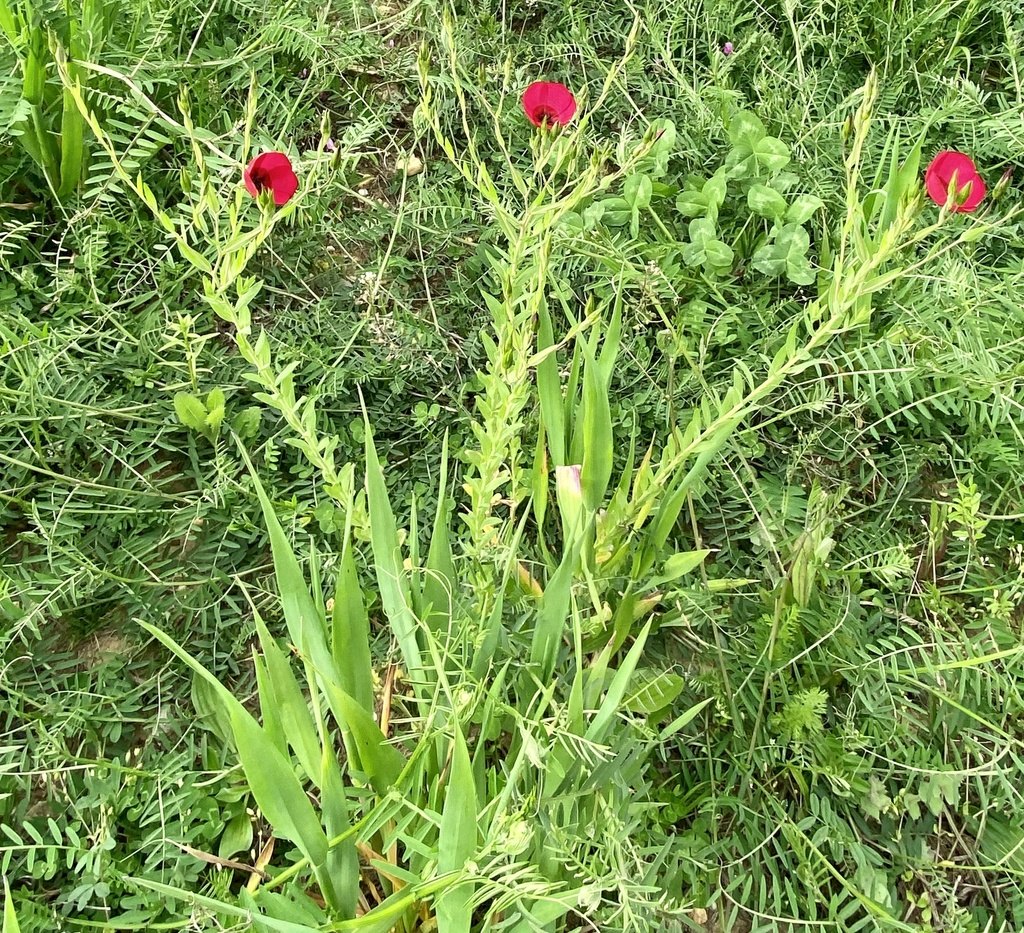
LATIN NAME: Linum grandiflorum
COMMON NAME: Scarlet Flax
Plant Profile
Linum grandiflorum was described by René Desfontaines in 1798, from plants he had studied in Algeria during the 1780s. It is native to Algeria and Tunisia, and it has escaped from gardens across southern Europe and North America. The epithet means large-flowered, and the flower earns it.
The blooms are three to four centimetres across, five broad overlapping petals of a crimson that reads almost black in bud, and anthers shedding pale blue pollen. That combination looks like a mistake and is not. Each flower lasts a morning, and a plant opens a new one every day for six weeks.
Two selections dominate the catalogues. ‘Rubrum’ is the deep, uniform red under which most seed is sold, and ‘Bright Eyes’ has a white eye at the centre of a paler flower. Salmon and white forms exist and cross freely, so saved seed gives a mixture rather than a variety, which is part of the charm.
The genus Linum includes the fibre flax that gives linen and linseed oil, and it ranks among the oldest cultivated plants in Europe. The ornamental species are a small side branch of the genus, grown for their flowers rather than their fibre, and they share the family’s habit of producing a capsule that splits into five valves when ripe.
Science & Biotechnology
Linum is a genus of about 200 species, and it sits in the Linaceae, a family of herbs and small shrubs with simple leaves and five-petalled flowers. The family is characterised by the capsule fruit and by the mucilaginous seed coat, which swells in water and which is the reason linseed is used as a poultice.
The leaves are one to two centimetres long, waxy, lance-shaped and grey-green, and they sit on wiry stems that branch from the base. The plant reaches forty to sixty centimetres and flowers in eight to ten weeks from sowing. The capsule holds ten seeds, and they are flat, glossy and brown when ripe.
The genus includes both diploid and polyploid species, and the cultivated flax, L. usitatissimum, is one of the oldest crops in the world, grown for fibre and for oil since the Neolithic. The ornamental species are not closely related to the crop, and they do not share its economic value, but they share its preference for light, well-drained soil and its tolerance of poor ground. Related plants on the list: Euphorbia polychroma, Euphorbia marginata and Euphorbia myrsinites.
Uses & Benefits
It is used in drifts at the front or middle of a border, in a meadow mix, and in a gravel garden, where its wiry stems and its brilliant colour are shown to best advantage. It is also good in a cutting garden for small arrangements, though the flowers fall within hours of cutting, which limits its use in the vase.
The plant is one of the best annuals for a hot, dry site, flowering through heat and drought without irrigation, and it self-sows freely where it is happy. In a mild climate it returns year after year from seed, appearing in the same place and in the cracks of paving, and it never becomes a nuisance because the seedlings are easy to pull.
The seed is edible in the same way as linseed, and it is rich in oil, though the ornamental species is not grown for that purpose. The plant is not used medicinally, and the foliage is not palatable to livestock, which is one reason it survives in pasture.
Its garden value is in its colour and its timing. It flowers in early summer, before the main flush of perennials, and it fills the gap between the spring bedding and the summer border. A drift of scarlet flax in June, with the sun behind it, is one of the brightest things in a garden, and it costs a packet of seed.
Growing from Seed
Sow direct where the plants are to flower, in early spring once the soil has warmed, at 15 to 18 °C. A thin covering of compost and a damp surface are enough, and the seedlings are through inside two weeks. The plant has a taproot and resents transplanting, so direct sowing is much better than modules.
Do not feed. Rich soil produces leaf at the expense of flower, and the plants become floppy and dull. A lean, sandy soil in full sun is what the plant wants, and it will flower harder there than in a rich border.
Our Take
Scarlet flax is one of the brightest annuals in the catalogue and one of the easiest, provided it is sown where it is to grow. It is not a plant for a vase or for a rich border, and it is not a plant that will impress anyone who does not see it in sun. Sow it in a drift, in full sun, in poor soil, and let it seed. It will come back, and it will be the reddest thing in the garden for six weeks in early summer.
Related Reading
Continue exploring with these related plants: