


Astilbe arendsii Seeds | Arends’ Astilbe
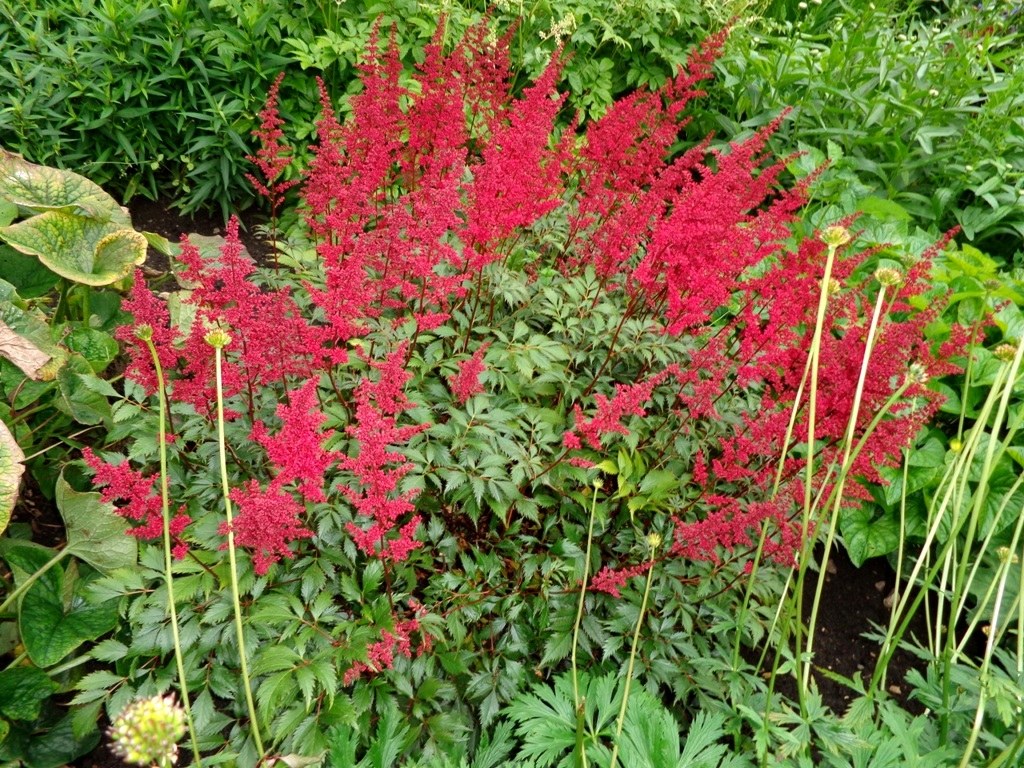
LATIN NAME: Astilbe arendsii
COMMON NAME: Arends’ Astilbe
Plant Profile
Astilbe arendsii is the Arendsii Group, the garden astilbes that fill shady borders in July with plumes of white, pink and red. The group was raised by Georg Arends at Ronsdorf, near Wuppertal, in the early twentieth century, from crosses involving Astilbe astilboides and A. thunbergii. It is a hybrid group, and botanists write the name with a multiplication sign.
The plant makes a clump of dark, divided leaves, twice or three times ternate, with toothed leaflets and a reddish tinge when young. From it rise wiry stems carrying a dense panicle of tiny flowers, thirty to forty centimetres long on a good cultivar. The whole plant is sixty to a hundred centimetres tall and half as wide.
The parents are east Asian. Astilbe astilboides is a Japanese species with white flowers and broad leaflets; A. thunbergii comes from Japan and China and brings the pink and red tones and a more open panicle. Neither is a plant of dry shade. Both grow in wet mountain woodland, along streams and in seepages, and the hybrid inherited that demand.
The genus holds about eighteen species, split between east Asia and eastern North America, and it belongs to the Saxifragaceae. The family is mostly alpine and woodland, and astilbe is the member that took to wet ground. That is the key to growing it: moisture at the root, shade above, and a soil that never dries out in summer. Its nearest neighbours on the list are Heuchera hybrida, Sedum selskianum and Sedum rupestre.
Science & Biotechnology
The panicle is made of hundreds of small flowers, each with four or five sepals and petals and a pair of stamens. The petals are narrow, and the effect of colour comes as much from the filaments and bracts as from the petals. That is why the plumes hold their colour after the flowers have opened and why they dry so well.
The genus is insect-pollinated, and the flowers are visited by small bees and flies rather than by anything large. Seed is produced freely in gardens, and seedlings appear around old clumps, but they are hybrids and do not come true. Named cultivars are multiplied by division, and seed strains are selected for uniformity over generations.
The Arendsii Group is a swarm rather than a clone, and different cultivars have different proportions of the two parents. Modern breeding has added Astilbe chinensis and A. simplicifolia, which brought dwarf habit and later flowering. That is why the group’s boundaries are fuzzy and why the multiplication sign is a convenience rather than a fact.
Uses & Benefits
It is a shade plant, and shade plants are scarce in July. That alone explains its place in the trade. It is used at the edge of woodland, in a damp border, beside water and in containers that can be kept wet. It combines with hostas, ferns and primulas, and it brings a vertical element that most shade plants lack.
The plumes are cut for arrangements and they dry well if cut before the flowers open fully. The colour fades but the shape holds, and a dried astilbe is a better object than most dried flowers. In the border the display lasts three weeks, then the foliage carries the plant until autumn, when it turns bronze and collapses.
There is no food or medicinal use. The plant is not toxic, and deer tend to leave it alone, which is unusual in a shade perennial. Its value is ornamental and, in wet gardens, structural: a clump of astilbe marks a place where the ground stays damp, and that is useful information when planning a border.
Growing from Seed
Sow on the surface of a moist, fine mix at fifteen to eighteen degrees, and do not cover the seed, which needs light. Germination takes three to four weeks and is uneven. Keep the tray wet and cool. Named cultivars will not come true from seed, so sow only if you want a variable batch or are selecting.
Prick out into small pots and grow them on in shade, keeping them wet. Plant out in spring or early autumn into soil enriched with leaf mould, at forty centimetres apart, with the crown at surface level. Mulch every year. A dry spring is more damaging than a cold winter, and the plant will scorch at the leaf edges within days.
Divide clumps every three or four years in early spring, when the new shoots are just visible, and replant the outer pieces. The centre of an old clump is woody and should be discarded. Water after division and keep the new plants shaded for a month. Cut the stems to the ground in late autumn, or leave them for the frost.
Our Take
Astilbe is the plant that makes a wet shady corner look deliberate. It is not exciting, and it does not need to be. What it does, it does in the worst month in the worst light, and it does it for three weeks without any attention at all. That is a rare combination in a garden.
Give it moisture, shade and a mulch, and divide it before it dies in the middle. The Arendsii Group is not a species and the name on the packet is approximate, but the plant in the ground is reliable, and reliability is what a shade border needs.
Related Reading
Readers interested in Arends’ Astilbe frequently explore these as well: